


Site Selection For Opening New Retail Store Powerpoint PPT Template Bundles DK MD




Try Before you Buy Download Free Sample Product
 Impress Your
 Audience
 100%
100% Editable
 Save Hours
 of Time


Our Site Selection For Opening New Retail Store Powerpoint PPT Template Bundles DK MD are topically designed to provide an attractive backdrop to any subject. Use them to look like a presentation pro.
People who downloaded this PowerPoint presentation also viewed the following :
Content of this Powerpoint Presentation
Slide 1: This slide introduces Site Selection For Opening New Retail store. State your company name and begin.
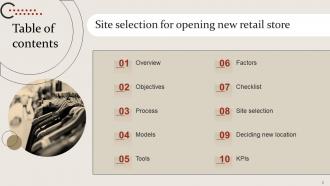
Slide 2: This slide shows Table of Content for the presentation.
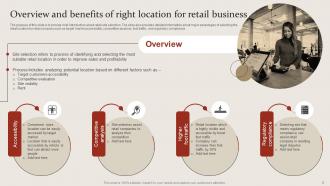
Slide 3: This slide presents Overview and benefits of right location for retail business.
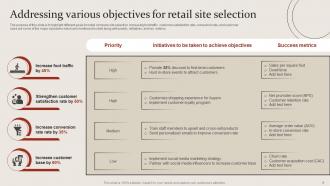
Slide 4: This slide displays Addressing various objectives for retail site selection.
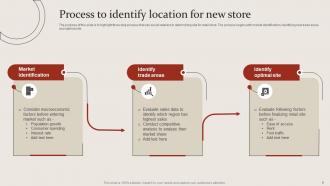
Slide 5: This slide represents Process to identify location for new store.
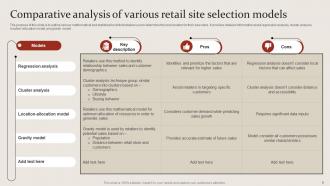
Slide 6: This slide showcases Comparative analysis of various retail site selection models.
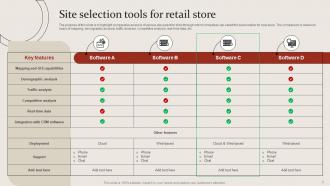
Slide 7: This slide shows Site selection tools for retail store.
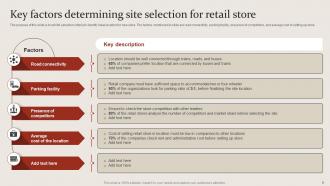
Slide 8: This slide presents Key factors determining site selection for retail store.
Slide 9: This slide displays Checklist to select ideal retail location.
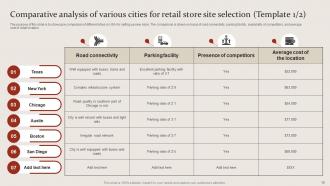
Slide 10: This slide represents Comparative analysis of various cities for retail store site selection.
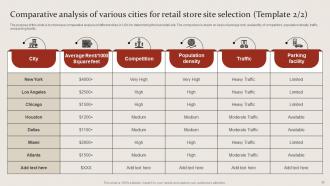
Slide 11: This is another slide continuing Comparative analysis of various cities for retail store site selection.
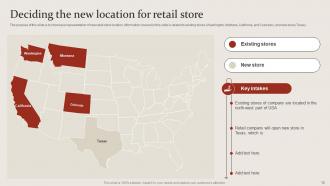
Slide 12: This slide showcases Deciding the new location for retail store.
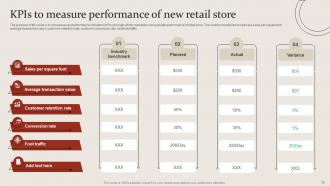
Slide 13: This slide shows KPIs to measure performance of new retail store.
Slide 14: This is a Thank You slide with address, contact numbers and email address.
Site Selection For Opening New Retail Store Powerpoint PPT Template Bundles DK MD with all 19 slides:
Use our Site Selection For Opening New Retail Store Powerpoint PPT Template Bundles DK MD to effectively help you save your valuable time. They are readymade to fit into any presentation structure.








FAQs for Site Selection For Opening New Retail Store Powerpoint PPT Template
Key factors for evaluating potential site locations include demographics and target market proximity, accessibility and transportation infrastructure, zoning regulations and permits, competition density, and operational costs including rent and utilities. These considerations work together to determine market viability, customer reach, and operational efficiency, with many retailers and service businesses finding that strategic location analysis significantly impacts revenue potential and long-term profitability.
Market demand influences site selection by determining customer accessibility, regional purchasing power, and competitive positioning within target demographics. Retail chains analyze foot traffic patterns, income levels, and consumer behaviors to identify high-demand locations, while manufacturers consider proximity to major markets, distribution efficiency, and transportation costs, ultimately securing strategic positioning that maximizes revenue potential and operational effectiveness.
Infrastructure serves as the foundation for optimal site selection, encompassing transportation networks, utilities, telecommunications, workforce accessibility, and regulatory frameworks. These critical elements directly impact operational efficiency, cost structures, and scalability potential, with many organizations finding that robust infrastructure in manufacturing, retail, and logistics sectors ultimately delivers faster market entry, reduced operational expenses, and sustained competitive advantage.
Geographic information systems (GIS) assist site selection by analyzing spatial data, demographic patterns, competitor locations, transportation networks, and environmental factors in comprehensive digital maps. Through layered data visualization, businesses can evaluate multiple criteria simultaneously, identify optimal locations based on customer proximity and market potential, while minimizing risks and maximizing operational efficiency for strategic competitive advantage.
Zoning regulations significantly impact site selection by determining permitted business activities, building heights, density limits, parking requirements, and operational restrictions. These legal frameworks can limit expansion opportunities while ensuring regulatory compliance, with many retail chains, manufacturing facilities, and healthcare organizations finding that early zoning analysis prevents costly delays and enables strategic location decisions that align with long-term growth objectives.
Environmental impact assessment significantly influences site selection by evaluating potential ecological effects, regulatory compliance requirements, and long-term sustainability factors that affect project viability. Through comprehensive environmental analysis, organizations can identify optimal locations that minimize ecological disruption, ensure regulatory approval, and reduce future operational risks, while many developers finding that proactive environmental planning ultimately delivers faster permitting processes and enhanced community acceptance.
Effective site feasibility study techniques include demographic analysis, traffic pattern assessment, competitor mapping, zoning compliance review, and infrastructure evaluation. These methodologies streamline decision-making by analyzing market potential, accessibility factors, and operational requirements, with retail chains and healthcare organizations finding that comprehensive feasibility studies ultimately deliver reduced investment risks and enhanced location performance.
Competition significantly influences site selection through market saturation analysis, competitive positioning assessment, and customer accessibility evaluation. Businesses strategically choose locations that offer competitive advantages, such as proximity to complementary services, differentiated positioning from direct competitors, or access to underserved market segments, ultimately enabling market share growth and sustainable revenue generation.
Involving local communities in site selection delivers enhanced stakeholder buy-in, reduced regulatory hurdles, valuable local insights, improved risk mitigation, and stronger long-term operational relationships. This collaborative approach enables organizations to identify potential challenges early, streamline permitting processes, and build community support, ultimately reducing project delays and costs while ensuring sustainable operations.
Economic incentives significantly influence site selection decisions by reducing operational costs, providing tax advantages, offering workforce development support, and delivering infrastructure benefits. These incentives enable companies to enhance profitability through lower establishment costs, streamlined regulatory processes, and access to skilled labor pools, with many organizations finding that strategic incentive utilization delivers substantial competitive advantages and long-term operational efficiency.
Access to transportation networks is critically important in site evaluation, directly impacting operational costs, supply chain efficiency, and market reach capabilities. Strategic proximity to highways, ports, railways, and airports enables businesses to reduce shipping expenses, accelerate delivery times, and enhance customer service levels, ultimately delivering significant competitive advantages in increasingly logistics-dependent markets.
Site selection in emerging markets presents both challenges and opportunities, including political instability, regulatory uncertainties, infrastructure limitations, currency fluctuations, and cultural barriers. While these markets offer growth potential and cost advantages, organizations must carefully evaluate local partnerships, government relations, and exit strategies, with many companies finding that thorough due diligence and phased implementation approaches ultimately deliver competitive advantage in high-growth regions.
International factors significantly influence site selection through trade agreements that affect tariffs, customs procedures, and market access requirements, along with currency stability, regulatory harmonization, and cross-border logistics considerations. Companies leveraging favorable trade corridors and economic partnerships often achieve reduced operational costs, streamlined supply chains, and enhanced market penetration capabilities, ultimately delivering competitive advantages in increasingly globalized markets.
Businesses can measure site selection success through foot traffic analysis, sales revenue per square foot, customer acquisition costs, operational efficiency metrics, and return on investment calculations. These measurements enable retailers, restaurants, and service providers to evaluate location performance against projections, optimize resource allocation, and make data-driven decisions for future expansion strategies.
Technology integration drives modern site selection through advanced analytics, GIS mapping, demographic modeling, traffic pattern analysis, and predictive algorithms that evaluate location viability. These digital tools enable businesses to assess market potential, competitor proximity, and infrastructure capacity with greater precision, while many retail chains, healthcare systems, and financial institutions finding that data-driven location decisions reduce operational risks and accelerate market entry timelines.
-
“Thank you to the SlideTeam. Your presentations look really skillful and have made my life so much easier.”
-
Superb! The innovative and inspiring template designs provide an edge to the presentation.