

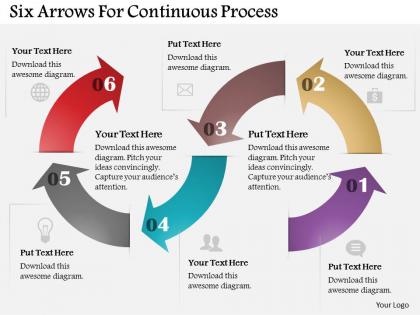
Six arrows for continuous process powerpoint templates




Try Before you Buy Download Free Sample Product
 Impress Your
Audience
 100%
Editable
 Save Hours
of Time


Count your chickens with our Six Arrows For Continuous Process Powerpoint Templates. They ensure the automatically hatch.
People who downloaded this PowerPoint presentation also viewed the following :
Six arrows for continuous process powerpoint templates with all 5 slides:
You have belief amd faith in your futuristic plans. Chalk them out for your team with our Six Arrows For Continuous Process Powerpoint Templates.


FAQs for Six arrows for continuous
Continuous improvement foundational principles include process standardization, data-driven decision making, employee empowerment, systematic problem-solving, and customer-focused optimization. These principles streamline operations by eliminating waste, enhancing quality control, and fostering innovation cultures, with many organizations finding that consistent application delivers measurable efficiency gains and sustainable competitive advantage.
Organizations can effectively measure continuous improvement impact through key performance indicators, baseline comparisons, employee feedback metrics, cost-benefit analyses, and customer satisfaction scores. Many manufacturing and healthcare institutions find that combining quantitative data with qualitative insights delivers comprehensive visibility into operational efficiency gains, while enabling leadership teams to make strategic decisions that ultimately enhance competitive advantage and sustain long-term growth.
Employee engagement drives continuous improvement success by fostering ownership, encouraging idea generation, and creating cultural buy-in for change initiatives. Engaged employees actively identify inefficiencies, propose solutions, and champion process improvements, with organizations like Toyota and General Electric finding that frontline worker participation delivers significantly higher implementation rates and sustainable results.
Industries adapt continuous improvement methodologies by customizing frameworks to address sector-specific constraints, regulatory requirements, compliance standards, and operational workflows. Manufacturing companies implement lean principles for waste reduction, healthcare organizations focus on patient safety protocols, financial services emphasize risk management processes, while retail businesses prioritize customer experience optimization, ultimately delivering enhanced efficiency and competitive advantage across diverse operational environments.
Common obstacles include resistance to change, lack of leadership commitment, insufficient training and resources, siloed departments, and inadequate measurement systems. These challenges often stem from organizational culture issues, competing priorities, and short-term thinking, with many companies finding that successful implementation requires sustained executive support, cross-functional collaboration, and comprehensive change management strategies.
Data analytics enhances continuous improvement frameworks by identifying performance gaps, predicting bottlenecks, and measuring initiative effectiveness through real-time metrics and trend analysis. Manufacturing companies leverage predictive analytics for equipment optimization, while financial services use customer data insights to streamline processes, ultimately delivering faster decision-making, reduced operational costs, and measurable competitive advantage.
Best practices include encouraging experimentation, establishing regular feedback loops, celebrating small wins, providing learning opportunities, and empowering team members to suggest process improvements. These approaches enhance engagement by creating psychological safety, implementing structured improvement methodologies, and recognizing contributions, with many organizations finding that consistent leadership support ultimately delivers higher innovation rates and operational efficiency.
Leadership influences continuous improvement sustainability by establishing clear vision, allocating necessary resources, modeling improvement behaviors, and creating accountability systems that reward innovation. Effective leaders foster psychological safety where employees feel empowered to suggest changes, while consistently communicating progress and celebrating wins, with many organizations finding that engaged leadership drives 60% higher success rates in sustaining long-term improvement cultures.
Effective continuous improvement tools in manufacturing include Lean Six Sigma, Kaizen events, value stream mapping, statistical process control, and root cause analysis methodologies. These approaches streamline operations by eliminating waste, reducing defects, and optimizing workflow processes, with many automotive and electronics manufacturers finding that strategic implementation ultimately delivers 15-30% efficiency gains and enhanced competitive positioning.
Continuous improvement principles integrate into project management through regular retrospectives, iterative planning cycles, stakeholder feedback loops, performance metrics tracking, and lessons learned documentation. These practices enable project teams to identify inefficiencies, streamline processes, and enhance delivery quality throughout project lifecycles, with many organizations finding that systematic improvement approaches reduce costs, accelerate timelines, and ultimately deliver superior project outcomes.
Continuous improvement enhances customer satisfaction by delivering more reliable products, faster service delivery, and personalized experiences through iterative refinements based on feedback and data analysis. Organizations implementing these practices see reduced complaints, increased repeat purchases, and stronger brand loyalty, with companies in retail and financial services finding that proactive improvements often exceed customer expectations, ultimately creating competitive differentiation.
Continuous improvement involves small, incremental changes implemented regularly over time, while breakthrough improvement focuses on dramatic, transformational changes that deliver immediate, significant results. Continuous improvement emphasizes employee participation, cost-effectiveness, and sustainable progress, whereas breakthrough improvement requires substantial investment, carries higher risk, and targets revolutionary outcomes, with many organizations finding that combining both approaches delivers optimal competitive advantage.
Organizations leverage technology through automation platforms, data analytics tools, process monitoring systems, workflow optimization software, and AI-driven insights for identifying improvement opportunities. These technologies streamline operations by eliminating manual bottlenecks, providing real-time performance visibility, and enabling predictive analysis, with many manufacturing and healthcare organizations finding that automated monitoring delivers faster problem resolution and measurable efficiency gains.
Long-term benefits include enhanced operational efficiency, increased employee engagement, improved customer satisfaction, reduced waste, and sustained competitive advantage. Organizations embracing this mindset across all levels find that teams become more adaptable and innovative, while systematic process optimization delivers significant cost reductions and faster service delivery, ultimately creating a culture of excellence that drives measurable business growth.
Organizations can train employees for continuous improvement through structured workshops, mentorship programs, problem-solving methodologies like Lean and Six Sigma, and regular feedback sessions that encourage innovation. Many manufacturing and healthcare organizations find that embedding improvement metrics into performance reviews, creating cross-functional improvement teams, and celebrating small wins ultimately builds a culture where employees proactively identify inefficiencies and drive operational excellence.
-
Very well designed and informative templates.
-
Unique research projects to present in meeting.