


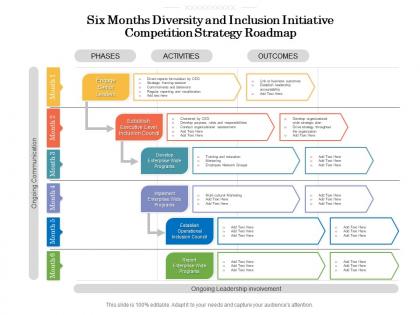
Six months diversity and inclusion initiative competition strategy roadmap





Try Before you Buy Download Free Sample Product
 Impress Your
 Audience
 100%
100% Editable
 Save Hours
 of Time


Visualize your work plan and communicate your ideas impactfully with our pre designed Six Months Diversity And Inclusion Initiative Competition Strategy Roadmap. Showcase the detailed overview of the project, the key deliverables, and the milestones to be achieved with the help of our fully customizable PowerPoint layout. You can easily emphasize on the project goals and discuss all the activities involved in an easy to comprehend manner by utilizing our professionally designed PPT theme. This roadmap PowerPoint layout is a perfect strategic planning tool that can help in keeping the project on track. With our attractive PowerPoint theme, you can articulate the workflow, track the work progress, and have a clear vision of the goal to be achieved. Download this versatile Six Months Diversity And Inclusion Initiative Competition Strategy Roadmap and save your hours of work.
People who downloaded this PowerPoint presentation also viewed the following :
Six months diversity and inclusion initiative competition strategy roadmap with all 2 slides:
Use our Six Months Diversity And Inclusion Initiative Competition Strategy Roadmap to effectively help you save your valuable time. They are readymade to fit into any presentation structure.
FAQs for Six months diversity and inclusion initiative
Honestly, you need four things to make D&I actually stick. Leadership has to put their money where their mouth is - real resources, not just pretty words. Data's huge too - figure out where you're failing with hiring and promotions first. Then build policies that don't suck around recruitment and culture stuff. Oh, and measure everything constantly because otherwise it just becomes another forgotten initiative (seen that happen way too many times). The trap most companies fall into? Treating it like a checkbox project instead of something that never really ends. Start with an honest audit - can't fix what you don't know is broken.
Start with the basics - hiring rates, promotions, retention across different groups. Compensation analysis too. But honestly? The numbers are just half the story. Employee surveys about feeling included matter way more than most companies think. Exit interviews are gold mines if people actually talk. Focus groups help too, though getting honest feedback can be tricky. Check who's joining mentorship programs and employee resource groups. Here's the thing - set actual targets before you start measuring, otherwise you're just drowning in spreadsheets. Do a baseline first, then quarterly check-ins.
Leaders totally set the vibe for the whole thing. Without them actively showing inclusive behavior and calling out bias, nothing really sticks. They can't just fire off yearly emails (some don't even do that much, honestly). Regular inclusion conversations matter. So does amplifying diverse voices in meetings and tracking actual metrics. The real test? Look at your own team dynamics first. Are you genuinely creating space where everyone can contribute something meaningful? That's where most people trip up - they focus on the big picture stuff but miss what's happening right in front of them.
Honestly, start with structured interviews - same questions for everyone so you're not just going with gut feelings. Remove names from resumes during the first review, it's wild how much that helps. Get different people on your interview panels too, fresh eyes catch stuff you might miss. I know bias training sounds corporate-y but it actually works. Oh, and definitely track your hiring numbers by demographics - patterns jump out that you'd never notice otherwise. Don't try to change everything overnight though, pick like two things first. The structured interviews alone made a huge difference at my last job.
Oh totally - diverse teams are way more innovative. When people come from different backgrounds, you get so many more creative solutions to problems. I've seen it firsthand honestly. Homogeneous groups miss obvious stuff that diverse teams catch right away. The brainstorming sessions are just... better, you know? Research backs this up too - diverse teams consistently crush it on innovation metrics. If you're trying to boost creativity at work, focus on diverse hiring and make sure people actually feel safe speaking up with their wild ideas.
So ERGs are basically communities where people with similar backgrounds or experiences can connect and support each other. They're super useful for giving underrepresented employees a real voice in the company. Plus they create mentorship opportunities and help leadership actually understand what barriers people are dealing with. Honestly, I think they're one of the better workplace initiatives because they often push through policy changes that benefit everyone, not just specific groups. If your company has them, definitely check out what's available. Even if you don't join right away, it's worth knowing what groups exist and how you might get involved later.
honestly, diversifying leadership starts with where you're even looking for people - partner with organizations that serve underrepresented groups instead of the same old networks. Set actual targets for leadership roles and track them religiously. Your promotion process needs clear pathways, plus mentorship that actually connects people to senior leaders (not just random pairings). Make your interview panels diverse too - kinda obvious but so many companies miss this. Here's the kicker though: tie diversity goals directly to exec bonuses. Amazing how invested people get when their wallet's involved. Be transparent about progress because accountability is everything.
Check out your local census data first - who actually lives in your area? Community surveys help too. Look at your current team and figure out what's missing. Honestly, the best D&I strategies match both your community AND the skills you actually need. Don't just copy what some company in Silicon Valley did, you know? Partner with nearby schools and cultural groups for recruiting - that's where you'll find genuine connections. The whole thing should feel real to your specific location, not like you're just ticking boxes.
Skip the boring PowerPoint sessions - they actually make things worse. Interactive stuff works way better: role-playing, people sharing their own stories, talking through real situations that happen at your office. I mean, who hasn't sat through one of those painful mandatory trainings? Survey your team first to see what they're actually dealing with, then build around those specific problems. Unconscious bias training is fine but give people concrete tools they can use afterward. The goal is getting everyone comfortable enough to have honest conversations. Oh, and make it ongoing - not just a one-time thing.
So intersectionality is basically about how people's identities stack up - like being a Black woman isn't just "Black" plus "woman," it's its own thing with unique challenges. Companies mess this up constantly by treating each identity separately instead of seeing how they mesh together. You can't just have your "women's initiative" and "diversity program" running in parallel - that misses the whole point. When you're testing policies, talk to people who actually live at these intersections. Don't just grab separate focus groups for each demographic. Way more effective that way.
Honestly, most companies mess this up in predictable ways. Leadership pays lip service but doesn't actually commit resources or model the behavior. Then they dump it all on HR like it's not everyone's job. The worst part? Treating it like checking boxes instead of actually shifting culture. And don't get me started on measurement - how do you even track if someone feels included day-to-day? It's tricky stuff. What works is weaving D&I into regular business processes from the start. Make it part of how things get done, not some separate thing nobody cares about.
Look, feedback shows you what's really going on vs what you think is happening with diversity stuff. Run some pulse surveys or focus groups - even exit interviews work. Ask specific questions about belonging and whether people see advancement opportunities. Leadership blind spots are so common, like you'll think hiring is totally fair while everyone else spots the bias patterns immediately. Focus groups can be awkward but they're worth it. Different groups will have totally different day-to-day experiences. Just don't gather all this feedback and then ignore it - that's how you breed serious cynicism.
Legal compliance is your starting point - Title VII, ADA, all that fun stuff. Discrimination lawsuits will absolutely wreck you. The tricky part? Making sure your diversity efforts actually create equal opportunities instead of just checking boxes. Nobody wants tokenism. Be transparent about what you're trying to achieve and how you'll measure it. Honestly, the legal side gets messy fast depending on where you are. Loop in your legal team early, especially if you're thinking about any quota-type approaches - that's where reverse discrimination claims pop up.
Honestly, partnering with outside organizations is a game-changer for diversity stuff. HBCUs, professional groups for underrepresented communities, diversity nonprofits - they've already built the trust and networks you're trying to tap into. Way smarter than starting from scratch. They can help with recruiting, mentorship programs, training on unconscious bias, all that. The best part? They know what actually moves the needle instead of just looking good on paper. I'd pick maybe 2-3 groups that match your goals and just reach out. Most are pretty open to collaborating if you're genuine about it.
Honestly, data analytics is like having a reality check for your D&I efforts. You'll see exactly where you stand - not where you hope you are. Track stuff like representation across teams, pay gaps, who's getting promoted, and retention rates. The numbers don't sugarcoat things, which can be brutal but necessary. It also shows if your programs actually work or just sound nice on paper. Oh, and without data you're basically guessing at everything. I'd start with a workforce audit and pick maybe 2-3 key metrics to watch consistently.
No Reviews