

Sliding scale insulin chart ppt design




Try Before you Buy Download Free Sample Product
 Impress Your
 Audience
 100%
100% Editable
 Save Hours
 of Time


Allow folks to ave fun at your expense with our Sliding Scale Insulin Chart Ppt Design. Be considered an entertaining joker.
People who downloaded this PowerPoint presentation also viewed the following :
Content of this Powerpoint Presentation
Diabetes affects around 422 million people globally, with 7 million new cases diagnosed a year. This alarming growth in the disease poses a significant risk to human life. There have been treatments for diabetes. One of these is Sliding-Scale Insulin (SSI). SSI is one of the common therapies in hospitals and healthcare facilities to help patients with insulin dosage. This chart for calculating the recommended insulin dosage is simple and convenient.
Meal planning is about making life easier. Download your favorite Meal Plan Template immediately and start your path to a happy life.
SlideTeam’s pre-designed SSI Templates will help you create a dosage program to regulate glucose levels. This 100% editable and customizable template is an excellent tool for doctors, healthcare providers, medical professionals, and others to use as a corrective insulin component before moving on to more advanced treatment. This helps determine whether insulin should be initiated or changed regularly. Use this to help you remember your insulin dose schedule.
Browse and download SlideTeam’s Top 25 Drugs and Medicines PowerPoint Templates to help you communicate your medical findings effectively.
Template 1: Sliding Scale Insulin Chart

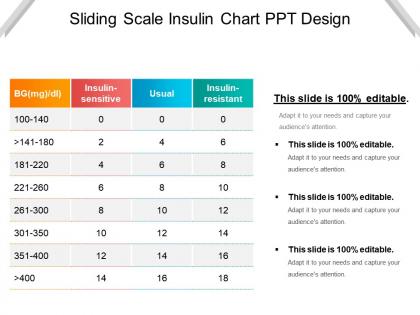
This PowerPoint Template depicts a sliding-scale insulin chart for blood sugar control. It shows the pre-defined blood glucose (bg) ranges, insulin-sensitive, normal, and insulin-resistant, to ensure that target glucose management is attained and sustained. Medical professionals can use this chart to understand their patients' daily insulin requirements and monitor how their bodies respond to diets.
Browse and download another PPT Design on SSI.
Dosing Insulin.
SlideTeam’s sliding scale insulin table can help you show an insulin treatment routine. This lowers the chance of problems from diabetes and blood sugar levels.
IoT in medicine has radically altered the way things function. It has improved patient care, streamlined processes, and provided valuable data insights. Click here to read more.
Sliding scale insulin chart ppt design with all 5 slides:
Instill enthusiasm for the event with our Sliding Scale Insulin Chart Ppt Design. Get folks excited to join.




FAQs for Sliding scale insulin
So basically you check the patient's blood sugar first, then look at their chart to see how many insulin units to give. Each chart has different ranges - like maybe 2 units if they're 150-200, more units if it's higher. Pretty simple concept but honestly the ranges can vary a lot between patients. These are all customized per person though, so don't grab the wrong chart by accident! Once you do it a few times you'll get the rhythm down. It's just matching numbers really - find their glucose level, give the corresponding insulin dose.
Tell them it's basically their safety net when blood sugar goes wonky. Blood sugar bounces around all day naturally - this chart just shows them exactly what to do when it spikes above where it should be. I always compare it to GPS for insulin doses, honestly takes all the scary guesswork out of it. Walk through some real examples from their specific chart so they get it. The whole point is avoiding those dangerous highs without going overboard and crashing into lows. Oh, and definitely give them your direct number for that first week - they'll have questions.
So you'll want blood glucose ranges first - like 150-200, 201-250, that kind of thing. Then match each range with the right insulin dose. Rapid-acting insulin is usually what people use for these scales. Definitely include when to check levels and when to give the dose - timing matters way more than people think. Don't forget correction factors since everyone's different with how they respond. Add meal coverage sections if your patient needs it, plus emergency contacts for scary high or low readings. Standard ranges are fine to start, but you'll need to tweak based on their history.
Honestly, sliding scale charts are kinda garbage because everyone's different. Your patient might need way more insulin than the chart says, or maybe way less - depends on how their body actually responds. Weight, age, stress, other meds, even being sick all mess with insulin sensitivity. I've seen patients spike from tiny meals while others stay rock solid. The worst part? These charts pretend everyone's the same. You gotta watch your patients closely and ditch the preset doses when they're clearly not working. Don't just follow the chart blindly - that's how you get in trouble.
Okay so here's the thing - you absolutely have to monitor blood glucose because the sliding scale is useless without actual numbers to work with. How else would you know which insulin dose to give? The chart literally can't function if you don't know where the patient's levels are sitting. Honestly, it's like trying to cook without tasting your food. Monitoring also helps you catch scary highs or lows before they turn into real emergencies. You'll start seeing patterns too, which helps with timing adjustments. Just make sure you're checking consistently and writing it all down so you can tweak things as needed.
Honestly, teaching patients properly makes or breaks the whole sliding scale thing. They've gotta nail checking their glucose and reading that chart - plus figuring out the right insulin dose. When their numbers go crazy, they need to know it's time to call someone. I can't tell you how many people just guess and end up back in the ER. Don't just hand them papers and call it good. Have them show you they actually get it while they're still there. Oh, and make sure they can walk through the whole process themselves before heading home.
Honestly, apps are a game-changer for sliding scales. No more doing math when you're exhausted at 2 AM or squinting at charts. Just punch in your blood sugar and boom - it calculates your insulin dose automatically. Plus they track your patterns over time, which is super helpful for spotting trends. Most send testing reminders too (because let's be real, we all forget sometimes). The fancy ones even sync with your glucose meter and insulin pen. I'd grab a well-reviewed diabetes app and plug in whatever sliding scale your doctor gave you. Way less room for mistakes.
Honestly, timing and math trip people up the most. Patients get confused matching their blood sugar to the right insulin dose - especially when they're panicked about high numbers. Plus they forget when to check glucose or mix up their fast vs slow-acting insulin. The calculations freak out older folks particularly. Walking through practice runs helps a ton. Maybe make them a simpler chart with bigger text and color coding? My aunt struggled with this stuff until we simplified her whole system.
Honestly, those standard charts are pretty useless without personalizing them first. Track their baseline glucose patterns and see how they actually respond to corrections - don't just go by the textbook numbers. Active patients usually need way lower ratios than what the charts say, which nobody really talks about enough. Factor in their carb ratios, time of day stuff, stress, illness, whatever. Start conservative though. You can always bump it up later but you can't un-give insulin, you know? Document everything so you're not flying blind when you adjust things over the next few weeks.
Look for patterns in those glucose readings first. When they're consistently high despite following the chart, bump up insulin by 0.5-1 units per range. Too many lows? Drop the doses or raise those glucose triggers. Honestly, sliding scales are pretty much dinosaurs at this point, but whatever. Document everything like crazy. Don't react to single weird readings - look at 3-5 day trends instead. Make small changes and actually give them time to work before you mess with it again. That's the hardest part, waiting it out.
Sliding scale is totally reactive - you're basically playing catch-up after blood sugars spike. Basal-bolus actually prevents those spikes by giving long-acting insulin as a baseline, then adding mealtime doses on top. Way more like how your pancreas would naturally work. Most doctors I've worked with much prefer basal-bolus because you get better control overall. Less of those crazy highs and lows too. Honestly, sliding scale feels pretty old-school at this point. If you're dealing with hospitalized patients still on sliding scale protocols, it's worth pushing for basal-bolus - outcomes are just better across the board.
So the big scary ones are hypoglycemia if you give too much and DKA if you don't give enough - both can literally kill someone. I've seen SO many calculation errors with these sliding scales, it's honestly terrifying sometimes. They're also just not great for long-term control since you're always playing catch-up instead of staying ahead of it. Plus they totally ignore when your patient ate or if they've been walking around all day. Quick math mistakes happen way too easily when you're slammed with five other patients. Double-check everything and grab another nurse for the higher doses - trust me on this one.
Look at those sliding scale patterns over a few weeks - that's where the real insights are. When you see consistent corrections happening at the same times (like always needing extra before dinner), that's your roadmap for fixing their baseline doses. Honestly, it's way better than just chasing individual high numbers. Those patterns show you exactly where their long-acting or mealtime insulin is falling short. Then you can work with endo to shift from this reactive approach to something more predictive with basal-bolus. It's like having a glucose diary that actually tells you something useful.
Yeah, so tons of studies since the early 2000s show sliding scale insulin is pretty much garbage compared to basal-bolus. Worse blood sugar control, more highs and lows - the whole mess. It's especially bad for ICU patients, which honestly makes you wonder why hospitals stuck with it so long. Even outpatient elderly folks do worse on it. The reactive dosing thing just doesn't cut it when you could be proactive instead. I'd definitely push your team toward basal-bolus protocols if you can swing it. Way better outcomes across the board.
Oh totally get your family involved if you can! They're honestly lifesavers when it comes to tracking blood sugar patterns and reminding you about timing - my aunt does this with my uncle and it works great. Having someone else learn the warning signs for highs and lows is huge too, plus they can help with all that record-keeping stuff which gets old fast. For older folks or anyone with memory problems, it's basically essential. The stress relief alone helps keep blood sugar more stable. I'd definitely teach at least one person how to read your chart and what symptoms to watch for.
-
Awesome use of colors and designs in product templates.
-
Great product with highly impressive and engaging designs.