

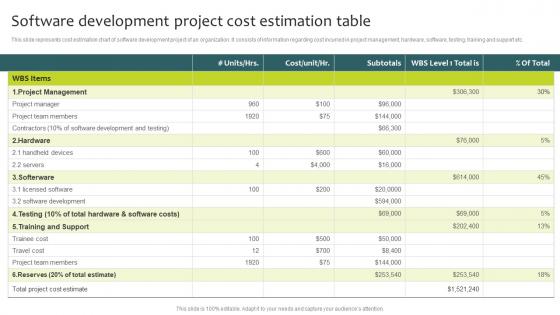
Software Development Project Cost Estimation Table




Try Before you Buy Download Free Sample Product
 Impress Your
Audience
 100%
Editable
 Save Hours
of Time


This slide represents cost estimation chart of software development project of an organization. It consists of information regarding cost incurred in project management, hardware, software, testing, training and support etc.
People who downloaded this PowerPoint presentation also viewed the following :
Software Development Project Cost Estimation Table with all 6 slides:
Use our Software Development Project Cost Estimation Table to effectively help you save your valuable time. They are readymade to fit into any presentation structure.






FAQs for Software Development Project
Honestly, scope creep is probably gonna be your biggest headache. Resource availability matters too - like, can you actually get the people you need when you need them? Timeline's always tight, obviously. Your team's skill level will totally change how long things take (learned that one the hard way). Don't forget external stuff you can't control, plus whatever data you have from past projects. Market conditions shift vendor prices around too. Always pad your estimates though - seriously, those random issues that come out of nowhere will eat your budget alive. Run everything by stakeholders early so you're not scrambling later.
So historical data is like your best reality check - it shows you what actually went down on similar projects before. Look at your last 5-10 projects and compare what you estimated vs what you actually spent. You'll start seeing patterns, like where labor always goes over or when material costs spike unexpectedly. Way better than just winging it based on hunches (been there, done that, regretted it). The whole point is spotting which costs are unpredictable so you can pad those areas accordingly. Honestly, it's saved me from some pretty embarrassing budget blowouts.
Think of risk assessment as your backup plan when estimating costs. List out what could realistically go wrong - material prices jumping, workers calling in sick, clients changing their minds halfway through. Then figure out how likely each thing is and build actual buffers based on that math, not some random percentage. I learned this the hard way watching projects crash and burn because nobody planned for Murphy's Law. Don't just slap 10% on top and call it good. Calculate real contingencies. Trust me, being pessimistic upfront beats scrambling for extra cash later when everything inevitably goes sideways.
So basically, top-down starts with your whole budget and you chop it into pieces. Bottom-up? You're adding up every single task first. Honestly, I'm lazy so I always do top-down for quick estimates - especially when the client's still figuring out what they actually want. Bottom-up is a pain but way more accurate since you're getting into the weeds with each deliverable. Takes forever though. My usual move is top-down for proposals, then once we lock down scope I'll switch to bottom-up. Speed vs precision, you know? Just depends what you need right now.
Honestly, these tools are total time-savers - they pull from your old project data so you're not reinventing the wheel constantly. Built-in formulas catch stupid math mistakes too, which... yeah, we've all been there. The best part? You can mess around with different scenarios super fast. Want to see what happens if you push the deadline back two weeks? Boom, instant cost update. Most integrate with whatever PM software you're already using. Start with something simple that plays nice with your current setup - even a decent Excel template works if that's what you're comfortable with.
Dude, you're gonna mess up the timeline - I guarantee it. Everyone thinks they can nail the schedule but honestly, stuff just takes longer than you think. My first big project? Total disaster because I didn't pad enough time. Hidden costs will bite you too - there's always something you missed. Dependencies between tasks are sneaky, and scope creep is real. Don't just copy what worked before either, every project's different. Get other people involved when you're estimating, write down what you're assuming, and always add like 20% buffer minimum. Track how wrong you were so you get better next time!
Ugh, scope creep is the worst for cost estimates. You calculate everything based on your original plan, then suddenly everyone wants "just a tiny addition" or "one more feature." Those little changes? They're never actually little. Your budget gets completely wrecked because you're doing way more work than you planned for. I've seen projects go 50% over budget from this stuff. Best thing you can do is write everything down super clearly at the start and make people go through a formal process before adding anything new. That way you can actually calculate what their "quick change" will cost before agreeing to it.
Dude, you HAVE to build contingencies into your estimates. Trust me on this one. Stuff always goes sideways - material costs spike, scope creeps up, or you realize nobody thought about that weird corner issue. My first big project? Total disaster because I didn't budget for surprises. Usually I do 10-20% depending on how messy things might get. Sure, it feels like padding the numbers, but you'll either blow your budget or end up cutting corners without it. Better to have that cushion upfront than scramble later when everything hits the fan.
Get stakeholders involved from day one - don't wait. Walk them through exactly how you're calculating things so there's no mystery. Have them double-check your assumptions about scope and requirements because honestly, they know the business way better than you do. Can't tell you how many times I've watched estimates completely fall apart over "simple" stuff we totally misunderstood. Set up regular check-ins as things change (and they will). Document everything they approve. Oh, and this is huge - make sure they get that estimates aren't guarantees. They're ranges. Set that expectation early or you'll hate your life later.
So there's a few ways to tackle this. Overhead rates are probably your best bet to start - just take your historical indirect costs and slap them on as a percentage of direct costs or labor hours. Super straightforward. Activity-based costing gets you way more precision, but honestly it's a pain because you're tracking every single cost driver. There's also cost allocation where you divvy things up by department usage or square footage - my old boss loved that method for some reason. I'd say go with overhead rates first since it'll get you close enough, then maybe switch to ABC later if you're dealing with huge projects that need pinpoint accuracy.
Dude, the method you pick totally changes how accurate your budget ends up being. Quick options like analogous estimating save time but miss important stuff. Bottom-up takes forever - I'm talking spreadsheet hell - but you'll get way better numbers. Parametric sits in between those two. Here's the thing though: your executives want clean, simple figures while your actual team needs detailed breakdowns to get work done. Choose based on what project phase you're in and how much you can afford to be wrong. Oh, and start broad then get more specific as you figure things out.
Look at case studies from your industry - they show you where estimates totally bombed and why. Each field has weird quirks you won't expect. You'll notice patterns like scope creep blindsiding people or missing those annoying hidden dependencies. Honestly, construction guys deal with weather delays while software teams get crushed by feature requests. Start your own database too, even from messy projects. Document what you guessed vs what actually happened. It's basically learning from everyone else's expensive mistakes without the pain. Way better than figuring it out the hard way yourself.
Document everything and be super upfront about your assumptions from day one. I got absolutely roasted in a budget meeting once because I didn't do this properly - not fun! Break estimates into clear chunks so people see exactly what drives costs: labor, materials, overhead, whatever. When things change (and they will), give regular updates instead of hiding behind vague numbers. Don't say "around $50K" - say "$45-55K if vendor rates stay put." Also explain your methodology and flag any risks that might mess with the numbers. Trust me, you'll save yourself so many headaches later when someone inevitably asks why costs shifted.
Here's the thing - ditch hours and dollars for now. Story points or t-shirt sizing work way better in Agile. Compare stories against each other instead of trying to guess absolute costs (which honestly never works out anyway). Look at your team's velocity from past sprints to get a sense of what's coming. Chop everything into smaller pieces and re-estimate constantly as you figure stuff out. That's the whole point - your numbers will change and that's totally fine. Start rough based on team capacity, then adjust every sprint based on what you're actually shipping.
Dude, definitely track cost variance first - that's comparing what you actually spent vs what you planned. Anything within 10% is pretty solid. Schedule stuff matters too since delays usually mean you're bleeding money. What I'd do is break it down by work categories so you can see where you always mess up estimates versus where you're actually decent. Yeah it's boring to track but trust me, the data helps tons for next time. Just throw it all in a basic spreadsheet after each project. Your guessing game will improve way faster than you'd think.
-
The templates are easy to get, and the chat customer support is excellent.
-
Unique design & color.