


Steeple analysis for evaluating aviation business




Try Before you Buy Download Free Sample Product
 Impress Your
 Audience
 100%
100% Editable
 Save Hours
 of Time


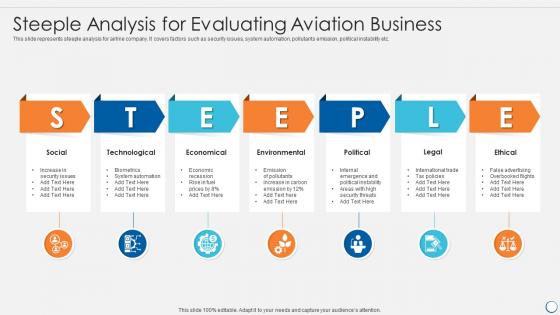
This slide represents steeple analysis for airline company. It covers factors such as security issues, system automation, pollutants emission, political instability etc.
People who downloaded this PowerPoint presentation also viewed the following :
Content of this Powerpoint Presentation
The modern realm of aviation is no stranger to challenges—from economic shifts to regulatory changes, technological advancements, and socio-political climates; the industry is dynamic and volatile. Consequently, in-depth strategic foresight is not just advantageous—but imperative. This is precisely where the importance of STEEPLE analysis, a versatile and robust approach helping companies navigate the complexities of their operational environment with clarity, hits home.
However, the complexity of the aviation sector, combined with the plethora of variables to analyze, makes the process challenging. From the constantly fluctuating fuel prices to the ever-changing geopolitical climate and the fundamentals of regulatory standards, there is an assortment of factors that need analysis. Use SlideTeam Steeple's analysis for evaluating aviation business presentations as a reliable tool.
Template 1 Steeple Analysis for Knowing Your Aviation Business

Our slide is a unique and innovative solution created to assist aviation companies with the complexities of strategic and situational analysis and designed to streamline the process. Plus, the slides are available in PNG and JPG formats, making them accessible and suitable for broader sharing. Finally, and most importantly, the user-friendly design of slides ensures exceptional ease of use, even for industry newcomers.
Just as airlines should be gradual in their approach to expansion, conducting strategic analysis should be done while keeping in mind the steady pace of industry changes. With SlideTeam’s solution, the sky is not even the limit! Let’s have a closer look at how this slide is helpful.
Look out for our blog on Steeple Analysis Powerpoint Templates to learn more details.
By conducting an in-depth analysis of social, technological, economic, environmental, political, legal, and ethical factors, stakeholders can acquire a much-needed insight into the decisive trends and potential obstacles. Let’s learn about it in detail.
The slide features a detailed Steeple analysis primarily focused on the aviation industry. The analysis provides insight into various external factors affecting airline companies. Specifically, these factors include security issues, system automation, pollutant emissions, political instability, social trends, technological advancements, economic fluctuations, environmental concerns, political landscapes, legal regulations, and ethical considerations. By analyzing these factors aviation businesses can make informed businesses.
The slide can be used to obtain a more detailed view of the aviation business's external environment. Dividing the business environment into social, technological, economic, environmental, political, legal, and ethical dimensions reveals opportunities and threats posed by external factors. This information is crucial for effective strategic planning, risk management, and decision-making processes.
Don’t miss out our blog on Steeple Analysis and Impact for Pharmaceutical Industry in depth.
The slide is designed for airline companies’ executives and managers. It can be used to explore the external factors that might affect the industry and develop appropriate strategies and tactics in response. Financiers and investors can also utilize the slide to assess the types and grades of risks associated with investments. Policymakers and regulatory bodies could also make use of the slide.
To ensure the long-term prosperity of your aviation business, start employing the slide right away.
BE CLEAR AND SOLID
Employing STEEPLE analysis is important in understanding the factors in the aviation business. Through the analysis of the social, technological, economic, environmental, political, legal, and ethical dimensions, the professionals in aviation can anticipate a challenge, make use of the opportunities, and make informed strategic decisions.
By embracing the Steeple analysis for evaluating aviation, businesses can quickly adapt to market changes and develop their activities to match the requirements of the laws and business.
Look out our blog on Steeple Analysis of Marketing Audit Economic Environment to learn in detail.
Steeple analysis for evaluating aviation business with all 6 slides:
Use our Steeple Analysis For Evaluating Aviation Business to help you effectively save valuable time. the slides provide what is steeple analysis and the uses of steeple analysis. They are ready-made to fit into any presentation structure





FAQs for Steeple analysis for
STEPLE breaks down into Social, Technological, Economic, Environmental, Political, Legal, and Ethical factors. Basically you're scanning for outside forces that could mess with your business. Don't be vague though - "AI changes everything" tells you nothing useful. Instead, dig into what's actually shifting in your industry and when it might hit. Different people should tackle different categories since nobody knows it all. Oh, and make it quarterly, not some dusty document you write once. The whole point is catching trends before they catch you off guard. Short sentences work. Longer ones help you think through the connections between what's happening now and what's coming next.
STEEPLE just breaks down your external environment into chunks - Social, Tech, Economic, Environmental, Political, Legal, Ethical. Go through each one looking for shifts that could mess with your industry or open doors. Maybe aging demographics create new customer bases, or new regulations hurt your competitors more than you. Don't get crazy detailed though. Pull 2-3 solid insights from each category, then figure out which ones actually matter for your business. Honestly, most companies skip this step and get blindsided later. Once you've got your key factors, you can game out different scenarios and tweak your strategy accordingly.
STEEPLE is all about the big external stuff you can't control - like tech changes, politics, economic shifts, that whole macro environment thing. SWOT's different because it looks at your actual company's strengths and weaknesses plus external opportunities and threats. Honestly, I think STEEPLE's underrated for planning because it makes you step back from just thinking about competitors. You're looking at whether regulations might change or if there's some social trend that'll hit your industry. Then you can use SWOT to figure out how your specific business fits into all that. Makes way more sense to do STEEPLE first, then zoom in with SWOT.
Honestly, I'd do it once a year minimum but add quick quarterly check-ins too. The full annual thing covers everything - social, tech, economic, environmental, political, legal stuff. But quarterly reviews? Just hit the big changes affecting your industry. Things move way too fast now to wait a whole year (seriously, look how AI just exploded). I mean, you don't want to get caught off guard by something that shifted months ago. Set a calendar reminder and treat it like your other planning meetings. The quarterly ones don't need to be massive - maybe 30 minutes tops.
Culture basically drives everything else in your STEEPLE social analysis. Think about it - it shapes what people buy, how they work, even how they react to new tech. Most people totally skip over this part, which is crazy because it's so impactful. You've got to look at cultural attitudes around family, work-life balance, social mobility - all that stuff. It directly hits your market demand and who you can actually hire. Honestly, just map out the main cultural values in whatever markets you're targeting first. Makes everything else click into place way easier.
Tech changes everything in STEEPLE analysis, honestly. It's like dominoes falling - AI doesn't just hit your "T" section, it messes with economics, triggers new laws, changes how people think about jobs. Everything moves faster now too. Political stuff shifts quicker because of social media. Environmental tech creates new regulations overnight. You can't just update this thing once a year anymore - maybe quarterly? The ripple effects are wild. One breakthrough in automation suddenly impacts three other categories you weren't even watching. It's exhausting but you gotta stay on top of it.
Don't try analyzing every single factor - you'll just confuse yourself. Pick the 3-4 things that actually matter for your project first. Most people get obsessed with political changes when honestly? Economic stuff probably affects them way more. Also think about how factors connect to each other, not just random lists. Like social trends usually push tech changes forward. Oh and please don't just copy some generic template you found online. Make it fit your actual situation. Start narrow, then expand once you've got the big pieces figured out.
STEEPLE analysis is perfect for CSR planning - honestly, it's way more useful than people think. Look at social trends first (what do consumers actually care about now?), then tech opportunities like green innovations. Don't forget environmental pressures and political/legal stuff that could bite you later. Economic conditions matter too since they affect your stakeholders directly. Running your CSR strategy through each factor helps you spot the best investment opportunities. Plus you'll catch risks before they become problems. I always tell people it's like having a roadmap instead of just throwing money at random causes and hoping something sticks.
Get everyone involved from day one - seriously, this makes or breaks the whole thing. Map out who knows what: finance handles economic stuff, legal covers regulations, you get it. Those workshop debates? Pure gold - people arguing over assumptions is where the magic happens. Ask open questions and actually listen (harder than it sounds). Oh, and document as you go or you'll forget half the good stuff. Create that safe space where someone can say "I think we're totally wrong about this" without getting shut down. Have them validate everything before you wrap up.
STEEPLE analysis basically forces you to step outside your industry bubble when making big decisions. So if you're in healthcare, you'd look at aging populations (Social), new regulations (Legal), AI stuff (Technology) - you get the idea. Tech companies love spotting opportunities this way, like how environmental worries are pushing demand for green computing. Most people totally ignore the Legal and Ethical parts, which is dumb because they'll bite you later. Pick the 3-4 factors that actually matter for your situation, then run some scenarios. Works way better than just winging it.
STEEPLE doesn't have to be a nightmare, trust me. Government databases are your best friend for the political/legal stuff, and industry reports cover most of the social and tech trends. Honestly, I just use Excel half the time - works fine. MindTools has decent PESTLE templates if you want something prettier. News aggregators are clutch for spotting what's actually happening (not just what happened six months ago). Oh, and Porter's Five Forces templates? Super helpful framework. Start basic though. I made the mistake of jumping into fancy software right away and got totally lost in features I didn't need.
Ugh, globalization makes STEEPLE analysis such a pain for multinationals! You can't just look at one country's factors anymore. Now you're tracking social, tech, economic stuff across like 10 different regions at once. A political mess in one place suddenly screws up your whole supply chain - it's wild how connected everything is. What really gets me is how global trends hit each market totally differently. You'll want to build separate STEEPLE breakdowns for each region, then figure out how they all connect back to your main strategy. Honestly feels like solving a puzzle sometimes.
Honestly, just track how many of your predictions actually happened vs the ones that didn't. I keep a basic scorecard - yeah it's kinda nerdy but whatever, it works. Check if you caught major changes before your competitors did, and more importantly, whether your insights actually influenced real decisions. Quarterly reviews help you see patterns in what you're missing. The real win is avoiding those "oh shit, didn't see that coming" moments or spotting opportunities everyone else slept on. If your STEEPLE analysis isn't helping you make better strategic calls, then you're probably overthinking it.
Honestly, the key is customizing what you show each group. Executives want the big picture stuff - major risks and opportunities. Operations teams need the nitty-gritty details that actually affect their day-to-day work. Skip the massive reports though, nobody reads those anymore. Visual dashboards are your friend here. Focus on what really matters and connect each external factor to actual business impacts. Don't just tell them what's happening out there - explain what it means for your company specifically. Oh, and always throw in some actionable next steps. People hate analysis that just sits there without clear follow-ups.
STEEPLE analysis really works when you use it *before* making big moves. Netflix nailed this switching from DVDs to streaming - they saw tech shifts coming and how people wanted entertainment differently. Tesla did something similar, reading environmental regulations and consumer attitudes about sustainability. Walmart's a great example too, though they were playing catch-up to Amazon (probably should've moved faster honestly). Most digital transformations that actually succeed involve this kind of systematic analysis. The trick is spotting technological, social, and economic changes early instead of scrambling after competitors already beat you to it.
-
Best way of representation of the topic.
-
Professional and unique presentations.