


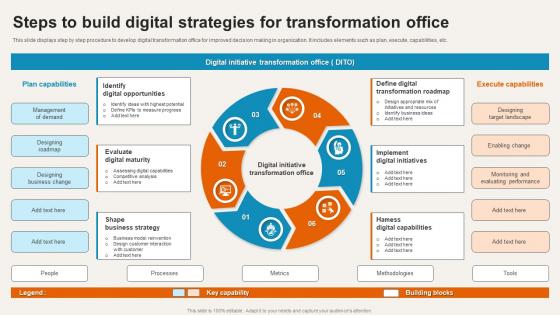
Steps To Build Digital Strategies For Transformation Office




Try Before you Buy Download Free Sample Product
 Impress Your
 Audience
 100%
100% Editable
 Save Hours
 of Time


This slide displays step by step procedure to develop digital transformation office for improved decision making in organization. It includes elements such as plan, execute, capabilities, etc.
People who downloaded this PowerPoint presentation also viewed the following :
Steps To Build Digital Strategies For Transformation Office with all 6 slides:
Use our Steps To Build Digital Strategies For Transformation Office to effectively help you save your valuable time. They are readymade to fit into any presentation structure.





FAQs for Steps To Build Digital Strategies
Honestly, most companies mess this up by obsessing over the tech while completely ignoring the people side. You need leadership that actually gets it, not just lip service. Get your team bought in early or you're screwed. Data governance matters too - can't stress that enough. Oh, and tie everything to real business outcomes, not just "we need to be more digital" nonsense. I'd pick one actual problem you can solve first, then expand. Agile processes help, but don't overthink it. The culture shift is way harder than picking the right software stack.
Start with a digital maturity assessment - basically audit where your tech, processes, and team skills actually are right now. Look at stuff like data analytics, automation, customer experience, your IT setup. There are frameworks like the Digital Maturity Model, but honestly? Just pick something and be brutally honest about your current state. Survey your people, check your systems, see how you stack up against competitors. Oh, and don't forget the cultural side - are your teams even ready for change? That's usually the trickiest part. Once you've got that baseline, you'll know exactly what needs fixing first.
Look, you absolutely need leadership on board or you're screwed. They control the money and resources, so without their buy-in, your whole project dies. Plus someone has to deal with all the people freaking out about change - and trust me, everyone hates when you mess with how they do their job. Your leaders need to actually walk the walk too, not just talk about going digital. The biggest thing? They've got to explain why this matters to everyone involved. Honestly, I'd spend most of your energy getting the leadership team to agree on the "why" first. Everything else falls apart without that foundation.
Think of data analytics as your roadmap for going digital - it tells you what's actually worth fixing first. Instead of just throwing money at digitizing random stuff (which honestly most companies do and it's a disaster), you can figure out what's genuinely slowing your team down. Analytics shows you how customers are really using your digital stuff and where the hidden opportunities are. My advice? Start small - audit what data you already have, then pick one specific problem to dig into. Don't go crazy trying to analyze everything right away or you'll just overwhelm yourself.
Honestly, the worst part is always people pushing back on any changes - drives me nuts. Your team won't have the digital skills they need, and budgets get slashed halfway through (classic). Those ancient legacy systems are brutal too, like some dinosaur computer that somehow runs everything but can't connect to modern stuff. Strategy gets muddy fast, your data's probably garbage, and everyone wants to tackle ten things at once. Here's what actually works: pilot something small first. Train people properly - seriously, don't skimp here. Get the executives on board early because you'll definitely need them later when stuff inevitably goes sideways.
Honestly, the biggest thing is explaining WHY stuff is changing - people hate being left in the dark. Get them involved in planning so they feel like they're part of it instead of just getting steamrolled. Training is super important too because nobody wants to look stupid with new systems. I've seen this go sideways when managers skip that step. Celebrate the small wins and actually listen when people complain. Find your early adopters first - they'll do half the work convincing everyone else for you. Make it feel exciting, not like everything's falling apart.
Honestly? Cloud computing, AI/ML, and data analytics are where most companies are seeing real wins. Automation tools and API-first setups are solid too. IoT's massive for manufacturing and retail - though yeah, feels like every company thinks they need it now lol. Customer experience platforms can't hurt either. But here's the thing - don't go crazy trying to adopt everything at once. Pick maybe 2-3 technologies that actually fix problems you're having. I'd start with cloud migration and getting your data infrastructure right first. Once that's locked down, you can layer other stuff on top way easier.
Honestly, map out your customer journey first - like, actually figure out where people are rage-quitting or bouncing. Use real data though, not what you think they want. I've watched companies blow tons of money building digital stuff nobody even uses lol. Target those specific frustration points instead of just throwing tech at everything. Get feedback constantly and pivot fast when needed. Oh, and definitely involve actual customers in testing - run small pilots with a few groups before you go all-in on changes. Way better than guessing what'll work.
Honestly, you need both sides of the coin here - customer stuff and internal operations. Start with customer metrics like NPS scores, faster service times, how much people actually use your digital tools. Operational side is your automation savings, productivity bumps, fewer screw-ups from manual processes. Revenue's obvious but don't forget new digital income and ROI on tech spend. Here's the thing though - pick maybe 4-5 metrics max that actually match what you're trying to achieve. Otherwise you'll drown in data. Set your baselines now so you can see if this whole thing actually worked later.
Honestly, just start small with the free stuff - Google Workspace, Canva, maybe a social media scheduler. Don't try to go crazy and digitize everything at once (I've watched way too many small businesses crash and burn doing that). Pick one thing that'll either make you money or save you serious time. Cloud tools are your friend since you won't have huge upfront costs. Oh, and train your current people instead of hiring some expensive digital expert right away. Way cheaper and they already know your business. Focus on what actually moves the needle first.
Honestly, start with an ethics committee to review your big moves - that's been a game changer for companies I've seen do this right. Be super transparent about data collection because people are savvy about that now. Regular bias audits are crucial so your AI doesn't screw over certain groups. The workforce thing is tricky though - you've got to be honest about job changes but also invest in retraining. Don't forget accessibility when you're rolling out new systems either. Oh, and the digital divide is real, so think about who might get left behind.
Honestly, you've gotta get all your teams talking to each other - IT, marketing, operations, the whole crew. Silos are like project killers for digital stuff. When everyone's in their own bubble, you end up with tech solutions that maybe work great for IT but totally confuse your customer service people. Super frustrating. Different perspectives catch problems early too. Set up regular meetings where everyone gets to weigh in, not just the tech folks calling all the shots. Otherwise you'll waste time building the same thing twice or miss how changes actually affect the business side.
Oh man, digital transformation totally flips your company culture upside down. People go from playing it safe to actually trying new stuff - which is honestly refreshing but scary at first. Job roles get super blurry since everyone suddenly needs to be tech-savvy and work with data. Your hierarchy usually gets flatter too. Teams start collaborating across departments way more, and decision-making speeds up like crazy. The whole experimentation thing becomes normal. I'd definitely start training people early though, and be really upfront about how their jobs will change. Otherwise you'll have some very confused (and possibly angry) employees.
Dude, cloud computing is basically what makes digital transformation actually work. It's all about getting that scalability and flexibility without breaking the bank on infrastructure costs. You can move your old legacy systems over, set up remote work stuff, use AI tools - all without those crazy upfront expenses. Honestly, deployment becomes way faster too. My advice? Start small with non-critical apps first, then work your way up to the important systems. Oh, and figure out if you need public, private, or hybrid cloud based on your security requirements. That part's kinda crucial but everyone skips it initially.
Honestly, just pick one small pilot and start there. Don't try to transform everything at once - that's how companies crash and burn. Get cross-functional teams together so they can actually move fast when stuff inevitably goes sideways. Talk to real users constantly, not just once every quarter in some fancy presentation. Failure's gonna happen anyway, so might as well learn from it instead of pretending everything's perfect. Here's the thing though - focus on solving actual problems, not whatever shiny tech is trending. The tools change every six months, but good business outcomes don't. Seriously, just start next week with something small.
-
The PPT layout is great and it has an effective design that helps in presenting corporate presentations. It's easy to edit and the stunning visuals make it an absolute steal!
-
Excellent template with unique design.