

Steps To Build Transformation Management Office In Organization




Try Before you Buy Download Free Sample Product
 Impress Your
Audience
 100%
Editable
 Save Hours
of Time


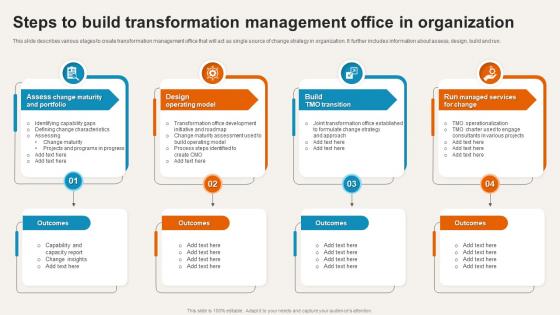
This slide describes various stages to create transformation management office that will act as single source of change strategy in organization. It further includes information about assess, design, build and run.
People who downloaded this PowerPoint presentation also viewed the following :
Steps To Build Transformation Management Office In Organization with all 6 slides:
Use our Steps To Build Transformation Management Office In Organization to effectively help you save your valuable time. They are readymade to fit into any presentation structure.






FAQs for Steps To Build Transformation Management
A Transformation Management Office (TMO) serves as the central governance body that oversees, coordinates, and accelerates organizational change initiatives across multiple departments and projects. It streamlines transformation efforts by standardizing methodologies, allocating resources strategically, and ensuring alignment with business objectives, while many organizations finding that TMOs deliver faster implementation timelines, reduced costs, and ultimately sustainable competitive advantage in an increasingly dynamic business environment.
A TMO aligns transformation initiatives with strategic objectives by establishing governance frameworks, conducting strategic assessments, and creating alignment matrices that map initiatives to business goals. Through regular stakeholder engagement and performance monitoring, organizations streamline resource allocation, minimize redundant efforts, and accelerate strategic outcomes, with many enterprises finding that centralized transformation oversight delivers measurable competitive advantage.
TMO KPIs include transformation milestone completion rates, employee adoption percentages, cost reduction achievements, revenue impact metrics, and stakeholder satisfaction scores. These indicators enable organizations to track progress across financial, operational, and cultural dimensions simultaneously, with many enterprises finding that balanced scorecards combining quantitative results and qualitative feedback ultimately deliver comprehensive visibility into transformation effectiveness and competitive advantage.
TMOs commonly face resistance to change, inadequate stakeholder buy-in, resource constraints, unclear communication channels, and misaligned objectives across departments. These challenges often stem from organizational silos, competing priorities, and insufficient change management frameworks, with many enterprises finding that early stakeholder engagement and structured communication protocols significantly enhance transformation success rates.
A TMO facilitates stakeholder communication by establishing structured reporting frameworks, conducting regular cross-functional meetings, creating centralized communication hubs, and implementing transparent status dashboards. These approaches streamline information flow by standardizing messaging protocols, reducing communication silos, and ensuring consistent updates across all levels, with many organizations finding that centralized communication governance ultimately delivers faster decision-making and enhanced project alignment.
TMOs can secure stakeholder buy-in through transparent communication strategies, early stakeholder involvement in planning phases, clear demonstration of business value propositions, and regular progress updates with measurable outcomes. These approaches enable organizations to build consensus across departments, address concerns proactively, and maintain momentum throughout transformation journeys, with many companies finding that consistent engagement ultimately delivers higher success rates and smoother implementation processes.
A TMO prioritizes multiple transformation projects by establishing clear governance frameworks, resource allocation matrices, and strategic alignment criteria that evaluate projects based on business impact, urgency, and interdependencies. Through centralized portfolio management and cross-functional coordination, organizations streamline project execution, minimize resource conflicts, and maximize synergies between initiatives, ultimately delivering faster organizational change and sustained competitive advantage.
A TMO can leverage automation tools, data analytics platforms, project management software, collaboration technologies, and AI-driven insights to streamline transformation initiatives. These technologies enhance processes by accelerating decision-making, improving resource allocation, and enabling real-time monitoring, with many organizations finding that digital integration ultimately delivers faster implementation timelines and measurable competitive advantage.
Essential TMO team members require change management expertise, project management proficiency, stakeholder engagement capabilities, data analysis skills, and strategic communication abilities. These competencies enable teams to navigate complex organizational transformations by facilitating cross-functional collaboration, measuring transformation metrics, and managing resistance, with many organizations finding that diverse skill sets ultimately deliver more successful outcomes.
A TMO integrates change management by embedding structured communication frameworks, stakeholder engagement protocols, and resistance mitigation strategies directly into transformation planning and execution phases. Through dedicated change champions, regular pulse surveys, and phased rollout approaches, organizations can address cultural shifts proactively, ultimately ensuring smoother adoption and sustainable transformation outcomes across all business units.
Stakeholder feedback serves as a critical compass for TMO initiatives, enabling course corrections, identifying implementation gaps, and validating transformation outcomes across organizational levels. This continuous input loop helps TMOs refine strategies, address resistance points, and accelerate adoption, with many organizations finding that regular feedback cycles significantly improve transformation success rates and stakeholder buy-in.
A TMO fosters innovation culture by establishing cross-functional collaboration frameworks, implementing idea management systems, creating psychological safety for experimentation, and aligning innovation metrics with strategic objectives. Through structured innovation processes and change management expertise, organizations streamline creative workflows, accelerate prototype development, and scale successful innovations, with many companies finding that TMO-led initiatives significantly enhance their competitive advantage and market responsiveness.
A TMO serves as the central coordination hub, working closely with IT on technology implementations, HR on change management and workforce transitions, and finance on budget oversight and ROI tracking. This collaborative approach ensures alignment across departments, streamlines communication channels, and minimizes operational disruptions, with many organizations finding that integrated TMO partnerships accelerate transformation timelines while delivering measurable cost efficiencies.
A TMO can assess organizational change readiness through comprehensive stakeholder surveys, leadership alignment evaluations, cultural maturity assessments, resource availability analysis, and historical change performance reviews. These evaluations help identify potential resistance points, capability gaps, and communication needs, enabling the TMO to develop targeted preparation strategies and adjust implementation approaches, ultimately ensuring higher success rates and smoother transformation journeys across the organization.
A TMO can implement regular milestone celebrations, transparent progress dashboards, cross-functional working groups, continuous feedback loops, and adaptive communication strategies. These practices sustain engagement by maintaining visibility into achievements, fostering collaborative ownership across departments, and enabling real-time course corrections, with many organizations finding that consistent recognition and stakeholder involvement ultimately delivers higher transformation success rates and lasting organizational commitment.
-
I want to express my gratitude to SlideTeam’s presentation design services team for helping me create the best presentation of my life!
-
Such amazing slides with easy editable options. A perfect time-saver.