


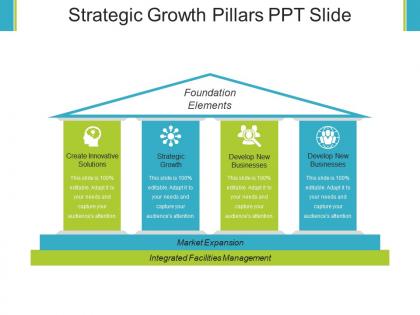
Strategic growth pillars ppt slide





Try Before you Buy Download Free Sample Product
 Impress Your
 Audience
 100%
100% Editable
 Save Hours
 of Time


Cool down angry emotions with our Strategic Growth Pillars Ppt Slide. Address the cause of hurt feelings.
People who downloaded this PowerPoint presentation also viewed the following :
Strategic growth pillars ppt slide with all 5 slides:
Our Strategic Growth Pillars Ppt Slide have a dramatic effect. The audience will enjoy the extra flourish.


FAQs for Strategic growth
So strategic growth pillars are just your company's 3-5 main areas where you're gonna focus for long-term growth. Picture them as buckets for your time and resources - things like "expand into new markets" or "boost digital capabilities." Most companies screw this up by picking too many pillars. Then everything gets half-assed attention. You want each pillar to have someone actually owning it, plus real metrics to track progress. Oh, and concrete stuff happening underneath each one - not just fancy words on a slide deck. Start by figuring out where your actual growth opportunities are, then build around those. Keep it simple.
Honestly, most companies are way off about where they actually stand - it's kinda crazy how delusional we can get about our own performance. Start with solid benchmarking data from industry reports and competitor research. Break your growth into the big stuff: revenue growth, market share, customer acquisition costs, retention rates. Compare those against industry averages and top performers. The real magic happens when you figure out WHY the gaps exist. Set up a simple scorecard to track this quarterly - sounds boring but you'll actually spot patterns. Oh, and don't forget peer networks for insights too.
Look, market research is your roadmap to smart growth moves. It reveals actual opportunities instead of wishful thinking. Use it to find market gaps, test if people want your new stuff, scope out competitors, and discover customer problems you could solve. Honestly, I've watched so many businesses pick directions based purely on hunches - total disaster most of the time. Research helps you figure out which ideas will actually work versus which ones just sound good on paper. Map where you stand now, then dig into related opportunities through customer chats and checking what competitors are doing.
Okay so basically you want to flip it around - start with your mission/vision first, then figure out what growth pillars actually make sense. Ask yourself what specific wins would get you closer to that bigger picture you're going for. Say your mission's all about sustainability - then your pillars should obviously include stuff like green product development or maybe circular economy work, not just hitting random revenue numbers. Each pillar needs to connect back to your core purpose somehow. I'd probably map out each growth area against your values and see which ones feel most aligned. Some will jump out as obvious fits.
Track both types of metrics - the stuff that predicts what's coming (customer acquisition cost, pipeline velocity, market penetration) and what already happened (revenue growth, lifetime value, market share). Most companies get obsessed with the backward-looking numbers and totally miss the warning signs. I'd set up maybe 5-7 core metrics that cover financial performance, customers, operations, and innovation. Check them monthly. The trick is making sure they actually connect to your growth goals - otherwise you're just collecting data for no reason. Oh, and don't go overboard with too many metrics or you'll drown in spreadsheets.
Tech and innovation aren't really their own pillars - they're more like the backbone that makes everything else work better. You know how your phone makes everything easier? Same concept here. Instead of having a separate "tech pillar," weave those capabilities into your existing growth areas. New market expansion? Tech can help you reach customers. Product development? Obviously tech plays a role there too. I'd focus on figuring out which specific technologies actually move the needle for your goals, then build those into each area strategically. Don't overcomplicate it though.
Customer feedback is basically your roadmap for figuring out growth priorities. It shows you what people actually want vs. what you think they want (huge difference, trust me). You'll spot gaps in your current stuff and see where demand is hottest. Honestly, it's like getting inside your customers' heads without the weird factor. This info helps you decide which growth areas deserve your money and time first. Oh, and feedback often reveals needs you didn't even know existed - those can become your next big opportunities. Just collect it everywhere and weave those insights into your planning.
Honestly, partnerships are like taking a shortcut to stuff you don't have yet. Why spend years building your own distribution network when you could just team up with someone who already has one? Same goes for tech, credibility, whatever gap you're trying to fill. The trick is finding real mutual benefit - not just some fluffy "strategic alignment" nonsense. I'd start by figuring out what you actually suck at or don't have resources for. Then look for companies that are already crushing it in those areas but might want what you bring. Makes way more sense than trying to do everything yourself.
Honestly, culture trumps strategy every single time. Your team will either run with your growth plans or drag their feet - and trust me, I've watched amazing strategies crash because nobody actually bought in. Risk-averse companies? Forget about innovation. Departments that don't talk to each other? Good luck scaling anything meaningful. Here's what I'd do: take a hard look at your culture before you even think about launching new initiatives. People need to feel safe taking chances and working together. Otherwise you're just setting yourself up for frustration when everyone goes through the motions but nothing actually moves forward.
Honestly, you need to track two types of metrics at once - stuff that shows immediate results AND activities that build for the future. I'd go with something like 70-20-10 for your resources: most to core business, some to growth opportunities, and a little slice for experimental stuff. Too many teams I know get obsessed with quarterly numbers and completely forget about planting seeds for next year - it's brutal to watch. Track leading indicators for long-term goals right alongside your usual KPIs. Figure out which short-term wins actually connect to your bigger vision, then go harder on those ones.
Build your growth stuff with scaling in mind right from the start - seriously, think systems not just random strategies. Map out where you're hitting walls now and fix those first. Automate everything you can, especially how you get customers and run daily ops. Your team needs cross-training too because nothing screws you over faster than when only one person knows how something works (learned that the hard way). Design each piece so it can double or triple without falling apart. The whole point is making processes that handle more volume without you rebuilding everything from scratch.
Look, financial planning is basically your roadmap for making growth actually happen instead of just hoping it will. You've gotta match your budget to what matters most - like if getting new customers is the priority, put your money there, not on random side projects. I swear, most teams just throw resources at everything and then act shocked when nothing works. Be ruthless about saying no to stuff. Check what you're spending on now versus what you say is important - the gaps will probably blow your mind.
Honestly, the worst thing you can do is pick like 6+ pillars - you'll just water everything down. Most companies I've seen mess this up by choosing stuff that sounds fancy but customers don't actually care about. Leadership loves doing this in boardrooms without asking the people who have to make it happen (eye roll). "Digital transformation" means absolutely nothing, by the way. Keep it to 3-4 max, make them specific enough that your team knows what winning looks like. And definitely run them by actual customers first - saves you from looking stupid later.
Honestly, sustainability isn't just feel-good stuff anymore - it actually drives real revenue. People are willing to pay more for brands that match their values, and you'll cut operational costs through energy savings and less waste. The talent piece is huge too; good employees want to work somewhere with purpose. Investors are also throwing money at ESG companies right now, so there's that angle. I'd start small though - audit where you're at environmentally and pick one visible change customers will actually notice. Don't try to boil the ocean on day one.
Honestly, employee engagement makes or breaks your growth plans. People who actually care about their work will innovate and push through tough spots. The ones just collecting paychecks? They'll tank even your best strategies. Engaged employees become walking advertisements for your company too - they'll help you snag better talent and customers without you even asking. Here's what really works: show people exactly how their daily tasks connect to the big picture. Once they see their role in the success story, everything changes. Short sentences hit different sometimes. Trust me, skip this step and watch your brilliant plans fizzle out during execution.
-
Visually stunning presentation, love the content.
-
Good research work and creative work done on every template.