


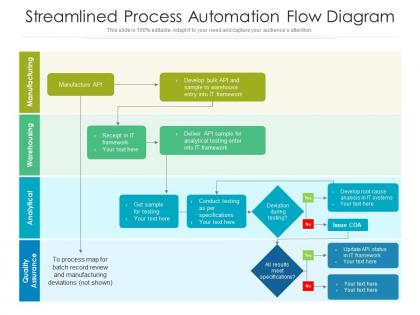
Streamlined process automation flow diagram




Try Before you Buy Download Free Sample Product
 Impress Your
 Audience
 100%
100% Editable
 Save Hours
 of Time


Our Streamlined Process Automation Flow Diagram are topically designed to provide an attractive backdrop to any subject. Use them to look like a presentation pro.
People who downloaded this PowerPoint presentation also viewed the following :
Streamlined process automation flow diagram with all 2 slides:
Use our Streamlined Process Automation Flow Diagram to effectively help you save your valuable time. They are readymade to fit into any presentation structure.

FAQs for Streamlined process
Honestly, the biggest thing is just how much faster everything gets done - automation crushes those repetitive tasks. Your team will actually enjoy work more since they're not stuck doing boring data entry all day. Plus robots don't screw up like we do, so fewer mistakes overall. Cost savings show up pretty fast too, which makes the bosses happy. Oh, and everything becomes way more consistent once you set it up right. I'd start with whatever processes make you want to pull your hair out - usually the super repetitive, rule-heavy stuff. Those are no-brainers to automate first.
Honestly, automation usually works out pretty well for everyone when you don't just spring it on people. Your team gets way more productive because they're doing actual thinking work instead of mindless data entry stuff. People are generally happier too - nobody wants to spend their day on boring repetitive tasks. Sure, there's always that initial freakout about being replaced by robots, but that fades. I'd definitely get your team involved in picking what to automate first. Ask them what tasks make them want to bang their head against their desk - start there. Oh, and don't forget to train people on whatever new stuff they'll be doing instead.
Honestly, the team pushback is brutal - nobody wants their routine messed with. Costs hit you upfront too, which sucks. Then you're stuck figuring out what to automate first (I'd pick something simple that annoys everyone daily). Integration's a nightmare when systems don't talk to each other. Your data's probably messier than you think, so expect some cleanup headaches. Best move? Start tiny with one process that'll give you an obvious win. Gets people on board faster. Don't go crazy trying to automate your entire operation right away - that's how you burn out your budget and your team.
Manufacturing and healthcare are huge winners with automation - they're buried in repetitive stuff that's perfect for robots to handle. Finance too, especially loan processing and fraud detection. Logistics companies save tons on sorting and tracking. Honestly, medical billing is such a mess that automation there is almost mandatory at this point. The sweet spot? Look for anything high-volume and standardized in your field. Even tiny efficiency bumps become massive when you're doing thousands of transactions. Assembly lines, patient scheduling, quality control - all gold mines for this stuff.
Honestly, just start with the free stuff - Zapier, IFTTT, even basic Excel macros work great. Don't overthink it. Look at what's eating up most of your time first. Data entry? Email responses? Whatever's driving you nuts. We set up this super simple Google Forms thing that feeds into Sheets for lead capture and I couldn't believe how much time it saved us. Also, you're probably already paying for tools that do automation - most CRMs have features people never even touch. Pick literally one thing this week and automate it. Build from there once you see how easy it actually is.
So AI basically takes regular automation and makes it way smarter. Traditional systems just follow basic if-then rules, but AI can learn from patterns and adapt without you constantly reprogramming stuff. Pretty cool honestly. Look for repetitive tasks that need some decision-making - like document processing, predictive maintenance, or chatbots that actually get context (not those annoying ones that don't understand anything lol). The best part? It handles situations you didn't even think to code for. Just gotta find those workflows where you're doing the same thing over and over but need to think a little each time.
So first thing - measure before you start, then check monthly for like 6 months minimum. Track the obvious stuff: time saved, costs, fewer mistakes, better output. But don't sleep on the softer wins either - your team's happiness, customer scores, whether people can finally focus on actual strategy instead of mind-numbing busywork. Honestly, those soft metrics are what'll really sell leadership on it. Oh, and make yourself a basic dashboard so you're not hunting through spreadsheets every time someone asks for numbers. Trust me on that one.
Honestly, start with whatever you're already using - if you're on Microsoft stuff, Power Automate is pretty decent and won't make you learn a whole new system. UiPath and Automation Anywhere are the heavy hitters for things like invoice processing, but they're overkill if you just need basic workflows. Zapier's nice for connecting different apps together (I use it for random stuff all the time). Python's always an option if someone on your team codes. But seriously, just pick one annoying process that's eating up everyone's time and automate that first. You'll see results fast and can build from there.
Honestly, automation is a game-changer for customer experience. Your response times get way faster, and you cut down on those annoying human errors that make people frustrated. Customers love getting instant confirmations instead of waiting around. They don't have to repeat their info five times either - which, let's be real, drives everyone crazy. The best part? Your team can focus on the actually complicated stuff instead of doing the same boring tasks over and over. I'd start with whatever processes you find yourself doing constantly. You'll notice the difference pretty quick, and your satisfaction scores will thank you.
Biggest thing to watch out for is jobs getting axed - automation straight up replaces people. Security's another nightmare if hackers get in. You'll also become way too dependent on tech that might crash right when you need it. Oh, and the costs can spiral out of control fast if you don't plan properly (seen it happen). You lose human intuition too, which honestly matters more than people think when weird situations pop up. Start with small test runs first. Keep people involved in big decisions. Always have a backup plan because stuff breaks.
Honestly, start with encryption everywhere - data moving around AND stored data. Set up role-based access so random people can't see stuff they shouldn't. The monitoring piece is huge though, most places totally blow this off. You need real-time alerts when weird access patterns happen or systems start acting funky. Oh, and definitely audit your current setup BEFORE you automate anything - last thing you want is automating a security hole, right? Keep everything patched too. I know it sounds like a lot but these three areas will cover your bases pretty well.
So RPA basically acts like a human clicking around your current software - no need to mess with backend stuff or databases. Traditional automation digs deeper into the actual code and APIs. Way more setup time though. Honestly, RPA is perfect when you need something working fast. Just point it at repetitive tasks like data entry or moving info between apps. Sure, traditional methods are probably better long-term, but who has time for that? I'd go RPA first for the quick wins, especially if IT's already swamped. You can always upgrade later.
Oh man, communication is huge here - seriously, rumors about layoffs will torpedo your project faster than any bug will. Explain the "why" upfront and what's actually in it for them. Don't just dump a one-hour training session on people either. Roll things out bit by bit instead of going full chaos mode with everything at once. Here's the thing though - get your team involved in designing this stuff! They know the weird quirks of your current processes way better than you do. Trust me, they'll catch problems you'd never think of. Build confidence gradually and actually listen when they give feedback.
Go small first - pick something with clear wins you can actually measure. I always map out the current process before touching anything because automating garbage just makes garbage faster lol. Your team needs to be in the loop from day one or they'll hate it. People get weird about automation taking their jobs, so just be upfront about what you're doing. Test the hell out of everything in a sandbox first. Have a backup plan ready because things will break. Then track your results against where you started - otherwise you can't prove it was worth the money.
Ugh, regulatory stuff makes automation such a headache. You can't just set something up and walk away - everything needs paper trails and approvals. Pharma, finance, healthcare... they all want you following FDA rules or SOX compliance. Means you're stuck adding tons of logging, user controls, and sometimes manual checkpoints even when things should be automated. Honestly feels backwards sometimes. But here's the weird thing - once you jump through all these hoops, your systems actually end up way more bulletproof than if you'd just winged it from the start.
-
Unique design & color.
-
Illustrative design with editable content. Exceptional value for money. Highly pleased with the product.
-
Great product with highly impressive and engaging designs.
-
Awesome use of colors and designs in product templates.