


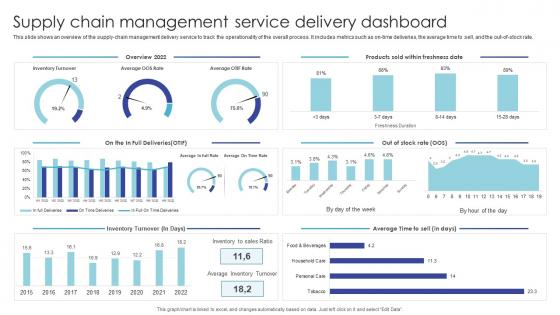
Supply Chain Management Service Delivery Dashboard




Try Before you Buy Download Free Sample Product
 Impress Your
 Audience
 100%
100% Editable
 Save Hours
 of Time


This slide shows an overview of the supply chain management delivery service to track the operationality of the overall process. It includes metrics such as on time deliveries, the average time to sell, and the out of stock rate.
People who downloaded this PowerPoint presentation also viewed the following :
Supply Chain Management Service Delivery Dashboard with all 7 slides:
Use our Supply Chain Management Service Delivery Dashboard to effectively help you save your valuable time. They are readymade to fit into any presentation structure.






FAQs for Supply Chain Management
Dude, you get real-time visibility into everything - no more guessing where stuff is. GPS tracking and IoT sensors show you exactly what's moving and if anything's going wrong. Way better than the old phone tag nightmare, honestly. You can catch problems before they blow up and automatically update customers. The predictive stuff is pretty wild too. I'd start with just your most important shipments first - you'll see results right away and then expand. Trust me, once you see how much clearer everything becomes, you won't want to go back to spreadsheets.
Honestly, the biggest mistake I see companies make is relying too heavily on one supplier - it's like dating someone who's your only friend, you know? Map out your whole supply chain first so you can spot the weak links. Build relationships with backup suppliers before you actually need them. Those early warning systems are a lifesaver too. Yeah, keeping extra inventory costs money, but it beats scrambling when your main supplier falls through. Risk assessments sound boring but they're worth doing regularly. Start small - pick your three biggest vulnerabilities and make backup plans for those.
Honestly, going green with your supply chain is pretty smart business-wise. You'll cut costs through less waste and better energy use. Brand-wise, customers actually care about this stuff now - it's not just virtue signaling anymore. Risk goes down too since you're not relying on resource-heavy processes that could get disrupted. Oh, and most sustainable changes actually make operations run smoother, which is kind of a win-win. I'd probably start with something manageable like packaging changes first. Test it out, see what happens.
Honestly, demand forecasting can make or break your whole supply chain game. Get it right and you'll avoid those awful stockouts that piss off customers OR having way too much inventory just sitting there draining your cash. There's so many moving pieces that depend on decent forecasts - like when to order stuff, how much to produce, even planning your shipping routes. I always tell people to dig into their historical sales data first and look for seasonal patterns. That's your starting point for forecasts that actually work. Oh, and don't underestimate how tricky this gets once you factor in all the variables!
Honestly, start with demand forecasting - use your past sales data to predict what you'll actually need. ABC analysis is a game changer too. Basically you rank inventory by value so you're not babying cheap screws like they're gold. Just-in-time delivery cuts storage costs but suppliers can be flaky, so there's that risk. Safety stock helps avoid those awful stockouts without tying up too much cash. Track your turnover ratio monthly - that'll show you what's actually working. It's all about finding that balance between storage costs and keeping customers happy.
So you want suppliers and manufacturers talking regularly, right? Real-time demand sharing fixes those weird stockout situations - plus you avoid buying too much crap you don't need. Get them in on product design early too, since honestly they know their stuff way better than most internal teams give them credit for. Regular planning meetings keep production schedules aligned. When issues come up (and they will), you've already got communication flowing so problems get solved fast. Oh, and start small - pick your most important supplier first and set up monthly check-ins before going crazy with everyone.
Honestly, data analytics is a game changer for supply chains. Instead of just winging it, you'll actually see what's happening - demand shifts, inventory gaps, which suppliers suck. Machine learning catches patterns you'd totally miss otherwise. The best part? You stop scrambling when stuff goes wrong because you can predict problems ahead of time. Route optimization, cutting waste, knowing who to trust - it's all there. My advice? Don't overthink it. Pick something that's driving you crazy, like demand forecasting, and start there. The data will show you where to go next.
Honestly, supply chains are kind of a mess right now with all the geopolitical drama and random disasters hitting left and right. Don't put all your suppliers in one region - learned that one the hard way during COVID. You need real-time tracking tools so you're not flying blind, plus keep extra stock of anything mission-critical. Multiple backup plans are clutch. I'd start by figuring out where you're most vulnerable first. Like, what would actually break your business if it went down tomorrow? Those supplier reliability issues never seem to go away either, and demand keeps jumping around like crazy.
So JIT basically means you get materials right when you need them instead of hoarding stuff. Way less stressful than it sounds, trust me! Your suppliers become actual partners - you'll share demand data and coordinate super tightly. Yeah, it feels weird at first not having backup inventory sitting around. But you save tons on storage costs and become crazy responsive to what customers actually want. Less waste too. I'd start small though - pick your most reliable suppliers and test it on components that won't kill you if something goes wrong. Build up from there.
Dude, geopolitical stuff can totally flip your supply chain in a day. Trade wars and sanctions mean you can't just rely on one country anymore - you've got to spread suppliers around. Remember Brexit? Companies were scrambling like crazy to fix their European routes. Buffer stocks become way more important, even though they're expensive. Short sentences work better sometimes. You should probably run "what if" scenarios regularly so you're not blindsided when politicians inevitably mess things up. Building flexibility into sourcing decisions isn't glamorous, but it'll save your butt when things go sideways.
Honestly, there's so many ways to automate supply chains now. I'd start with demand forecasting - AI can predict what you'll need way before you run out. Warehouse robots are getting insane at picking and packing stuff. Your inventory systems can track everything live and auto-reorder when you're running low. Route optimization is huge too - saves money and gets deliveries out faster. Oh, and AI can spot supplier issues before they screw you over, which is clutch. My advice? Pick one thing like inventory tracking first. See how it works, then build from there once you're making money back.
So logistics is basically what keeps your whole supply chain from completely falling apart. You need stuff moving from A to B at the right time and cost - pretty straightforward concept but harder to execute than you'd think. When it works, customers are happy and your costs stay reasonable. Screw it up though? Delays everywhere, budgets blown, angry customers calling constantly. I'd say the biggest thing is staying on top of communication with whoever handles your shipping - that's honestly where like 90% of problems start. Oh and visibility into where everything is at all times. Can't fix problems you don't know about.
Don't treat compliance like something you'll deal with later - build it right into your supply chain from the start. Map out all your suppliers first (seriously, most companies have no clue where everything actually comes from). Set hard requirements in contracts, not suggestions. Third-party audits are non-negotiable, and you need a tracking system for all certifications and docs. Here's what'll save you: alerts when certs are about to expire. Trust me, scrambling at the last minute sucks. Make compliance a dealbreaker, not a checkbox.
Honestly, focus on the big three first: cost per order, inventory turnover, and on-time delivery. Fill rates are critical too - that's what actually keeps customers happy. Order cycle time matters a lot. Cash-to-cash cycle shows how fast you're turning inventory back into money, which is pretty crucial for cash flow. My advice? Don't go overboard tracking every single thing. Pick maybe 5-6 metrics that actually match what your business cares about and check them weekly. More than that and you'll just get overwhelmed with data that doesn't help.
Honestly, consumer trends mess with your entire supply chain setup. Like when everyone suddenly demanded eco-friendly packaging or same-day delivery - you can't just make tiny adjustments. The whole thing needs rebuilding: sourcing, manufacturing, distribution, everything. Amazon Prime basically ruined us all by making 2-day shipping feel slow, right? Now supply chains have to be super flexible because people change what they want so fast. Building in that flexibility from the start is crucial - otherwise you're scrambling every time there's a new trend. It's exhausting but necessary.
-
You know what? I'm so glad I opted for this PPT design. It has been a total game-changer for me and my presentations. Thank you!
-
The quality of the templates is as fine as it could get. It was a purchase well made!