


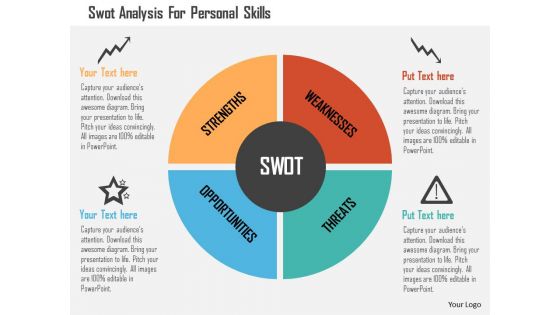
Swot analysis for personal skills flat powerpoint design




Try Before you Buy Download Free Sample Product
 Impress Your
 Audience
 100%
100% Editable
 Save Hours
 of Time


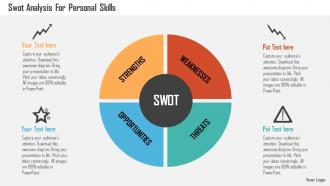
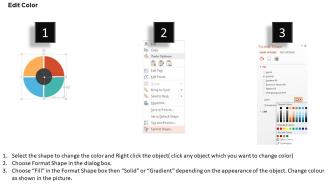
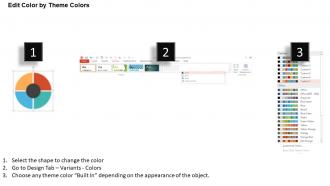
If you want to synchronize your firm’s resources and capabilities with the competitive environment in which your firm operates, then you need to take a look at our amazing swot analysis for personal skills flat PPT Template. This Slide includes a diagram which is similar to a pie-chart with four parts and a circle in the center. Each of the four pie-chart slice has a component of the SWOT i.e. Strengths, Weaknesses, Opportunities and Threats. SWOT analysis can be used to conduct competitive analysis, strategic planning or any other study. This is because, through a SWOT analysis, a business can identify any environmental factor that plays a favorable or unfavorable role in any particular objective. Small businesses, large enterprises as well as individuals can use this SWOT analysis Slide in their business presentations. The whole SWOT analysis methodology brings to light your resources, and gives inspiration and the essential drive to continue your marketing strategies in spite of all odds. Download now and enjoy the benefits. Your thoughts and our Swot Analysis For Personal Skills Flat Powerpoint Design will make a great ensemble. They will win the prize hands down.
People who downloaded this PowerPoint presentation also viewed the following :
Swot analysis for personal skills flat powerpoint design with all 5 slides:
Our Swot Analysis For Personal Skills Flat Powerpoint Design can be employed by any group. They are conducive to all categories.
FAQs for Swot analysis for personal skills
So SWOT has four parts - strengths/weaknesses are stuff you control internally, while opportunities/threats are external market things you can't really change. Most people just fill out each box and think they're done, which is kinda pointless honestly. The real value comes from connecting them together. Like, how do your strengths help you grab opportunities? What weaknesses leave you exposed to threats? I always tell people to match each strength with an opportunity, then do the same with weaknesses and threats. That's where you actually figure out your strategy instead of just making lists.
Look, SWOT analysis only works if you're brutally honest about everything. Get your whole team involved - they'll spot stuff you're totally blind to. The real value comes when you start connecting the dots between sections. Like, how do your strengths help you grab new opportunities? Which weaknesses leave you exposed when threats pop up? Honestly, most people just fill out the four boxes and think they're done. Big mistake. You need to actually use what you found to figure out which moves will give you the most impact. Otherwise it's just another useless exercise.
So market research is basically your sanity check for SWOT analysis. Instead of just guessing what your strengths are, you actually get real data from customer surveys and competitor analysis. Honestly, I've sat through way too many meetings where people claim stuff is a "strength" with literally zero proof - it's painful. The research shows you what customers actually care about versus what you think matters. Survey your customers first about what they value most. That'll tell you where you're really winning and which weaknesses need fixing ASAP. Way better than going off hunches.
Look, when you're talking about innovation as a strength, get specific with it. Don't just say "we're innovative" - everyone claims that. Instead, throw out real numbers like "we launched 3 breakthrough products in 18 months" or "we hold 15 patents in our field." Your R&D team and how fast you bring stuff to market compared to competitors? That's gold. Also mention your culture - does your team actually take risks and try new approaches? I know it sounds a bit fluffy, but companies that encourage experimentation usually crush it. Patent portfolio, investment in new tech, creative problem-solving skills - all fair game to highlight.
Okay so basically take each threat and figure out what you can actually control. Some you can fight back against - like if competitors are beating your prices, maybe beef up your value prop or cut costs somewhere. Others? You're just gonna have to roll with and prep for. Build some backup plans, spread your revenue around, get tighter with important people. I'd honestly focus on the threats that could really mess you up first. Then make sure someone's actually responsible for dealing with each one. Otherwise it'll just sit in some presentation forever doing nothing.
Honestly, the biggest mistake is being way too vague. Like saying you have "passionate staff" but not explaining why that matters or what they actually do well. Also, don't mix up internal vs external stuff - limited funding is YOUR weakness, not some outside threat. And please stop pretending every weakness is secretly an opportunity. It's not! Just be real about where you're actually struggling, whether that's crappy programs or a board that doesn't show up. But here's the thing - actually DO something with it afterward. I've seen so many organizations spend hours on these exercises just to shove the results in a filing cabinet.
Dude, you can't just do SWOT once a year in tech - that's way too slow. The whole industry moves at warp speed, so I'd say quarterly at minimum. Focus hard on what's coming that could mess with your position, not just current stuff. Honestly, I think of weaknesses as temporary gaps you can fix fast rather than permanent problems. That's the beauty of tech, right? You can pivot quick. Keep your competitive intel fresh and be ready to totally change direction when some new technology drops or the market shifts. It's all about staying flexible.
Dude, culture totally changes your SWOT analysis when you go global. Like, being super direct might work great in Germany but could backfire in Japan where people are way more subtle. I've literally watched companies mess this up during expansions - it's painful to see! How you make decisions, solve problems as a team vs individually, even your whole approach to deadlines gets viewed completely differently depending where you are. Your customer service style that works at home? Might seem rude somewhere else. Definitely run your analysis past local people first before you commit to anything major.
Honestly, getting your employees involved in SWOT analysis is a game changer. They're dealing with customers and processes every day, so they'll spot things management completely misses - weird operational hiccups, patterns in complaints, stuff like that. When people help build the analysis, they actually care about implementing changes afterward. Makes sense, right? The frontline folks know what's really broken versus what just sounds impressive in meetings. I'd definitely run separate sessions with different departments though - you get way better insights when people aren't all talking over each other.
Honestly, visual templates are a game-changer for SWOT meetings. People actually focus when they can see the four quadrants laid out instead of just rambling. I always use sticky notes or digital boards so everyone can throw ideas up at once - way more efficient than going around the table. It keeps things organized too since you've got clear spaces for each category. Otherwise you end up jumping between strengths and threats randomly (been there, done that). The best part? Stakeholders feel heard because they watch their input get captured right there on the board. Makes a huge difference in getting buy-in.
Honestly, most companies mess this up by doing SWOT once and forgetting about it. You need to update yours whenever something big shifts - new competitors, market changes, product launches, that kind of stuff. I usually tell people to schedule formal reviews twice a year minimum. But here's the thing - if something major happens in your industry, don't wait. Just do a quick refresh right then. Your strengths and weaknesses aren't static, and neither are external threats. Oh, and definitely revisit it before quarterly planning or any big strategic moves. It's way more useful when you keep it current.
SWOT's actually perfect for this - just map out both companies' strengths, weaknesses, opportunities, and threats side by side. The sweet spot? When your strengths cover their weak areas and vice versa. Honestly, I've watched so many partnerships crash because teams get starry-eyed about the potential upside. They totally ignore how risks can multiply when you combine forces. What you want to do is create two SWOT grids - one for "staying separate" and another for "joining up." Sounds boring but it'll show you pretty fast if this thing makes real sense or just looks good in a PowerPoint deck.
Honestly, this is way simpler than people make it. Take your strengths and track metrics that prove you're actually using them - like if innovation's your thing, watch that market share climb. Weaknesses? Set improvement targets with deadlines. "Cut response time 30% by June" - boom, done. For opportunities, measure conversion rates from those new markets you spotted. Threats are tricky though - most folks just forget about monitoring after the analysis is over. I'd create monthly scorecards with 2-3 metrics per section. The real trick is picking numbers that connect to what you're actually doing, not just stuff that looks good on paper.
A SWOT analysis is basically your reality check before product decisions. Forces you to look at internal strengths/weaknesses plus external opportunities and threats. Like, you might find your team's coding skills match up perfectly with some new tech trend, or realize budget issues could screw up your timeline right when competitors are dropping similar features. Honestly, it's just having a brutally honest convo with yourself about what's doable. The trick is not sugarcoating anything during the assessment - then use what you learn to figure out which features to prioritize and where to put your resources for maximum impact.
Know your audience - execs want the big picture stuff, but department heads need specifics they can act on. Charts and visuals work way better than walls of text (SWOT analysis gets messy fast). Keep presentations short because honestly, people's attention spans are terrible these days. Interactive workshops beat one-way presentations every time - let people talk through what it all means. Oh, and don't just present findings and call it done. Connect everything to actual next steps or recommendations so they're not sitting there wondering "okay...now what?"
-
Good research work and creative work done on every template.
-
Great designs, Easily Editable.