


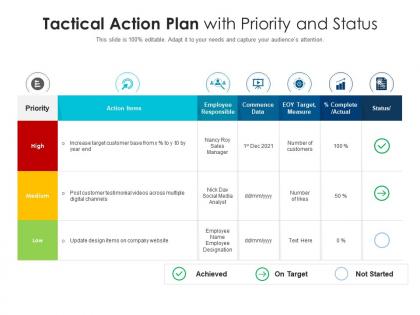
Tactical action plan with priority and status




Try Before you Buy Download Free Sample Product
 Impress Your
 Audience
 100%
100% Editable
 Save Hours
 of Time


Our Tactical Action Plan With Priority And Status are topically designed to provide an attractive backdrop to any subject. Use them to look like a presentation pro.
People who downloaded this PowerPoint presentation also viewed the following :
Tactical action plan with priority and status with all 2 slides:
Use our Tactical Action Plan With Priority And Status to effectively help you save your valuable time. They are readymade to fit into any presentation structure.
FAQs for Tactical action plan with
You need clear goals, specific action steps with deadlines, and someone owning each piece. Also figure out your budget/resources upfront. Think of it as your 3-6 month roadmap between big picture strategy and daily tasks. Here's the thing - most plans crash because people forget to measure anything. Define what winning looks like before you start, then do monthly check-ins to see if you're actually getting there. Oh, and don't skip the regular reviews. Seriously, schedule them now or you'll keep pushing them off and wonder why nothing's working.
Think of strategic plans as your big 3-5 year vision - the whole "where do we want to be" thing. Tactical plans? That's the nitty-gritty stuff you're actually doing this year to get there. Strategy is like picking your destination, tactics are the actual driving directions. Honestly, most people get these mixed up all the time. Executives usually handle the strategic side, but you'll probably spend most of your time in tactical mode with your team. Next time you're planning something, just ask yourself - am I deciding where we're going, or figuring out how to get there?
Look, you've gotta do your market analysis first - that's what tells you if your tactical plan will actually work or just flop. Figure out who you're competing against, how customers behave, what trends are happening. Without that intel, you're basically flying blind. It's like planning a trip without checking if the roads are even open, you know? Once you've got solid data on gaps and opportunities, then you can pick tactics that'll actually move the needle. Oh, and don't skip the resource allocation part - that's where most people mess up. Get your market research done before writing any objectives.
Pick 3-5 metrics you can actually track without going crazy - revenue goals, project deadlines, customer happiness, whatever matches your objectives. Check them monthly or quarterly (depends how fast things move for you). The real trick? Actually looking at the numbers instead of drowning in daily fires. I swear that's where most people mess up. Compare what happened vs what you planned, plus ask your team how things feel on the ground. Sometimes the data looks good but everyone's miserable, you know? Start simple or you'll end up with spreadsheets you never touch.
Honestly, it depends what you're going for. Asana and Trello are solid for basic task tracking - I've used both and they're pretty intuitive. Monday.com is good too but can get pricey. If you need heavy-duty strategic planning, Cascade and OnStrategy are worth checking out since they're made for that specific thing. Microsoft Project exists but it's way too much unless you're managing something massive. Oh, and Miro's great for brainstorming sessions - we use it all the time for mind mapping stuff. I'd definitely try free trials of like 2-3 before you decide anything.
Honestly? Monthly reviews are where it's at, but quarterly works if you're swamped. Things move so damn fast now - our Q2 strategy got completely torched when a competitor dropped something we didn't see coming. That sucked. But it taught me to stop waiting for those big annual planning meetings to fix stuff. Markets shift, customer needs change, your team learns new things. Short, regular check-ins help you catch what's working and ditch what isn't. I'd start with monthly sessions - even if they're just 30 minutes to gut-check your tactics.
Honestly, the worst thing you can do is be super vague about what you're actually trying to achieve and when. I've watched so many teams create these fluffy plans that sound impressive but don't help anyone make real decisions. Don't forget to get input from the people who'll actually be affected - seriously, this bites people more often than you'd think. Keep it simple too. Cramming in a million moving parts or assuming you'll have unlimited resources is just setting yourself up to fail. Oh, and treat your plan like a living document. Check in every few weeks and tweak things when reality inevitably gets messy.
Dude, getting other people involved is a total game-changer for planning. You'll catch stuff you'd never see on your own - different perspectives are clutch. Your timelines become way more realistic when the people actually doing the work help build them. Plus everyone's more invested when they helped create it, you know? I've seen so many plans fail because they were just handed down from above. The creative solutions that come up when minds mix? Chef's kiss. Oh, and bring stakeholders in early - not after you've already decided everything. Trust me on this one.
Honestly, just draw actual lines connecting your tactical stuff to the big-picture goals. Sounds silly but it works. Meet with leadership regularly - I've seen teams go completely sideways when they don't. Those massive business objectives? Chop them into bite-sized pieces your tactical plan can actually accomplish. Oh, and use whatever metrics and buzzwords the executives are obsessed with so you're all talking the same language. Set up quarterly reviews to pivot when priorities change. And they always change - usually right when you think you've got it figured out.
Honestly, I just make a super basic chart - impact vs how much work it'll take. Sounds nerdy but whatever, it works. Go for the easy wins first to get some momentum going. Once people see you're actually getting stuff done, then you can push for the bigger projects that need more resources. Also check if some things have to happen in order, like you can't do B until A is finished. The hardest part is saying no to ideas that sound cool but don't actually help your main goals. Be ruthless about cutting that stuff.
Honestly, just keep things super visual and simple - charts beat walls of text every time. Different people care about different stuff, so don't send the same update to your CEO and your dev team (learned this one the hard way lol). Short check-ins work way better than those novel-length emails nobody reads. Always explain WHY you're doing something, not just what you're doing. Oh, and actually listen when people have questions or pushback - stakeholders who feel heard won't fight you later. Sometimes I'll even do quick Slack polls instead of formal surveys.
Honestly, you've gotta bake flexibility right into your plan from day one. I do check-ins every week or two to see what's actually working - learned that lesson when a competitor totally blindsided us last quarter and our whole strategy went out the window lol. Keep some budget aside for when you need to pivot fast. The biggest thing? Your team can't think adapting means they screwed up. It's just good planning. Oh, and map out your worst-case scenarios ahead of time so you're not scrambling when things go sideways.
Honestly, data analytics just gives you the real facts instead of guessing. You'll spot stuff in customer behavior and market trends that you'd completely miss otherwise. Think of it like having x-ray vision for your business - you can actually predict what's coming next and figure out which tactics work versus the ones that just make you feel productive (but aren't doing much). Plus you can put your resources where they'll actually make a difference. My advice? Start small though. Pick one metric you want to improve and dig into that first. Way less overwhelming.
Dude, you HAVE to get your team involved or this thing's gonna crash and burn. They're the ones actually doing the work, so they'll spot problems you'd never think of. Plus when people help build the plan, they're way more invested in making it succeed - none of that passive-aggressive "well I guess we'll try your idea" energy. Honestly, I've seen so many plans fail just because leadership thought they could figure everything out in a conference room. Get them in early while you're still sketching things out. Trust me on this one.
Honestly, visual aids are a game changer for tactical plans. Complex stuff becomes way more manageable when you break it into charts and timelines instead of dense paragraphs that nobody wants to read. Your team can actually see how everything connects - who's doing what, when things are due, how their work impacts everyone else's. Presentations go smoother too since people get it faster when there's a visual flow to follow. I'd start simple - PowerPoint or Google Slides work fine. Even basic templates beat trying to explain everything through text alone.
-
Helpful product design for delivering presentation.
-
Easily Editable.
-
Innovative and Colorful designs.