


Talent mapping monitoring plan and response plan




Try Before you Buy Download Free Sample Product
 Impress Your
 Audience
 100%
100% Editable
 Save Hours
 of Time


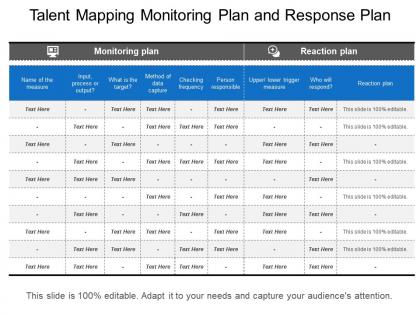
Introducing Talent Mapping Monitoring Plan And Response Plan PPT template for the assessment of employee talent. Utilize this competency model PPT presentation to showcase employee monitoring and reactive plan and various components of the same such as input, output, data capturing method, etc. Take advantage of this talent management PowerPoint layout to determine future talent needs and assess the viability of your current staff for meeting those needs. Employ this talent pool PowerPoint infographic to source high-potential players in your department for future recruitment, and develop a strategic plan to fill vacancies and talent gaps. Incorporate talent management software in this talent pipeline PPT visual for the effective and efficient retaining of competent employees in your organization. Download this amazing recruitment mapping PPT slideshow and create a strong impression on your employees and succeed in maintaining a pool of the best candidates in your industry.
People who downloaded this PowerPoint presentation also viewed the following :
Talent mapping monitoring plan and response plan with all 5 slides:
Give folks an insight into the assignment with our Talent Mapping Monitoring Plan And Response Plan. Be able to interact with the candidates.


FAQs for Talent mapping monitoring plan
Key components of an effective talent mapping strategy include comprehensive skills assessment, succession planning frameworks, competency gap analysis, leadership pipeline development, and performance tracking systems. These strategic elements work together by identifying high-potential employees, aligning talent with business objectives, and creating targeted development pathways, ultimately enabling organizations to build robust internal talent pools while reducing recruitment costs.
Talent mapping integrates into recruitment by creating detailed competency profiles, identifying skill gaps, mapping career progression paths, and establishing cultural fit criteria before posting positions. This strategic approach enables recruiters to target qualified candidates more precisely, streamline interview processes, and reduce time-to-hire, with many organizations finding that pre-mapping delivers better retention rates and stronger team performance.
Technology revolutionizes talent mapping through AI-powered analytics, cloud-based platforms, predictive modeling, automated data collection, and integrated assessment tools. These solutions streamline candidate identification, enhance skill matching accuracy, and accelerate recruitment processes, with many organizations finding that strategic technology adoption delivers faster hiring, reduced costs, and significantly improved talent acquisition outcomes.
Organizations utilize talent mapping to identify skill gaps by systematically assessing current employee capabilities, analyzing future business requirements, and comparing existing competencies against strategic objectives. Through comprehensive skills inventories and competency frameworks, companies can pinpoint specific areas where additional training, hiring, or internal development is needed, ultimately enabling more strategic workforce planning and competitive advantage.
Common talent mapping challenges include incomplete data collection, skills assessment inaccuracies, rapid market changes, limited internal visibility, and resource constraints. Organizations overcome these by implementing robust HR analytics platforms, conducting regular competency evaluations, and establishing cross-departmental collaboration frameworks, with many companies finding that systematic approaches ultimately deliver enhanced workforce planning and competitive talent positioning.
Talent mapping contributes to employee development and retention by identifying skill gaps, creating personalized career pathways, and aligning individual aspirations with organizational needs. Through strategic talent assessment, companies can provide targeted training opportunities, enhance internal mobility, and demonstrate investment in their workforce, with many organizations finding that employees stay longer when they see clear advancement potential and development support.
Talent mapping informs succession planning by identifying high-potential employees, assessing skill gaps in critical roles, and creating development pathways for future leaders. Through comprehensive talent assessment, organizations can proactively prepare internal candidates for key positions, reduce external recruitment costs, and ensure business continuity, with many companies finding that strategic succession planning significantly enhances organizational resilience and competitive advantage.
Key metrics for evaluating talent mapping success include employee retention rates, internal promotion percentages, time-to-fill for critical positions, succession planning coverage, and skill gap reduction measurements. These indicators help organizations assess workforce readiness, optimize talent development investments, and measure competitive advantage, with many companies finding that comprehensive tracking ultimately delivers stronger leadership pipelines and reduced recruitment costs.
Talent mapping helps create diverse workforces by identifying underrepresented talent pools, tracking diversity metrics across departments and levels, and revealing recruitment biases in current hiring processes. Through systematic analysis, organizations can target specific communities, universities, and professional networks previously overlooked, while establishing measurable diversity goals that ultimately enhance innovation, decision-making, and competitive advantage.
Talent mapping in remote environments enables organizations to identify skill gaps, assess distributed team capabilities, and optimize resource allocation across geographic locations. Through digital assessment tools and virtual collaboration platforms, companies streamline recruitment processes, enhance cross-functional team formation, and maintain competitive advantage, with many finding that strategic talent visibility ultimately delivers improved project outcomes and organizational agility.
Talent mapping differs significantly across industries, with tech focusing on rapidly evolving technical skills, innovation capacity, and agility, while healthcare emphasizes regulatory compliance, patient safety credentials, and specialized clinical expertise. These industry-specific approaches enable organizations to identify sector-relevant competencies, assess candidates against appropriate benchmarks, and build talent pipelines that align with regulatory requirements and operational demands, ultimately delivering more targeted recruitment strategies.
Talent mapping best practices include defining clear role requirements, using multiple assessment methods, maintaining confidentiality, involving key stakeholders, and regularly updating data. These approaches streamline succession planning by identifying skill gaps, assessing internal capabilities, and creating development pathways, with many organizations finding that systematic mapping enhances retention and accelerates leadership transitions.
Managers can effectively communicate talent mapping's importance by highlighting how it enhances career development opportunities, improves succession planning, and creates transparent promotion pathways for team members. By demonstrating how talent mapping identifies skill gaps, enables targeted training investments, and ultimately delivers faster career progression and job security, teams increasingly recognize it as a strategic tool that benefits both individual growth and organizational success.
Talent mapping influences organizational culture by identifying skill gaps, promoting internal mobility, recognizing high performers, and aligning individual strengths with strategic goals. This comprehensive approach enhances employee engagement through transparent career pathways, targeted development opportunities, and strategic succession planning, with many organizations finding that talent visibility ultimately fosters a culture of growth and retention.
Talent mapping enables strategic workforce planning by identifying skill gaps, succession risks, and talent pools across organizational levels, departments, and external markets. Through comprehensive analysis, companies streamline recruitment strategies, enhance succession planning, and optimize resource allocation, with many organizations finding that proactive mapping delivers competitive advantage and faster responses to evolving business needs.
-
Illustrative design with editable content. Exceptional value for money. Highly pleased with the product.
-
Informative presentations that are easily editable.