


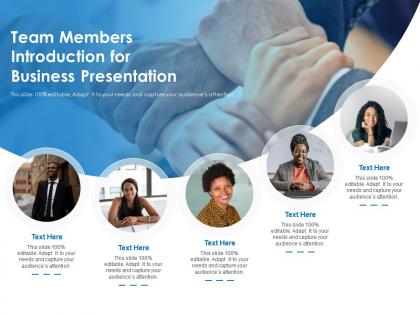
Team members introduction for business presentation infographic template




Try Before you Buy Download Free Sample Product
 Impress Your
 Audience
 100%
100% Editable
 Save Hours
 of Time


This Team Members Introduction For Business Presentation Infographic Template is a professionally drafted slide that can be deployed by managers, executives, owners, consultants, and other individuals to make their presentation more visually appealing. This layout helps the viewers gain quality information in less amount of time, thus conveying your message in the best possible manner. It reinforces the topics presented and makes their explanation more simplified, which is why this infographic template will suit any professional domain. Its vivid colors, graphics, design, etc., not only increases the aesthetics of the slideshows but also initiates immediate action. One of the advantages of downloading this PowerPoint design is that it can be reproduced as PNGs, JPGs, and PDFs that can be stored for further application. Hence, without indulging in a vigorous brainstorming session, download this layout now.
People who downloaded this PowerPoint presentation also viewed the following :
Team members introduction for business presentation infographic template with all 2 slides:
Use our Team Members Introduction For Business Presentation Infographic Template to effectively help you save your valuable time. They are readymade to fit into any presentation structure.
FAQs for Team members introduction for business
Start with the obvious stuff - team name, what you're trying to accomplish, main goals. Then list everyone's name and role, plus one skill that actually matters for what you're doing. Honestly, people always want to see the reporting structure even when it's super clear who's in charge. Don't write novels about each person though. Cover your team's responsibilities and current projects. Make sure to explain how other teams can work with you or ask for help. Oh, and definitely include contact info at the end so people know who to reach out to.
Honestly, templates are a game changer for team intros. Nobody zones out like they do with those painful roundtable things. You can fit all the important stuff - roles, skills, random fun facts - in a format that's actually readable. Introverts love it too since they're not getting ambushed with awkward spotlight moments. Everyone gets the same amount of space, which feels way more fair. Plus you'll have something to reference later when people forget who handles what (and trust me, they will). Start simple - photo, job title, three skills, and one weird personal fact. Works every time.
Honestly, the trick is getting people to share weird stuff about themselves instead of just their job title. Two truths and a lie works great, or ask about their strangest job ever - that one always gets people going. Don't do the boring circle thing either. Try speed networking or have everyone find someone with the same favorite pizza topping or whatever. Sounds cheesy but it actually works. My go-to opener is "tell us something that'd surprise us about you." People remember the guy who used to be a mime way better than they'll remember "John from accounting."
Have everyone do quick intros - name, role, plus their specific responsibility. Don't just say "Sarah handles marketing" though. Say "Sarah's running our social media strategy and tracking engagement." Way more useful. Give each person maybe 30-60 seconds to share what they're bringing and one solid accomplishment. I've sat through too many meetings where people just rattle off job titles and everyone's eyes glaze over. Then wrap up by connecting the dots - show how everyone's roles actually work together. Makes you look like a real team instead of random people who got stuck in a room together.
Ugh, the worst thing people do is those bland "this is Sarah, she's the project manager" intros that tell you literally nothing useful. Skip the title dumps and explain WHY each person matters for what you're trying to accomplish. Start with whoever's most relevant to the situation, not some random alphabetical order (seriously, who does that?). Give people the real context - like how they'll actually work with each team member day-to-day. Nobody needs someone's entire career history right now. Keep it under 2 minutes and let everyone jump in with their own additions.
So instead of the boring job title rundown, have everyone share a quick "origin story" - like how they stumbled into their field or some moment that changed how they work. Way better than listing years of experience! Oh, and you could frame your whole team's journey as one story too - showing how everyone's different backgrounds came together for whatever project you're tackling. Keep stories super short though, maybe 30-60 seconds max. Nobody wants a novel. Have your team prep one good story beforehand so they're not just making stuff up on the spot.
Honestly, just don't cram everything onto one messy slide like most people do. Big headshots work way better - you want faces people can actually see from across the room. Put names front and center with job titles below. White space is your friend here, seriously. Maybe throw in a quick fun fact for each person if you've got room. Oh and here's something I learned the hard way - check how it looks on mobile first since half the room will probably pull it up on their phones later anyway. Keep fonts readable and photo sizes consistent. Simple stuff but it makes a huge difference.
Okay so with virtual meetings, you can't just chat with people beforehand like normal. I always have everyone do quick intros - name, role, plus something about their background that's actually relevant. The personal touch really helps though - where they're calling from, random fun fact, whatever. Trust me, it's way better than just job titles. Keep it under 30 seconds per person or people zone out fast. Oh and definitely figure out who's going first, second, etc. beforehand. Those "um, who wants to go next?" pauses are brutal when you're staring at a screen full of faces.
So basically, when you mention what your team has accomplished, people instantly get that you're not just full of hot air - you've actually done stuff. It's like showing proof instead of just making promises. Your audience immediately sees what you're capable of and trusts you can handle their project. Honestly, your team members love hearing their wins called out too, gives them that little ego boost. Just don't go overboard though. Pick maybe 2-3 achievements that actually relate to what you're pitching, not every single thing you've ever done.
Honestly, just start by asking everyone how they like to work during those first team meetings. Skip the assumptions - ask stuff like "what's your communication style?" or "how do you prefer feedback?" Some people need time to warm up before they'll speak up, which is totally normal in lots of cultures. I've watched teams crash and burn because they skipped this step and then wondered why everything felt weird later. Oh, and don't treat it like some big formal thing - just weave it into your regular intros. Creates way better team dynamics when people actually know how to work together from the start.
Network diagrams are your best bet - use different line weights and colors to show how people actually work together. Org charts can work too, just make them show relationships instead of just who reports to who. Flow charts are solid for tracking how work moves around the team. Some people do the whole puzzle piece thing or gears, but honestly that feels kinda corny unless you nail the execution. I'd sketch out a few ideas first before getting fancy with design software. Focus on the connections that'll actually matter to whoever's looking at it. Keep it clean and don't overthink it.
Skip the boring job titles and show what makes each person actually interesting. Like "This is Sarah, our data wizard who somehow also breeds prize-winning goldfish" - you know, something that sticks. Keep it under 30 seconds per person or you'll lose everyone. Stories work way better than listing their resume. Honestly, people forget names instantly but they'll remember "the goldfish lady" when they need analytics help later. Mix in their work superpower with something personal. Makes them human instead of just another face in the meeting.
Honestly, humor just makes everyone feel more human instead of like they're reading corporate scripts. People actually remember the funny stuff - like when you mention Sarah accidentally stayed on mute for her whole presentation, or how Jake basically lives on espresso. We've all had those moments, you know? It creates this instant "oh god, same" connection. The trick is keeping it light and relatable though. Don't go edgy or make inside jokes that exclude people. Just throw in one genuinely amusing thing about each person's quirks or how they work.
Your team's feedback is honestly a game-changer for intro presentations. They'll catch when you're talking too fast or using confusing jargon that nobody gets. Plus they know everyone's personalities way better than you do, so they can suggest which accomplishments actually matter and help you nail the right tone. I always run mine by like 2-3 people first - they've saved me from describing someone's role completely wrong more than once. They also know what'll actually engage your specific audience. Just ask for specific thoughts on clarity and whether it flows well.
Okay so after the team intro, you'll want to keep things moving. Book one-on-ones in the first two weeks - way better for actual conversations than that surface-level stuff. Food is honestly your secret weapon here - coffee chats, lunch groups, whatever. Makes it way less weird. Set up some digital spaces too, like Slack channels where people can keep chatting about random interests. Oh and don't make it feel super structured or people will just check out. Give everyone different ways to connect since some folks hate small talk but love async messaging. The whole point is keeping it natural, you know?
-
nice
-
Graphics are very appealing to eyes.
-
Excellent products for quick understanding.