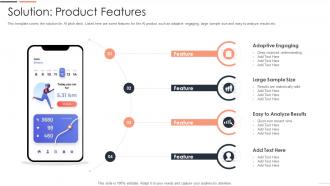
Technology pitch deck solution product features ppt background
Try Before you Buy Download Free Sample Product
Audience
Editable
of Time
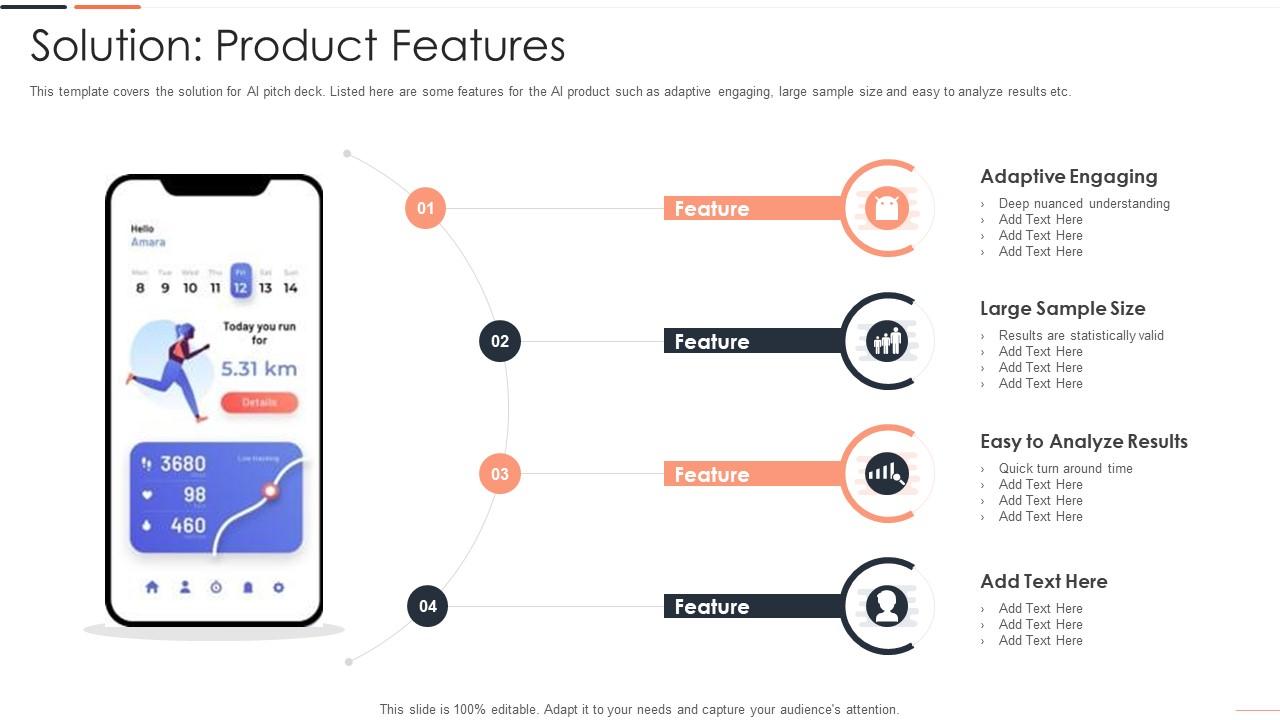
This template covers the solution for AI pitch deck. It also includes sample mockup for the product or app.
People who downloaded this PowerPoint presentation also viewed the following :
Technology pitch deck solution product features ppt background with all 6 slides:
Use our Technology Pitch Deck Solution Product Features Ppt Background to effectively help you save your valuable time. They are readymade to fit into any presentation structure.
FAQs for Technology pitch deck solution product
Okay so for your tech pitch deck, you'll want the usual suspects: problem/solution, market size, product demo, business model, traction, competitive landscape, team, and your funding ask. The demo slide is crucial - like, seriously don't phone it in because investors need to see this thing actually works. Tell a story that flows from "huge problem exists" to "we're the right team to fix it and make money doing so." Oh and keep it short! Most founders go way overboard. Stick to 10-12 slides max and practice your 10-minute version until you can do it in your sleep. Trust me on this one.
Look, nobody wants to sit through another boring feature demo. Tell them a story instead! Start with someone who's actually struggling with the problem your tech solves. Walk through their day, show the real frustration they're dealing with. Then boom - here's how your solution swoops in and fixes everything. Honestly, it's the difference between reading a manual and watching a good movie. Investors need to *feel* why this matters, not just understand your algorithms. Make them care about that customer's outcome first. Once they're emotionally hooked on the problem, they'll get way more excited about your tech as the answer.
Three things matter most: market size data (TAM/SAM stuff), customer validation like user growth and retention, plus where you stand against competitors. Real market research is gold - investors eat up actual customer interviews way more than made-up projections. Get your customer acquisition cost vs lifetime value ratio if you can. Honestly, tiny real numbers crush zero data every time. You're basically proving people genuinely want your thing, not just that some theoretical market exists. Oh, and start collecting this stuff during beta. Don't wait.
Dude, visuals are everything for tech pitches. People process images like 60,000 times faster than text, so those clean infographics and product screenshots actually keep investors awake instead of checking their phones. I've watched so many smart founders bomb because they just dump walls of code everywhere. Nobody wants that. Your engagement can jump by 650% when you ditch the text-heavy slides. Focus on visuals that actually explain what your tech does - not just random pretty stuff that looks nice but says nothing. Replace every boring bullet-point slide with something that tells your story faster. Trust me on this one.
Dude, the worst thing you can do is cram your slides with technical nonsense. Tell a story instead of dumping your whole product manual on them. Start with the actual problem - like, why should anyone care before you show them your fancy solution? I've seen so many pitches where people burn through 8 slides of features then barely mention how they'll make money. Makes no sense. Keep your demo tight and focused on what actually matters. Oh and definitely practice your timing - you might only get 5 minutes to nail the important stuff.
Build your pitch deck in layers, seriously. Start with the problem and solution in super simple terms - like, your mom should get it. I do this thing where I use analogies first ("it's basically like Uber but for..."), then get into the real technical stuff later. Short sentences work. Your main slides need to be grandmother-friendly, but throw all the technical specs into appendix slides for when the CTOs start grilling you. Test it on someone who's not in tech - if they look confused, you're not there yet. The engineers will appreciate having those backup slides ready though.
Look, investors want to see you actually get your market - not living in some dream world. You've got to show them who else is tackling similar problems and why your approach stands out. Here's the thing that drives me crazy: startups that claim they have zero competition. Major red flag that screams "we didn't do basic research." Yeah, acknowledge the big players, but then nail down what makes you different and better. The whole point? Prove there's actual space for you to grab market share. Stay honest about the competition but confident about your plan to beat them.
So for your business model slide - investors basically just want to see how you make money. Break down your revenue streams and pricing, but don't go overboard with crazy diagrams (I swear some founders make these way too complicated). Start with your main way of making money, then briefly touch on other streams. Include your key numbers - CAC and LTV for B2C, average contract value for B2B stuff. Just make sure you can actually back up whatever numbers you put on there because they'll definitely grill you on it during questions. Oh, and if you've got unit economics figured out, throw those in too.
Always wrap up by circling back to the problem you're solving - remind them why they need this NOW. Be super specific with next steps too, like "Can we grab 30 minutes Thursday?" instead of that wishy-washy "let's connect soon" stuff. If you can squeeze in a quick demo or visual moment, do it. People remember what they see way better. Oh, and beat them to any obvious objections before they even ask - shows you've thought this through. End with your exact funding ask and timeline. Honestly, the easier you make it for them to say yes, the more likely they will.
Definitely include a risks slide - investors actually want to see this stuff. Technical challenges, competition, regulatory issues, scaling problems. I know it feels counterintuitive but skipping it makes you look naive honestly. Cybersecurity risks, hiring troubles, funding gaps - whatever applies to your situation. The trick is matching each risk with your actual plan to deal with it. Don't just dump a list of scary things and walk away. Show them you've got solutions mapped out, maybe even backup plans. It builds way more trust than pretending everything's perfect.
Look, market research is what separates you from every other founder throwing around wild guesses. Investors want to see you actually know your stuff - market size, what's bugging your customers, who you're up against. Real data turns your pitch from "trust me bro" energy into something legit. Honestly, I've seen so many pitches crash because someone pulled numbers out of thin air. Don't be that person. Use credible sources that actually back up your claims about demand and opportunity. It's the difference between looking like you know what you're doing versus... well, not.
Honestly, less is more with these decks. Stick to 2-3 fonts max and give your content room to breathe with white space. Dark backgrounds look way more polished for tech stuff, just make sure the contrast doesn't suck. One key point per slide - I know it's tempting to jam everything in, but don't. Body text should be at least 24pt because projectors are the worst. Guide the eye top to bottom, left to right. Oh, and test it on different screens first! I learned that one the hard way when my slides looked like garbage on the actual projector.
Dude, this is huge - I'd say it's the
-
It saves your time and decrease your efforts in half.
-
Easy to edit slides with easy to understand instructions.