


Series A Round Funding Pitch Deck Product Roadmap





Try Before you Buy Download Free Sample Product
 Impress Your
 Audience
 100%
100% Editable
 Save Hours
 of Time


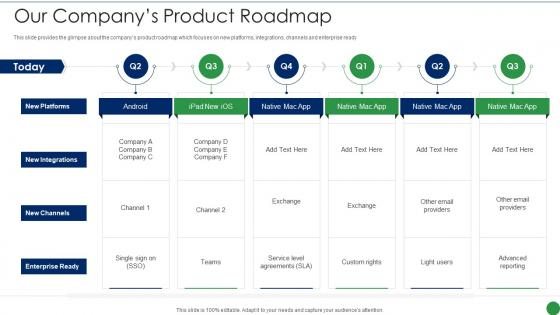
This slide provides the glimpse about the companys product roadmap which focuses on new platforms, integrations, channels and enterprise ready
People who downloaded this PowerPoint presentation also viewed the following :
Series A Round Funding Pitch Deck Product Roadmap with all 6 slides:
Use our Series A Round Funding Pitch Deck Product Roadmap to effectively help you save your valuable time. They are readymade to fit into any presentation structure.





FAQs for Series A Round Funding Pitch
OK so for Series A you basically need to nail the problem/solution thing, show your market size, and prove you've got real traction - like actual product-market fit numbers. Business model has to be crystal clear with how you make money. Don't skip the competitive stuff or team bios either. Financial projections are obvious but still necessary. The funding ask is huge - be super specific about what you'll do with the cash. Vague plans are death. Honestly, traction is everything at this stage since you're proving you can scale what's working. Keep it tight, maybe 12-15 slides tops, and practice till you're not just reading off slides.
Honestly, most founders mess this up by diving straight into features. Don't do that. Start with your personal story - what problem pissed you off so much you actually left your job to solve it? Then prove other people have the same pain with real customer stories and numbers. Show the market opportunity, but keep connecting it back to your mission. Oh, and make sure each section flows into the next one - you don't want investors zoning out halfway through. The whole thing should feel like you're building a case for why you're the team that'll actually pull this off.
Look, investors mostly just want to see one thing - are you actually growing? Show them your month-over-month revenue if you've got it. Customer acquisition costs vs what each customer's worth to you long-term. How many people stick around after signing up. Pick maybe 5-7 metrics max that tell the story - don't overwhelm them with everything you track (trust me, less is more here). Your retention rates matter way more than vanity metrics. Make sure whatever you show has been trending up for at least a year. Oh, and definitely include your market size and how you're grabbing share from competitors.
Dude, market size is make-or-break for Series A. Investors will tear apart your TAM/SAM/SOM slide first thing. You need billions in addressable market, not millions - sounds nuts but that's what they want to see. I've watched solid startups get rejected because their market seemed too small. Your numbers better be rock solid with real sources backing them up, none of that wishful thinking stuff. Show how you'll actually grab market share too. Honestly, spend extra time getting this right because everything else falls apart if the market looks tiny.
Dude, the team slide is HUGE for Series A. Investors aren't just betting on your idea anymore - they want proof you can actually scale this thing. Gone are the seed days where hustle and dreams cut it (though don't ditch those either). Now they're looking for real wins, industry experience, leadership skills. Show specific achievements for each key person and explain why they're perfect for their role. Missing a CMO or technical co-founder? Own it and lay out your hiring roadmap. Honestly, I've seen decent startups tank just because the team didn't look ready for prime time.
Dude, your deck's visual design actually matters way more than you'd think. Investors are drowning in pitches, so yours has to grab attention fast. I've literally watched incredible startups bomb because their slides looked like PowerPoint from the early 2000s - it's brutal. Clean layouts and consistent fonts help tell your story without burying the important numbers. Don't clutter everything up. Use charts that actually make sense, not ones that confuse people even more. Honestly? Just hire a designer if you can swing it, or at least grab a decent template that makes your content shine.
Dude, the biggest thing is being super vague about traction - like showing user signups instead of actual revenue. Unit economics matter way more than you think. Don't oversell your market size either, investors see right through that. They want to know HOW you'll capture it. Honestly, I cringe when founders burn half their deck explaining problems we all know exist. Show your solution and why people are actually paying for it. Real momentum beats fancy projections every time. Also prove you can make money - sounds obvious but you'd be surprised how many miss this.
Look, definitely don't pretend competition doesn't exist - you'll just seem clueless. But flip it around and own the conversation instead. Make a slide showing the competitive landscape so they know you get the market. Then hammer home what makes you different and why you're gonna crush it. Your unique value, any moats you can build, early traction that proves people actually want this thing. I mean, investors see dozens of pitches claiming they have "no competition" and it's honestly just lazy. Show them you've done your homework but also why you're the one they should bet on with your go-to-market plan.
Definitely include how much you're raising and break down exactly where that money's going. Investors want to see specific milestones you'll hit - like "$2M ARR by Q4" instead of just "grow revenue." Show what you've already done with past funding too, because that proves you actually execute on your plans. The momentum piece is huge honestly. Oh, and map out roughly when you'll need your next round and what traction you'll have by then. Product launches, team hires, market expansion - whatever's relevant. Just keep everything measurable so they can track your progress.
Pick 3-4 metrics that actually matter for your business and show consistent growth over time. Revenue, user growth, retention - whatever makes sense for what you're building. Month-over-month trends work great. Honestly, investors have seen every vanity metric trick in the book, so don't bother with the fluff. Throw in some bigger wins too like major customers you've landed or key partnerships. The whole point is proving you've got something that works and can grow bigger with their money. Oh, and product milestones help show you're actually shipping stuff that people want.
Shoot for 3-5 year revenue projections hitting $10-100M ARR by year 3-5 - that's what gets VCs excited. Don't just slap a hockey stick chart together though. Break it down by customer segments or product lines so they see you actually thought this through. Unit economics are crucial - show your CAC, LTV, gross margins, the whole deal. Path to profitability matters even if it's years away. Monthly cohort data is honestly like catnip to investors if you've got it. The trick? Be ambitious but not delusional. Back everything up with bottom-up market assumptions they can actually follow and believe.
Don't hide the scary stuff - investors will spot it anyway. Make a "Challenges & Mitigation" slide that calls out the real risks upfront. Competition, timing issues, scaling problems, whatever's actually worrying you. Then show your specific game plan for handling each one with real data backing it up. Trust me, they'll respect you way more for being upfront about it. I've seen too many founders try to dodge these questions in the Q&A and it always backfires. Being honest about obstacles shows you're thinking strategically, not just riding some fantasy growth wave.
Keep it to 10-15 slides, maybe 15-20 minutes max. Leave room for Q&A - that's honestly where the magic happens anyway. I've watched so many founders bomb with 25+ slide decks. Nobody's paying attention after slide 12, trust me. Stick to the basics: problem, solution, market size, your traction, team, money stuff. Oh, and definitely prep an appendix with extra slides but don't actually present them unless someone asks. Practice the timing beforehand so you're not rushing through or awkwardly stalling. The whole thing should feel conversational, not like you're reading a script.
Honestly, you'll want to tweak your deck for each type. VCs are all about scalability and market size - they want those big numbers. Angels? They're betting on YOU, so lean into the team story and vision stuff. Strategic investors care how you fit into what they're already doing. Corporate VCs want to see partnership potential and how you solve their headaches. Family offices are more conservative - show them proven revenue and clear exit paths. Research each firm beforehand and swap out maybe 2-3 slides that speak to their thing while keeping your main story the same. It's actually not as hard as it sounds once you get the hang of it.
Think of your product vision as the big "why" behind your Series A ask. Investors don't just want to see what you've built - they want to know where you're going and how huge this could get. Paint that picture of the massive opportunity ahead and your roadmap to capture it. Sure, features matter, but the real magic is showing you get the deeper problem you're solving. Honestly, I've seen too many founders play it safe here. Dream big enough to justify their investment, but keep it realistic. They need to believe you can actually pull this off.
-
The content is very helpful from business point of view.
-
I discovered this website through a google search, the services matched my needs perfectly and the pricing was very reasonable. I was thrilled with the product and the customer service. I will definitely use their slides again for my presentations and recommend them to other colleagues.