


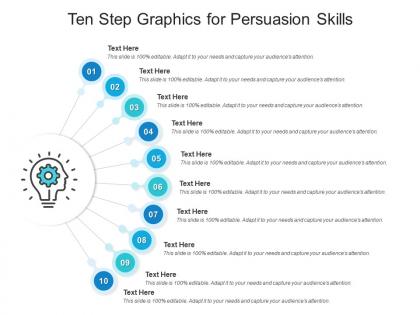
Ten step graphics for persuasion skills infographic template




Try Before you Buy Download Free Sample Product
 Impress Your
 Audience
 100%
100% Editable
 Save Hours
 of Time


Our Ten Step Graphics For Persuasion Skills Infographic Template are topically designed to provide an attractive backdrop to any subject. Use them to look like a presentation pro.
People who downloaded this PowerPoint presentation also viewed the following :
Ten step graphics for persuasion skills infographic template with all 2 slides:
Use our Ten Step Graphics For Persuasion Skills Infographic Template to effectively help you save your valuable time. They are readymade to fit into any presentation structure.
FAQs for Ten step graphics for persuasion
Effective persuasion relies on psychological principles including reciprocity, social proof, authority, commitment and consistency, liking, and scarcity, which tap into fundamental human decision-making patterns. These principles enhance communication strategies by building trust, creating urgency, and leveraging social dynamics, with organizations across sales, marketing, and leadership finding that strategic application delivers improved engagement, stronger relationships, and ultimately greater influence in business interactions.
Visuals enhance persuasive power by simplifying complex information, creating emotional connections, and making data memorable through charts, infographics, and compelling imagery. These elements help audiences process information faster, retain key messages longer, and feel more engaged, with many presenters finding that strategic visual storytelling significantly increases audience buy-in and decision-making speed.
Storytelling enhances persuasion by creating emotional connections, simplifying complex concepts, and making messages memorable through relatable narratives. Through compelling stories, organizations can illustrate product benefits, demonstrate problem-solving capabilities, and build trust with stakeholders, with many companies finding that narrative-driven presentations significantly increase audience engagement and decision-making outcomes.
Understanding your audience's needs fundamentally transforms persuasive strategy by enabling targeted messaging, relevant value propositions, and emotional connections that resonate with specific concerns and motivations. When organizations align their persuasive approaches with audience insights, they deliver more compelling presentations, negotiate more effectively, and build stronger stakeholder relationships, ultimately achieving higher conversion rates and strategic buy-in across diverse business contexts.
Common pitfalls include overwhelming audiences with data, failing to address counterarguments, lacking clear calls-to-action, ignoring audience perspectives, and relying solely on logic without emotional connection. These mistakes undermine credibility and engagement, with many presenters finding that balancing evidence with storytelling, anticipating objections, and structuring content around audience benefits ultimately delivers more compelling and successful outcomes.
Presentation structure significantly influences persuasive effectiveness by creating logical flow, building credibility through organized arguments, and guiding audiences toward desired conclusions. Strategic sequencing enables presenters to establish context, address objections systematically, and reinforce key messages, with many organizations finding that well-structured presentations increase stakeholder buy-in and accelerate decision-making processes.
Evidence types that strengthen persuasive arguments include statistical data, expert testimonials, case studies, research findings, and real-world examples from specific industries. These elements work together by building credibility through numbers, establishing authority through expertise, and demonstrating practical success, with many organizations finding that combining multiple evidence types creates more compelling presentations and ultimately delivers stronger stakeholder buy-in.
Effective presentations balance emotional appeal with logical reasoning by opening with compelling stories or visuals that connect personally, then supporting these emotions with concrete data, research findings, and structured arguments. This strategic combination enables presenters to engage audiences intellectually and emotionally, with many finding that alternating between personal anecdotes and factual evidence ultimately delivers more persuasive outcomes and lasting impact.
Persuasive writing and speaking differ primarily in delivery method, audience interaction, timing, and sensory engagement. Writing allows careful revision and permanent reference, while speaking enables real-time audience feedback, vocal emphasis, and immediate adaptation. Both mediums ultimately deliver compelling arguments through different channels, with many organizations finding that combining written proposals with live presentations maximizes persuasive impact and stakeholder engagement.
Body language significantly influences persuasive effectiveness by conveying confidence, credibility, and sincerity through posture, eye contact, gestures, and facial expressions. While strong, open body language enhances message reception and builds trust, inconsistent nonverbal cues can undermine even compelling arguments, with many business leaders finding that aligned verbal and physical communication delivers substantially more persuasive impact.
Effective objection-handling strategies include acknowledging concerns respectfully, reframing objections as opportunities for clarification, providing evidence-based responses, using the "feel-felt-found" technique, and asking clarifying questions to understand underlying issues. These approaches help presenters maintain credibility while addressing stakeholder concerns, with many sales teams and executives finding that proactive objection handling ultimately strengthens audience trust and increases successful outcomes.
Credibility is fundamental to persuasive authority, as audiences must trust the messenger before accepting the message through demonstrated expertise, consistent track record, and transparent communication. In sectors like healthcare, finance, and consulting, credibility enables professionals to influence critical decisions, streamline stakeholder buy-in, and ultimately deliver faster consensus-building and stronger business relationships.
Urgency creates psychological pressure that compels audiences to act immediately rather than postpone decisions, leveraging scarcity principles, time-sensitive benefits, and fear of missing opportunities. Through strategic deadline messaging, limited availability framing, and consequence highlighting, organizations enhance conversion rates, accelerate decision-making cycles, and minimize customer hesitation, ultimately delivering faster sales closure and increased engagement across marketing campaigns.
Effective repetition in persuasion involves varying the delivery method, context, and supporting evidence while maintaining the core message consistently. Strategic repetition through different channels, timeframes, and formats—such as visual reinforcement, testimonials, and data points—helps embed key concepts without redundancy, with many successful campaigns finding that spaced repetition across multiple touchpoints ultimately enhances message retention and drives stronger audience engagement.
Effective call-to-action techniques include urgency creation through limited-time offers, social proof integration, benefit-focused language, clear action verbs, and strategic placement within content flow. These approaches enhance conversion rates by addressing psychological triggers like scarcity and trust, with many businesses finding that combining multiple techniques, particularly in email campaigns and landing pages, significantly increases engagement and drives measurable results.
-
Top Quality presentations that are easily editable.
-
Innovative and attractive designs.
-
Innovative and attractive designs.
-
Very well designed and informative templates.