


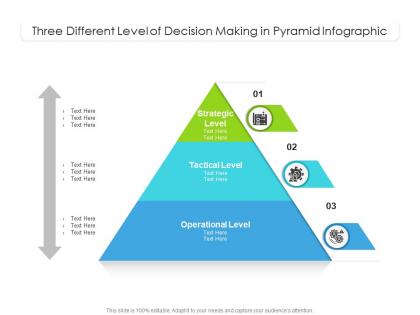
Three different level of decision making in pyramid infographic




Try Before you Buy Download Free Sample Product
 Impress Your
 Audience
 100%
100% Editable
 Save Hours
 of Time


Our Three Different Level Of Decision Making In Pyramid Infographic are topically designed to provide an attractive backdrop to any subject. Use them to look like a presentation pro.
People who downloaded this PowerPoint presentation also viewed the following :
Three different level of decision making in pyramid infographic with all 2 slides:
Use our Three Different Level Of Decision Making In Pyramid Infographic to effectively help you save your valuable time. They are readymade to fit into any presentation structure.
FAQs for Three different level of decision making
So there's three levels: strategic, tactical, and operational. Strategic is your big-picture stuff - mergers, entering new markets, major company direction changes. Tactical happens at the middle management level, figuring out how to actually execute those big strategies over a few months. Then operational is just daily firefighting - scheduling, resources, keeping the wheels turning. I swear we all get stuck in operational mode way too much instead of thinking strategically! But yeah, knowing which level you're dealing with helps you figure out who needs to be involved and how to frame the problem. Makes decision-making way less chaotic.
So strategic decisions are your big 3-5 year moves - market positioning, major investments, that kind of stuff. Tactical ones bridge the gap, turning strategy into actual plans over months or maybe a year. Then there's operational decisions, which honestly is just your daily grind keeping everything from falling apart. They all connect though. Strategy sets where you're headed, tactical figures out how to get there, and operations... well, that's where the rubber meets the road. The tricky part? Making sure you're not just firefighting every day but actually working toward those bigger goals you set.
Look, data analytics is basically your company's crystal ball for making smart choices. Daily operations? You'll get real-time insights to fix problems fast. Medium-term stuff runs on spotting trends and figuring out where to put your resources over the next few months. Long-term strategic moves - like expanding markets or quarterly planning - that's where forecasting really pays off. Without decent data, you're honestly just winging it (guilty as charged). My advice? Figure out what decisions you make most often and start building around those. Don't overcomplicate things right off the bat.
So basically you've gotta match how you communicate to what kind of decision it is. Big strategic stuff? That needs formal emails or all-hands meetings where you explain the reasoning. Team meetings work great for tactical decisions - you can actually discuss how to make things happen. Here's where most people screw up though - they way overcommunicate the small operational decisions. Like, just use Slack or quick standups for daily stuff. Don't make it complicated. The trick is staying consistent with your channels so people know where to look for different info.
Honestly, strategic stuff is the worst because you're basically guessing about the future. You'll be juggling way too many priorities at the tactical level - feels like constant firefighting, which is exhausting. Operations should be easy but then you get buried under info and deadlines. Here's the thing though - you never have all the facts but can't just freeze up. I'd say figure out your decision rules ahead of time for each type. And seriously, don't overthink the small operational stuff. Good enough beats perfect when you're drowning in decisions.
Dude, your company culture is like invisible rules that shape every choice people make. Innovation-focused places? People take way more risks and push limits. But conservative spots will have everyone moving super slow with endless approvals - honestly it can be frustrating to watch. Who gets to decide what also depends on those values. Some companies let everyone make calls, others hoard all the power at the top. Here's the thing though - watch how decisions actually happen, not what's written in some policy doc. That's where you'll see what leadership really cares about.
Honestly, decision-making gets way easier when you have some go-to methods. The 5 Whys thing is solid for getting to the real problem - just keep asking "why" until you hit the actual root cause. Decision matrices help too when you're weighing multiple options against your must-haves. My personal favorite though? The 10-10-10 rule. How will you feel about this choice in 10 minutes, 10 months, and 10 years? Really puts things in perspective. Oh, and don't forget to bounce ideas off other people first - different viewpoints are clutch. Set deadlines for yourself so you don't overthink it forever. Write down what you decided and how it turned out later. Trust me, you'll start spotting patterns in what works.
Dude, groupthink totally screws up strategic decisions. Everyone just goes along with whoever speaks loudest instead of actually thinking things through. Smart people suddenly make dumb choices together - it's honestly bizarre to watch. The real problem? These are huge decisions that shape your whole company's future. You need people pushing back, not nodding along. Build in some devil's advocates. Actually reward disagreement instead of punishing it. Oh, and make sure people feel safe speaking up when something seems off. Conflict in the room beats disasters later.
Honestly? It's all about speed vs staying on the same page. When teams make their own calls, they move way faster and can actually respond to what's happening around them - no waiting for the boss to weigh in. But then you get departments doing completely different things, which gets weird fast. I watched one company where marketing and sales were basically working against each other because of this. Centralized decisions keep everyone aligned, but man does it slow everything down. My take? Do both - keep the big picture stuff centralized but let people handle day-to-day decisions themselves.
Look, the biggest thing is how much faster you can analyze stuff when tech does the heavy lifting. Decision support systems will spot patterns in huge datasets that you'd never catch on your own - honestly saved my ass a few times. What-if scenarios that used to take hours? Done in seconds now. Your brain has biases (we all do), but these tools give you objective insights from different angles. Just don't go crazy trying to automate everything right away. Pick one system that actually works with how your team operates and expand from there.
Look, getting stakeholder buy-in early is absolutely critical - and I mean *really* early, not just checking a box later. You'll catch problems before they blow up your budget. People actually support stuff they helped create instead of fighting changes forced on them. I've watched so many good strategies crash and burn because leadership thought they could just announce decisions from the top down. Honestly, it's painful to watch sometimes. Find your key people first, then give them real input that matters. Makes all the difference in whether things actually happen or just sit in a drawer somewhere.
Market trends are basically like weather for your business - you can't ignore them. COVID proved this when retailers had to completely flip their strategies overnight. Your five-year plan? It'll need constant adjustments when consumer preferences shift or new tech pops up. I mean, who saw TikTok commerce coming five years ago? Build flexibility into how you make decisions so you can actually pivot when needed. Stay tuned into industry signals and have backup plans ready. Your strategy can't be carved in stone.
Honestly, it depends on what kind of decision you're measuring. Day-to-day stuff? Focus on the obvious metrics - did costs go down, are things faster, fewer mistakes happening. Big strategic moves need different tracking though. ROI, market share, customer happiness scores - that kind of thing takes months to really show up. Here's what people miss: the human side actually tells you a lot. If your team's miserable or stakeholders are complaining, your "successful" decision might not be so successful. Oh, and set up your measurements beforehand! Trust me on this one. Way easier than trying to figure out later if you screwed up.
So basically you create 3-4 different futures that could realistically happen - best case, worst case, whatever's in between. Then test how your strategy works in each one. It's like being strategically paranoid, which sounds weird but actually works. The whole point is catching blind spots before they bite you. Plus you'll have backup plans ready instead of scrambling later. I learned this the hard way on a project last year, honestly. Short sentences help too - they force you to think differently. Try it with your next big decision and watch what holes show up.
Honestly, start by writing down everyone who'll be affected - you'd be surprised how many people you miss at first. Don't just think about the obvious ones either, consider whoever's downstream from your choice. Ask yourself if you'd be cool with this decision being totally public. We've all seen those choices that work on paper but just feel sketchy, you know? Make sure you're not letting your own biases mess with your judgment. Are you being real about the trade-offs? Sometimes we get caught up in quick wins and forget about what happens six months later. Also, do you actually have enough info to decide, or are you just winging it?
-
Really like the color and design of the presentation.
-
Unique design & color.
-
Professional and unique presentations.
-
Enough space for editing and adding your own content.