


Timeline for event management powerpoint layout





Try Before you Buy Download Free Sample Product
 Impress Your
 Audience
 100%
100% Editable
 Save Hours
 of Time


In case you are running an Event Management company and are looking for a Timeline For Event Management PowerPoint Layout, then this professionally designed PPT template fits the bill. The accomplishments of your organization can be charted in the perfect chronological order through this slide. The image is colorful but at the same time maintains a professional look. You can display details regarding the progress of your company impressively to your prospective clients. This will not only ease your task of presenting the facts but will also have a lasting impression on the mind of your audience. The slide has a well designed image which caters to the timeline requirements of various types of presentations. So, download the slide, add the relevant details and make your mark. Improve conditions in the community through our Timeline For Event Management Powerpoint Layout. Encourage contributions for a common cause.
People who downloaded this PowerPoint presentation also viewed the following :
Content of this Powerpoint Presentation
Description:
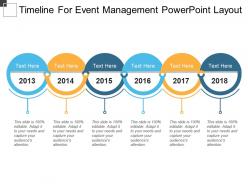
The image depicts a PowerPoint slide titled "Timeline For Event Management PowerPoint Layout". It features a horizontal timeline spanning from the year 2013 to 2018, with each year marked by a large, colored circle connected by a line. Under each year is a "Text Here" placeholder, suggesting that detailed information or events related to that particular year can be inserted. The design of the slide implies a sequence of events or milestones over a six-year period, typically used for showcasing the progression, planning, or key achievements within event management.
Use Cases:
This timeline slide is versatile and can be used across various industries for chronological presentations.
1. Event Planning:
Use: Showcasing past events and planning future ones.
Presenter: Event Coordinator
Audience: Clients, Event Team
2. Marketing:
Use: Outlining marketing campaign milestones over the years.
Presenter: Marketing Manager
Audience: Marketing team, stakeholders
3. Corporate Strategy:
Use: Presenting strategic corporate initiatives and their rollout.
Presenter: Strategy Executive
Audience: Board members, company employees
4. Project Management:
Use: Illustrating project phases and completion dates.
Presenter: Project Manager
Audience: Project team, investors
5. Non-Profit Organizations:
Use: Reporting on annual events, fundraisers, and program milestones.
Presenter: Program Director
Audience: Donors, volunteers
6. Education:
Use: Displaying school or university events and academic timelines.
Presenter: Administrator
Audience: Students, faculty, parents
7. Construction:
Use: Tracking the progress of construction projects over time.
Presenter: Construction Manager
Audience: Clients, contractors
Timeline for event management powerpoint layout with all 5 slides:
Give them the chance to feel happier with our Timeline For Event Management Powerpoint Layout. Introduce joy into their existence.

FAQs for Timeline for event
Key event management milestones include initial planning and goal setting, venue selection and booking, vendor coordination and contracts, marketing launch and registration opening, and final logistics confirmation. These phases typically span 3-6 months depending on event scale, with many corporate organizers finding that structured milestone tracking streamlines coordination, minimizes last-minute issues, and ultimately delivers smoother execution and enhanced attendee experiences.
Creating a detailed timeline improves communication by establishing clear deadlines, defining individual responsibilities, coordinating task dependencies, and providing shared visibility into project progress. Through centralized scheduling platforms, event teams streamline coordination between vendors, venues, and staff members, while reducing miscommunication and ensuring seamless execution, ultimately delivering more organized events and enhanced team accountability.
Common pitfalls include underestimating setup time, failing to build buffer periods for delays, overlooking vendor coordination requirements, and neglecting permit acquisition lead times. These oversights often cascade into rushed execution, vendor conflicts, and budget overruns, with many event planners finding that detailed contingency planning and realistic timeframe allocation ultimately deliver smoother operations and enhanced attendee experiences.
Corporate events typically require 2-3 months of planning with focus on logistics and vendor coordination, while weddings demand 6-12 months for venue booking, catering, and personal details. Festivals necessitate 12-18 months for permits, entertainment booking, and infrastructure planning, with each timeline reflecting the event's complexity, stakeholder requirements, and regulatory considerations that ultimately determine successful execution.
Budget allocation fundamentally shapes event timelines by determining procurement schedules, vendor selection periods, and resource acquisition phases. Higher budgets enable parallel planning processes and premium vendor bookings, while constrained budgets require sequential planning and longer lead times, with many event planners finding that early budget finalization accelerates overall timeline execution by 30-40%.
Event management software streamlines timeline creation by automating task scheduling, enabling real-time collaboration among team members, and providing centralized resource tracking with integrated deadline management. These platforms enhance operational efficiency through drag-and-drop timeline builders, automated vendor communications, and instant updates across all stakeholders, ultimately delivering faster event planning and reduced coordination errors.
Pre-event timelines ensure seamless coordination through task scheduling, vendor management, resource allocation, and milestone tracking, while post-event timelines focus on evaluation, feedback collection, vendor payments, and relationship maintenance. These complementary frameworks enable event organizers to deliver flawless experiences and capture valuable insights, with many organizations finding that structured timelines ultimately enhance operational efficiency and client satisfaction.
External factors significantly influence event timelines by requiring flexible scheduling, extended lead times, and strategic contingency planning throughout the planning process. Popular venues often book months in advance, while specialized vendors may have limited availability during peak seasons, with many event planners finding that building buffer time and maintaining backup options ultimately delivers smoother execution and reduced last-minute complications.
Best practices for setting event management deadlines include working backward from the event date, building in buffer time for unexpected delays, prioritizing critical path activities, establishing clear milestone checkpoints, and aligning deadlines with vendor availability and team capacity. These approaches streamline coordination by ensuring adequate time for venue booking, vendor negotiations, and marketing campaigns, with many event planners finding that realistic timeline planning ultimately delivers smoother execution and reduced last-minute stress.
Feedback from previous events shapes future timelines by identifying bottlenecks, optimizing resource allocation, and refining task sequences based on actual performance data. Event managers use post-event insights to adjust setup durations, vendor coordination windows, and contingency buffers, with many organizations finding that data-driven timeline refinements reduce costs and enhance attendee experiences significantly.
Virtual and hybrid events require adjusted timelines for technical rehearsals, platform testing, speaker training sessions, and extended pre-event communication phases. These events typically need additional weeks for technology integration, backup system preparations, and audience engagement planning, with many organizations finding that starting planning 2-3 months earlier than traditional events ensures seamless execution and enhanced attendee experiences.
Event timelines should incorporate transportation by scheduling arrivals 24-48 hours early for key stakeholders, coordinating group transfers, and building buffer time for delays, while accommodation planning requires booking confirmations 60-90 days ahead and room blocking strategies. Many corporate event planners find that integrating logistics early prevents last-minute disruptions, ensures seamless attendee experiences, and ultimately delivers more professional, well-coordinated events.
Effective event timeline management tools include project management platforms like Asana and Trello, specialized event software such as Eventbrite and Cvent, and collaborative resources like Google Workspace and Microsoft Teams. These technologies streamline planning by centralizing task coordination, automating deadline reminders, and enabling real-time collaboration, with many event organizers finding that integrated platforms ultimately deliver faster execution and seamless stakeholder communication.
Contingency planning integrates into event timelines through buffer periods, alternative vendor arrangements, backup venue options, and predetermined decision points at critical milestones. Event planners build flexibility by scheduling extra setup time, maintaining secondary supplier contacts, and establishing clear protocols for weather delays, technical failures, or last-minute changes, ultimately ensuring seamless execution despite unexpected challenges.
Successful event timelines include corporate product launches with 12-month lead times, wedding planning spanning 18 months, conference organization over 8-10 months, trade show participation with 6-month preparation, and festival coordination requiring 15-18 months. These structured approaches streamline vendor coordination, marketing execution, and logistics management, with many organizations finding that extended timelines enable better resource allocation, reduced costs, and enhanced attendee experiences, ultimately delivering competitive advantage and measurable ROI.
-
Appreciate the research and its presentable format.
-
Excellent design and quick turnaround.