


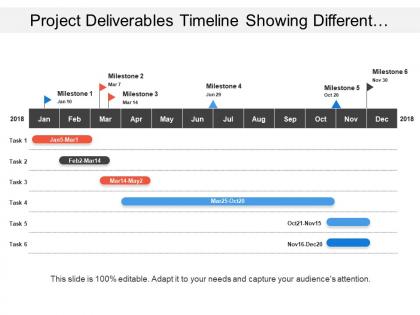
Project deliverables timeline showing different tasks with milestones




Try Before you Buy Download Free Sample Product
 Impress Your
 Audience
 100%
100% Editable
 Save Hours
 of Time


Introducing Project Deliverables Timeline Showing Different Tasks With Milestone slideshow. Determine the project dependencies, and the total time needed for each task with the help of this PPT layout. You can also mention the events and actions that take place in an organization with the help of this timeline management PPT visual. Five phases of the project which include initiation, planning, execution, performance/monitoring, and project close can be easily showcased by using the project scope PPT template. Highlight the steps for creating the timeline for a project. Discuss the planning, design, and construction required to execute and complete a project. Steps to deliver a successful project can be mentioned using this PowerPoint graphic. Discuss the project scope statement with the help of this content-ready PowerPoint theme. Project delivery methods can also be showcased with the help of our ready-to-use PPT slide design. Take the assistance of this ready-to-use PPT theme and discuss the key elements of the timeline such as tasks that are to be accomplished, date of the task, duration of tasks, dependencies between the tasks. Hence, build an accurate timeline by downloading this ready-to-use project planning PowerPoint presentation.
People who downloaded this PowerPoint presentation also viewed the following :
Project deliverables timeline showing different tasks with milestones with all 5 slides:
Infuse courage with our Project Deliverables Timeline Showing Different Tasks With Milestones. Convince folks to display greater daring.
FAQs for Project deliverables timeline showing different
Here's what you need: break your project into phases with specific tasks, then add start/end dates for each milestone. Don't forget task dependencies - like what has to finish before other stuff can even start. Assign resources so everyone knows their role. Oh, and definitely build in buffer time because things always take longer than you think (learned this the hard way). Add deliverables and review points so stakeholders aren't constantly bugging you for updates. One thing that's super helpful - color-code different teams or workstreams. Makes it way easier to read at a glance.
Honestly, it totally depends on what you're building. Construction projects are super linear - you can't put up walls before the foundation, right? Plus weather screws everything up, so always add buffer time for delays and permit headaches. Software's the opposite though. Way more chaotic, requirements change constantly, and you're basically guessing half the time. I'd do shorter sprints with lots of testing built in. The trick is figuring out how work actually flows in your industry. Look at what similar projects took before - that'll give you a realistic starting point instead of just winging it.
Honestly, Gantt charts are still your best bet - Microsoft Project, Asana, Monday.com. They're clutch for seeing how everything connects. Trello's solid too if you want something simpler with the whole card thing going on. I'm obsessed with Notion but fair warning, you can go down a rabbit hole customizing it (speaking from experience lol). Google Sheets works if you need something fast and everyone can jump in. Here's what I'd do though - just use whatever your team's already comfortable with first. You can always switch later when you hit those annoying limitations.
Honestly, Gantt charts are lifesavers for messy projects. They turn your chaotic timeline into something visual that actually makes sense. Instead of drowning in spreadsheet hell, you'll see task dependencies and bottlenecks right away. Plus when Sarah from marketing inevitably delays her part, you can show exactly how it affects everything downstream. Your stakeholders will get the whole project flow without squinting at confusing charts. I'd start with something basic like Monday or even Excel templates - no need to overcomplicate it at first.
Honestly, timelines are a lifesaver because they stop those "wait, who's doing what?" moments that derail everything. Your team can actually see dependencies mapped out, so nobody's sitting around waiting for feedback that never comes. I've watched projects crash and burn over this stuff - it's painful. The visual part helps you catch bottlenecks early too. Short sentences work. Longer ones give you room to explain why coordination gets so much smoother when everyone's looking at the same roadmap. Just share it in your next meeting and you'll see the difference immediately.
Ugh, timeline changes are the worst but here's what works for me. Drop everything and figure out what's actually broken - sometimes it's just one piece, not your whole project. Get on calls/send emails immediately because people hate finding out about delays from someone else. I always pad my new estimates a bit more than I think I need (learned that the hard way). Don't just dump the bad news though - come with solutions or at least next steps. Send one clear update with revised dates so nobody's confused. The faster you communicate, the less people freak out about it.
So milestones are basically checkpoints for your project - like pit stops but hopefully with less gas station coffee. They mark the big stuff: major deliverables, key decisions, or when you finish a whole phase of work. Breaking things down this way makes tracking progress way easier, plus you'll catch delays before they become disasters. Honestly, they're a lifesaver when you need to update stakeholders without boring them with every tiny detail. Just make sure your milestones actually mean something to the project's success, not random dates you picked because they looked nice on a calendar.
Gantt charts are your best bet here - they show everything at once, dependencies and all. But honestly? They can look pretty intimidating to people outside of project management. Maybe try roadmap views instead, or simple milestone charts that just hit the big stuff. Tools like Asana Timeline or Monday.com work well, though sometimes a clean PowerPoint does the trick too. Really depends on who you're presenting to. Executives want the 30,000-foot view with major milestones. Your actual team needs all the nitty-gritty details. Match the complexity to whoever's in the room.
Oh man, time estimates are where everyone screws up - we're all way too optimistic about how long stuff takes. Map out your dependencies first though, because finding out Task B needs Task A completely finished (not like 90% done) will absolutely wreck your timeline. Buffer time is your best friend for when random stuff goes sideways. Also factor in people's vacations and holidays - learned that one the hard way when half my team disappeared in December. Get everyone to actually look at the timeline before you lock it in. They'll spot the unrealistic parts you missed and won't complain as much later.
Yeah, totally doable! Break your timeline into sprints for Agile - just track release dates instead of getting crazy detailed with daily stuff. With Lean, focus on your value streams and when things actually ship. Gantt charts are kinda dinosaur-ish anyway, honestly. Map out your big deliverables first, then work in whatever cycles you're using underneath. The trick is staying flexible enough for changes while keeping stakeholders happy with their precious dates. They always want those concrete numbers, you know? Keep it loose but structured.
Update it weekly minimum, or daily if stuff's hitting the fan. Document WHY dates shifted - learned this when my PM grilled me about some delay and I looked like an idiot with zero context lol. Get input from people actually doing work, don't just wing it. Version control helps track changes over time. Here's the thing though - tell stakeholders about updates RIGHT when they happen. Don't sit on bad news until your next meeting. Oh and set a calendar reminder or you'll forget. Trust me on this one.
Dude, you HAVE to get your team involved in this stuff. They're doing the actual work, so their estimates will be way more realistic than whatever you cook up alone. Plus people actually care about hitting deadlines when they helped create them - nobody likes having timelines shoved down their throat from management. I made this mistake last year and wow, did that project blow up in my face. Your team knows all the weird little details and potential problems you'd never think of. Just get everyone in a room (or Zoom I guess) and actually listen when they tell you how long things take. Trust me on this one.
Look, Schedule Performance Index is clutch - anything under 1.0 means you're behind. Milestone completion percentage works great for updates since stakeholders get it immediately. Burn-down charts show remaining work over time, and honestly they're way easier to digest than spreadsheets full of numbers. Critical path delays will mess up your whole timeline, so definitely track those. Oh, and Earned Value compares what you planned vs what actually got done. Don't overcomplicate it though - pick maybe 2-3 metrics max and update weekly. Otherwise you'll spend more time tracking than actually working.
Okay so first thing - make a list of everything that could screw up your timeline. Stakeholder delays, tech problems, people being unavailable, whatever. Then rate each one on how likely it is and how badly it'd mess things up. Most people totally skip this part which is honestly why so many projects go off the rails. Add extra time to the phases where high-probability stuff could happen. For the less likely but really bad scenarios, block out some contingency time elsewhere in your schedule. I'd go with at least 15-20% buffer overall. Write down your reasoning too so when things change (and they will), you're not just winging it.
Templates are honestly a lifesaver - no more starting from scratch every single time. You'll get all the milestones and dependencies already mapped out, plus they include stuff like buffer time that I always used to forget about. My old stubborn self would rebuild everything from zero (such a time sink). The consistency thing is huge too since your whole team stays on the same page. Just grab a template that fits your project type, then tweak it however you need. Way better than reinventing the wheel.
-
Great quality slides in rapid time.
-
Informative presentations that are easily editable.