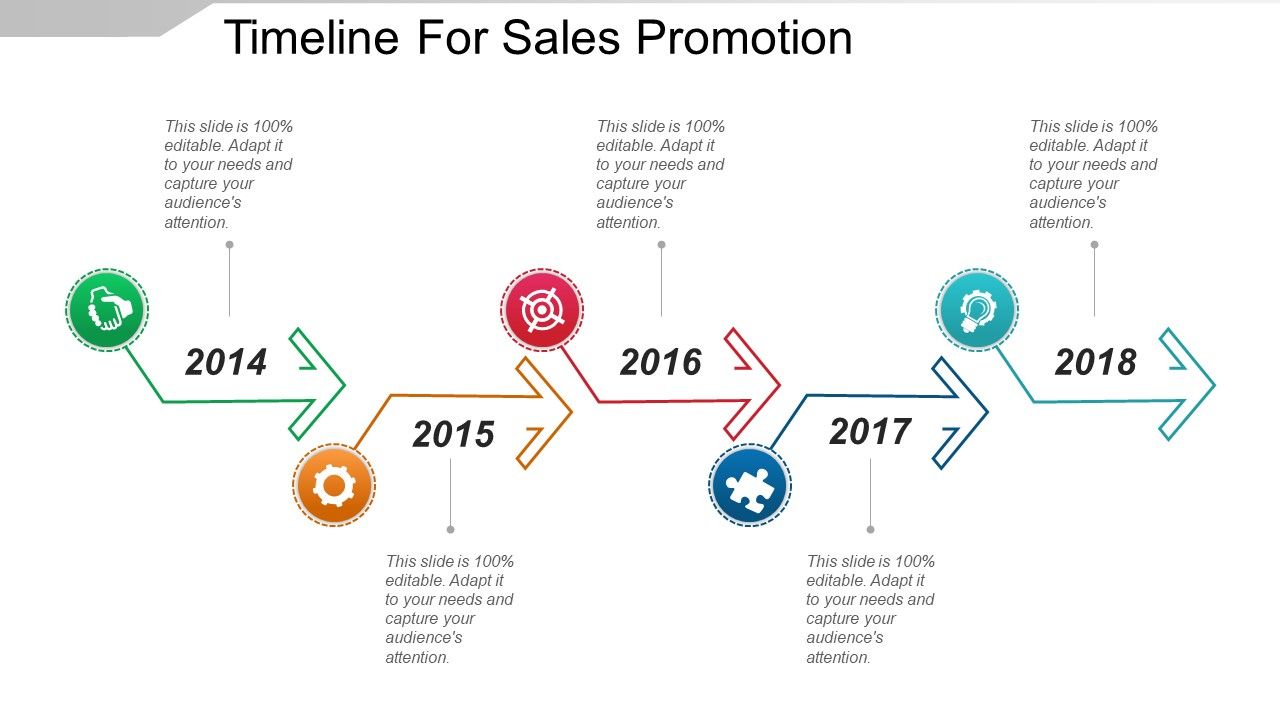
Timeline for sales promotion powerpoint presentation
Try Before you Buy Download Free Sample Product
Audience
Editable
of Time
Business growth mainly depends on its sales capability of target achievements and which is straightforwardly relies on the sales timeline therefore use our timeline for sales promotion PowerPoint Presentation. Thus to clarify the connection between business achievement and objectives accomplishment you should utilize our PowerPoint Slides. This sales promotion timeline PPT layout will help in attracting your potential business customers which will directly put impact on your business brand value too. You should utilize this PowerPoint format to clarify different components which contribute toward your sales accomplishment according to the distinctive timelines which are set by the business director to accomplish the set targets. Thus, you can describe the benefits arising to your enterprise though this interactive timeline PPT image design such as it increases the customer retention rate. Builds customer satisfaction and attracts new potential business customers and many more. This PPT format will similarly help you in imparting your idea skill in an extraordinarily noteworthy route with such timeline sales PPT outline. Thus start engaging your audiences with this PowerPoint Slide design. Go deep into the heart of every aspect with our Timeline For Sales Promotion Powerpoint Presentation. Be able to conduct intense discussions.
People who downloaded this PowerPoint presentation also viewed the following :
Timeline for sales promotion powerpoint presentation with all 5 slides:
Great Timeline For Sales Promotion Powerpoint Presentation are the right combination of quality graphics quality animations few words and limited transitions; we have them all and even more.
FAQs for Timeline for sales
Okay so for your sales promo timeline, start with pre-launch stuff - creative work, getting approvals, checking you actually have inventory (learned that one the hard way). Then nail down your actual promotion dates with a clear start and end. Buffer time is crucial because literally everything takes longer than you think it will. Map out when marketing goes live, staff training happens, any PR coordination. Oh and definitely build in contingency dates in case you need to extend things or pivot completely. The whole thing really comes down to being realistic about timing and setting checkpoints so you can adjust if stuff goes sideways.
So basically, a sales promotion timeline lets you map out all your campaigns so they don't crash into each other. You can see what competitors are doing and plan around their big moves. Plus you'll hit those key shopping periods without your own promos competing against each other. We totally screwed this up once - ran two back-to-back and customers were so confused lol. It helps with budgeting too since you can spread costs across quarters. Start with major holidays and product launches, then just work backwards from there. Honestly wish I'd done this sooner!
Honestly, I'd go with 6-8 weeks out for seasonal stuff to build up that excitement. Flash sales though? Keep those super short - like 24-72 hours max. Creates actual urgency instead of people rolling their eyes. Weekly or every other week hits the sweet spot for regular promos. Gives people time to think about it but doesn't feel overdone. Monthly just feels blah and predictable. Don't drag major sales past 2 weeks unless it's something huge like Black Friday madness. Your customers will get trained to just wait for the next discount if you're always running something. Test different lengths and see what actually converts best for your crowd.
Honestly, start tracking before you even launch the promo - super important. I'd focus on the basics: sales, conversion rates, new customers. Monitor daily during the campaign and maybe 2-3 weeks after. A simple spreadsheet works great (I'm obsessed with keeping everything in one spot). Compare against last year's numbers or whatever your normal baseline is. Here's the thing though - don't get tunnel vision on immediate sales. Track repeat buyers and lifetime value too. Oh, and schedule weekly check-ins to actually review the data, otherwise you'll forget.
I'd go with Asana or Trello first - they're solid for mapping out deadlines and stuff. Monday.com is decent too but kinda pricey. Excel works fine honestly, don't overthink it. If you're already doing marketing campaigns, HubSpot has timeline features built in which is pretty convenient. Google Sheets might be your best bet though since everyone can jump in and edit. I always end up going back to the simple tools anyway. Whatever your team's already using, just start there. The whole point is actually following the timeline you make, not spending hours picking the perfect app.
Quarterly reviews are the standard, but honestly? Monthly works way better these days. Things change too fast - competitors drop surprise campaigns, customer behavior shifts overnight, whatever. Do deep quarterly dives to see what actually worked versus what bombed. Then lighter monthly check-ins for quick tweaks. I always set calendar reminders because this stuff's super easy to forget when you're swamped. Oh, and watch your sales data between reviews too - don't wait for the formal review if something's clearly tanking.
Check your revenue lift and conversion rates first - those are the big ones. Redemption rates matter too since they show if people actually used your promo. I always look at average order value because sometimes a discount backfires and people just buy less overall. Customer lifetime value is huge though - some promotions bring in cheapskates who disappear after one purchase. Traffic spikes are obvious but worth tracking. Oh, and repeat purchase behavior tells you if you're building loyalty or just bleeding money. Honestly, just throw all this into a basic spreadsheet so you can compare different campaigns easily.
Your customers basically tell you exactly what promotions to focus on and when to run them. Like if everyone went crazy for Black Friday but totally ignored your Valentine's thing, you know where to put your energy next year, right? Response rates by day and time are super helpful too - way better than just following what everyone else does. Honestly, I've seen people waste so much money pushing sales when their audience isn't even thinking about buying yet. The timing stuff is probably the most valuable feedback you'll get. Just build your whole calendar around when they're actually engaged instead of generic "best practices."
Honestly, timelines are lifesavers for this stuff. Everyone knows their role and when things need to happen - marketing gets their assets done, sales knows when to start reaching out, support can prep for the chaos. No more of those "oh shit, I thought you were doing that" moments (we've all been there). Having everything mapped out means teams can actually plan ahead instead of scrambling. I learned this the hard way on a product launch last year. Just make sure you put it somewhere accessible and keep updating it, or it becomes useless pretty quickly.
Dude, you definitely want to scope out what your competitors are doing before timing your promos. I made this mistake once - launched right when our biggest competitor dropped a huge sale and we got totally buried. Look at their past year of major sales to find patterns. What discounts do they usually offer? How long do their promos run? Then you've got two plays: either go head-to-head if you're feeling confident, or find those sweet spots between their campaigns where you won't get drowned out. Honestly, the second option usually works better unless you've got something really special to offer.
Ugh yeah, bad timing will absolutely wreck your promotions. Customers start expecting discounts if you run them too close together - then nobody buys at full price anymore. I've seen brands completely confuse their audience this way. Don't even get me started on launching during major competitor announcements or big news cycles. Your message just disappears. Oh, and supply chain stuff matters too - you don't want to promote something that's backordered for weeks. Honestly, just plan your promo calendar way ahead and cross-reference it with holidays, industry events, all that. Makes such a difference.
Honestly, dig into your sales data from the last 2-3 years first. You'll spot patterns - like which months are dead and when people actually buy stuff. Holidays and weather mess with everything too, obviously. It's way more interesting than it sounds! Time your promos right before busy periods or during slow stretches to give things a push. I learned this the hard way with my own stuff. The trick is matching your promotion schedule to when sales naturally happen, not fighting against it.
Okay so first thing - map out ALL your touchpoints on one master calendar. Email, social, store displays, direct mail, everything. I learned this the hard way when we had email and in-store promos running different messages at the same time. Total mess. Your timing has to flow with how customers actually move through their journey, not against it. Keep the core message consistent but tweak it for each platform's vibe. Also set up tracking so you can see what's actually working - otherwise you're just guessing. The goal is choreographed, not chaotic.
Oh man, social media trends totally mess with your promo timing but in a good way! Like when something blows up on TikTok, you gotta move fast with a flash sale or whatever. Trending hashtags get you way more engagement than sticking to your original schedule - trust me on that one. We completely whiffed on this huge viral moment last quarter and I'm still kicking myself about it. Now I obsessively check social listening tools so we can pivot quick. It's honestly become this weird reflex where I'm always scanning for what's picking up steam. You'll thank yourself later for staying flexible with your promo calendar.
Honestly, dates are everything - be super specific and pad your timeline from day one. I send updates every week because people forget stuff constantly, and flag delays the second you see them coming. Shared calendars are a lifesaver so everyone's looking at the same deadlines. Call out when teams depend on each other too. Way too many promos crash because someone thought stakeholders would just "figure it out" when things changed. Overcommunicate like crazy instead of hoping people remember random conversations from weeks ago. Oh, and set those automatic milestone reminders!
-
Wonderful templates design to use in business meetings.
-
Great designs, Easily Editable.