


Tourism And Travel Company Profile Management Team




Try Before you Buy Download Free Sample Product
 Impress Your
 Audience
 100%
100% Editable
 Save Hours
 of Time


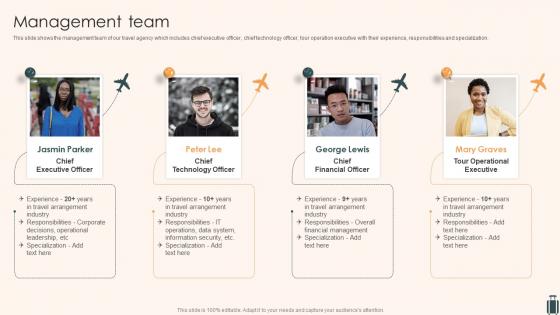
This slide shows the management team of our travel agency which includes chief executive officer, chief technology officer, tour operation executive with their experience, responsibilities and specialization.
People who downloaded this PowerPoint presentation also viewed the following :
Tourism And Travel Company Profile Management Team with all 6 slides:
Use our Tourism And Travel Company Profile Management Team to effectively help you save your valuable time. They are readymade to fit into any presentation structure.





FAQs for Tourism And Travel Company
Key roles within a tourism company management team include operations manager, marketing director, customer service manager, finance controller, and business development lead. These positions work collaboratively by streamlining tour logistics, enhancing guest experiences, and managing resource allocation, with many tourism organizations finding that this strategic combination ultimately delivers improved operational efficiency and competitive advantage in an increasingly dynamic travel landscape.
Effective communication enhances tourism management team performance by streamlining coordination between departments, enabling real-time response to customer needs, and ensuring consistent service delivery across all touchpoints. Through integrated communication systems, tourism companies can synchronize operations, reduce booking errors, and enhance guest experiences, while facilitating faster decision-making during peak seasons, ultimately delivering improved customer satisfaction and operational efficiency.
Cross-functional collaboration in tourism companies can be enhanced through regular interdepartmental meetings, shared project management platforms, cross-training programs, unified customer data systems, and collaborative performance metrics. These strategies streamline communication between sales, operations, marketing, and customer service teams, ultimately delivering seamless guest experiences, faster problem resolution, and improved operational efficiency across all touchpoints.
Market research influences tourism management decision-making by identifying customer preferences, analyzing competitor strategies, and revealing emerging travel trends and destination demands. Through comprehensive data analysis, tourism companies can optimize pricing strategies, develop targeted marketing campaigns, and enhance service offerings, while market insights enable managers to anticipate seasonal fluctuations and adapt operations accordingly, ultimately delivering competitive advantages and improved customer experiences.
Management teams in tourism face staffing shortages, seasonal demand fluctuations, regulatory compliance complexities, digital transformation pressures, and evolving customer expectations. These challenges intensify during peak seasons and global disruptions, with many hospitality companies and tour operators finding that strategic workforce planning, technology integration, and flexible service delivery models ultimately enhance operational resilience and competitive positioning.
Technology enhances tourism operations through automated booking systems, customer relationship management platforms, mobile applications, data analytics tools, and digital payment solutions. These systems streamline reservation processes, personalize customer experiences, and optimize resource allocation, with many hospitality companies finding that integrated technology delivers faster service, reduced operational costs, and significantly improved guest satisfaction rates.
Tourism management teams should track revenue per available room, customer satisfaction scores, booking conversion rates, average length of stay, and seasonal occupancy patterns. These metrics enable companies to optimize pricing strategies, enhance guest experiences, and maximize resource allocation across peak and off-peak periods, ultimately delivering improved profitability and competitive positioning in increasingly dynamic travel markets.
Cultural differences significantly impact global tourism companies through varied communication styles, decision-making approaches, leadership expectations, and conflict resolution methods. While these differences can create initial challenges in team coordination, they ultimately deliver competitive advantages by enhancing cultural authenticity, improving destination expertise, and enabling more nuanced customer experiences across diverse markets.
Sustainability plays a central role in tourism strategic planning by guiding environmental conservation efforts, community engagement initiatives, and long-term destination preservation strategies. Tourism management teams increasingly integrate sustainable practices into operational frameworks, resource allocation decisions, and stakeholder partnerships, with many destinations finding that eco-friendly approaches ultimately deliver enhanced visitor experiences, reduced operational costs, and stronger competitive positioning in environmentally conscious markets.
A tourism management team can foster innovation by encouraging cross-departmental collaboration, investing in staff training programs, regularly gathering customer feedback, implementing technology solutions, and creating innovation incentives. Through design thinking workshops and partnerships with local businesses, teams develop unique experiences like virtual reality tours or sustainable travel packages, ultimately delivering differentiated services and competitive advantages in an increasingly crowded tourism market.
Essential training for tourism company management teams includes customer service excellence, digital marketing strategies, sustainable tourism practices, crisis management protocols, and financial planning techniques. These programs enhance operational efficiency by improving guest experiences, expanding market reach, and building resilience, with many hospitality organizations finding that comprehensive leadership development ultimately delivers higher customer satisfaction and competitive advantage.
Tourism management teams handle crisis management through comprehensive emergency protocols, real-time communication systems, stakeholder coordination frameworks, and flexible operational contingencies. These teams streamline responses by establishing clear decision-making hierarchies, maintaining updated risk assessments, and leveraging technology platforms for instant guest notifications, with many hospitality organizations finding that proactive crisis planning ultimately delivers faster recovery times and enhanced customer confidence.
Best practices include competitive compensation packages, comprehensive training programs, career advancement opportunities, flexible scheduling arrangements, and strong company culture initiatives. These strategies enhance employee satisfaction by offering professional development, work-life balance, and clear growth pathways, with many tourism companies finding that investing in staff wellness and recognition programs ultimately delivers lower turnover and superior customer experiences.
Tourism management teams can cultivate partnerships through community consultation programs, local hiring initiatives, cultural collaboration projects, revenue-sharing agreements, and stakeholder advisory boards. These approaches enable sustainable tourism development while delivering economic benefits to communities, enhanced authentic experiences for visitors, and stronger operational foundations, with many tourism companies finding that local partnerships ultimately drive both social impact and competitive differentiation.
Customer feedback serves as a critical driver for tourism management practices, influencing service delivery, product development, operational improvements, and strategic decision-making across hospitality experiences. Through systematic feedback analysis, tourism companies enhance guest satisfaction, streamline booking processes, and refine destination offerings, with many hotels and tour operators finding that responsive feedback integration ultimately delivers higher customer retention rates and competitive advantage in an increasingly experience-focused market.
-
Really like the color and design of the presentation.
-
Based on my personal experience, I would recommend other people to subscribe to SlideTeam. No one can be disappointed here!