


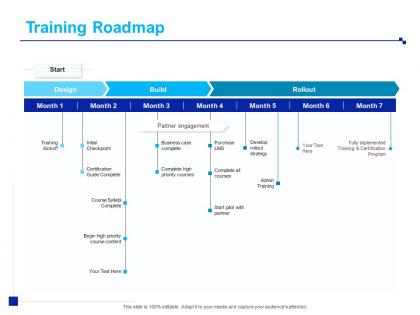
Training roadmap certification program ppt powerpoint presentation template




Try Before you Buy Download Free Sample Product
 Impress Your
 Audience
 100%
100% Editable
 Save Hours
 of Time


Our Training Roadmap Certification Program Ppt Powerpoint Presentation Template are topically designed to provide an attractive backdrop to any subject. Use them to look like a presentation pro.
People who downloaded this PowerPoint presentation also viewed the following :
Training roadmap certification program ppt powerpoint presentation template with all 2 slides:
Use our Training Roadmap Certification Program Ppt Powerpoint Presentation Template to effectively help you save your valuable time. They are readymade to fit into any presentation structure.
FAQs for Training roadmap certification program ppt
So it covers five main areas - instructional design, adult learning, delivery methods, assessment, and measuring results. Real projects and case studies for each one, which is nice. The instructional design part honestly changed everything for me in terms of how I build training programs. Most people totally skip the assessment planning bit, but that module's super valuable. You'll come out knowing how to design, deliver, and actually measure training that works. Oh, and definitely hit up that prerequisite reading if you're thinking about it - gives you a head start.
Yeah, it covers all the bases you'd want - ADDIE methodology, competency-based paths, measurable outcomes. Adult learning principles too. Way better than those random training modules companies usually slap together (ugh, we've all been there). Your certifications will actually align with major industry frameworks, which is huge when you're networking with other L&D folks. Oh and the continuous feedback loops are solid. So you can totally say you're using proven methods instead of just making stuff up as you go.
So they track four things - completion rates, assessments after training, how you actually perform on the job, and feedback surveys. Honestly, the assessments are where most people struggle because that's testing if you actually retained anything. Your completion rate just shows you're engaged, but the real test is applying it at work through performance reviews and what your manager says. The surveys are pretty useful too since people are brutally honest about what sucks. Oh, and you can check your own progress in the learning portal to see how you stack up against everyone else.
So they cover all the stuff that's actually relevant right now - microlearning, AI personalization, remote training, skills-based paths. Data analytics for ROI too, which is huge. The adaptive learning tech module looks solid, plus they get into designing for hybrid teams. What I like is they focus on building flexible roadmaps instead of just going through the motions. Honestly, I'd jump straight into the AI integration part first - that's where everyone's kind of freaking out and needs help the most. My company's been struggling with that exact thing lately.
So first thing - get your baseline numbers before you start anything. Track stuff like how long people stick around, how fast new hires get up to speed, training completion rates. Then check back in like 6-12 months later to see what changed. Most companies save the most money on turnover costs (which honestly makes total sense). Pick maybe 3-4 metrics that actually matter for your goals - don't go crazy trying to measure everything. Your facilitator should help figure out what to focus on. The performance improvements usually show up pretty quickly once people know what they're actually supposed to learn.
So they cover ADDIE - that's Analysis, Design, Development, Implementation, Evaluation - as the main thing. SAM model too for when projects need to move faster. Kirkpatrick's evaluation levels and Bloom's taxonomy are in there for learning objectives. The adult learning stuff was actually pretty cool, like how people's brains work differently than you'd think. Oh, and it's really hands-on rather than just reading about theory all day. Definitely save those ADDIE templates they give you - I use mine constantly now. The methodology parts are where you'll get the most practical value honestly.
Honestly, the tech side is what makes this certification program actually worth doing. AI creates custom learning paths based on how fast you pick things up, which is pretty cool. You can practice with simulations that feel real but won't get you fired if you mess up. Progress tracking happens automatically - no more tedious logging of every single module you finish. There's also virtual mentoring and mobile access, so you can learn during boring commute time. My advice? Dive into those tech features right away. They'll save you hours and make everything click better.
So they've got this mix of workshops, self-paced stuff, and group discussions which is nice. Visual learners get diagrams and videos, audio people get podcasts or whatever, and there's tons of hands-on projects for people like me who need to actually *do* things to get it. Most sections let you go at your own speed too. Oh, and they have some learning style quiz at the start - definitely take that because it'll point you toward what'll actually work for you. Way better setup than that last course I tried where everything was just boring lecture videos.
Time management's gonna be your biggest enemy - seriously, everyone thinks they can handle the workload until week 3 hits. The capstone project alone will eat your life if you're not careful. Most people try juggling it with their regular job and just crash and burn during those intensive modules. Oh, and if you don't actually have the tech background they recommend? You'll get destroyed on the assessments. The group work part is annoying too since coordinating with random people online is always a disaster. Start blocking out study hours immediately and bug your mentor constantly - that's literally what they're there for.
So that certification actually shows you can map out smart learning paths instead of just randomly picking courses. Companies really need people who think strategically about employee development right now. You'll be able to prove you understand competency mapping and how to measure if training actually works - which honestly, most places are terrible at. Having any kind of certification just looks way more legit than winging it, you know? I'd definitely play it up when you're going for L&D leadership stuff or consulting gigs where they want someone who can think bigger picture.
So they set up peer review sessions and group projects where you work with people at different stages - which is actually pretty cool. You'll do case studies together and get feedback on your roadmaps. Honestly? The peer discussions beat the formal lectures most of the time. Everyone dumps their templates and real examples into this shared knowledge base, plus there are monthly coffee chats to keep things going. Oh, and definitely jump into those peer forums right away - that's where the good connections happen. Way more valuable than just doing the coursework solo.
Oh nice, so you'll get into this online community with other people who got certified - that's honestly the best part. They do webinars and refresher sessions too. The resource library stays open with templates and case studies, and they're always adding new stuff which is cool since everything changes so quickly. Priority access to workshops is included, plus you can hit up mentors from the program. Definitely jump into the forum first though - way more valuable than the other resources if I'm being honest.
Hey! So they throw you into real workplace scenarios instead of boring theory stuff - like dealing with difficult employees and designing training for different personality types. Role-playing sessions help you practice facilitating (yeah, they're cringy at first but actually work). Case studies come from actual training challenges companies face, which is cool. You'll handle pushback from people who think training is pointless too. Honestly? Jump into practice sessions right away. The whole thing builds your confidence before you're stuck in front of a room full of skeptical faces.
No formal requirements needed - they built it for all experience levels. Basic training knowledge helps but isn't necessary since they explain everything pretty well from scratch. You'll need about 5-8 hours weekly, which most people handle fine with their regular job. I'd definitely give your manager a heads up though, just so there's no weirdness about doing professional development stuff during work time. Honestly the time commitment is the main thing to consider. Otherwise just jump in!
Yeah, so the cool thing is they actually built adaptability right into it. You get fresh materials every quarter plus workshops on whatever new methods are popping up. Instead of just memorizing today's best practices, they teach you how to spot and test new approaches as they come out. Plus there's this practitioner community where people are constantly sharing what's actually working - honestly some of the failure stories are more helpful than the wins. Your cert stays current through these bite-sized learning modules, so you're never stuck using outdated stuff.
No Reviews