


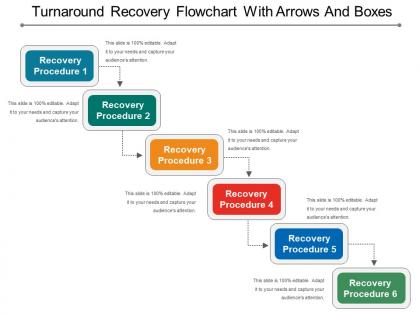
Turnaround recovery flowchart with arrows and boxes




Try Before you Buy Download Free Sample Product
 Impress Your
 Audience
 100%
100% Editable
 Save Hours
 of Time


Get a lot of accolades coming your way with our Turnaround Recovery Flowchart With Arrows And Boxes. You will display admirable accomplishment.
People who downloaded this PowerPoint presentation also viewed the following :
Turnaround recovery flowchart with arrows and boxes with all 5 slides:
Develop timelines with our Turnaround Recovery Flowchart With Arrows And Boxes. Take a call on reasonable limits.





FAQs for Turnaround recovery flowchart with
Successful turnaround recovery processes include rapid cash flow stabilization, stakeholder communication transparency, operational restructuring, strategic cost reduction, and decisive leadership execution. These characteristics work together by addressing immediate financial pressures, rebuilding market confidence, and streamlining operations, with many distressed companies finding that combining quick wins with long-term strategic repositioning ultimately delivers sustainable competitive advantage.
Businesses can assess financial health through comprehensive cash flow analysis, debt-to-equity evaluations, profitability reviews, operational efficiency audits, and market position assessments. These diagnostic tools enable organizations to identify critical vulnerabilities, prioritize resource allocation, and develop targeted recovery strategies, with many companies finding that systematic financial evaluation ultimately delivers clearer restructuring roadmaps and improved stakeholder confidence.
Leadership serves as the catalyst for turnaround recovery by setting strategic direction, making decisive resource allocation decisions, communicating transparently with stakeholders, and driving organizational culture change. Effective turnaround leaders streamline operations, restructure underperforming divisions, and implement cost-reduction initiatives, with many companies finding that strong leadership ultimately delivers faster recovery timelines and sustainable competitive advantage.
Organizations identify and prioritize critical issues through comprehensive financial analysis, stakeholder feedback assessment, operational efficiency reviews, and market position evaluation. By conducting systematic cash flow analysis, customer retention studies, and competitive benchmarking, companies can rank issues by urgency and impact, with many finding that addressing liquidity challenges first enables sustainable recovery across manufacturing, retail, and service sectors.
Stakeholder engagement strategies during turnaround recovery include transparent communication, regular updates, collaborative planning sessions, stakeholder mapping, and establishing clear feedback channels. These approaches enhance trust by involving creditors, employees, customers, and investors in recovery planning, while demonstrating commitment to resolution, ultimately delivering stronger stakeholder buy-in and sustainable recovery outcomes.
Data analytics informs recovery decisions by identifying performance bottlenecks, predicting cash flow patterns, and revealing operational inefficiencies through comprehensive financial modeling. Through advanced analytics platforms, struggling organizations can prioritize resource allocation, optimize restructuring strategies, and monitor recovery metrics in real-time, with many companies finding that data-driven insights accelerate turnaround timelines while minimizing risks.
Cultural changes essential for successful turnarounds include embracing transparency and open communication, fostering accountability at all levels, promoting agility and rapid decision-making, encouraging cost-consciousness, and developing a performance-driven mindset. These shifts enable organizations to streamline operations, enhance employee engagement, and accelerate problem-solving capabilities, with many companies finding that cultural transformation ultimately delivers sustained competitive advantage and long-term organizational resilience.
Businesses can evaluate turnaround recovery effectiveness by tracking key financial metrics, operational performance indicators, cash flow improvements, and stakeholder confidence levels throughout the implementation process. Through systematic monitoring of revenue growth, cost reduction achievements, and market position recovery, organizations can assess whether their strategies are delivering sustainable results, while regular benchmarking against industry standards helps ensure the turnaround maintains competitive advantage.
Key turnaround metrics include cash flow improvement, revenue growth rates, cost reduction percentages, debt-to-equity ratios, and operational efficiency indicators like inventory turnover and customer retention rates. These financial and operational benchmarks enable leadership teams to monitor recovery momentum across departments, identify emerging opportunities or bottlenecks early, and demonstrate tangible progress to stakeholders, ultimately delivering measurable transformation and sustainable competitive positioning.
Companies can communicate turnaround plans through transparent town halls, regular progress updates, clear role definitions, and direct leadership engagement with frontline teams. This approach fosters buy-in by demonstrating commitment to transparency, involving employees in solution development, and connecting individual contributions to recovery outcomes, with many organizations finding that engaged employees become advocates for change, ultimately accelerating implementation and improving retention during challenging transitions.
Organizations should avoid underestimating implementation timelines, failing to secure stakeholder buy-in, cutting essential operations too deeply, and neglecting employee communication during recovery efforts. These pitfalls often derail turnaround initiatives, with many companies finding that maintaining operational continuity while implementing strategic changes, ensuring adequate cash flow management, and preserving key talent ultimately delivers sustainable recovery and competitive repositioning.
Businesses can leverage technology to facilitate turnaround recovery through automated financial monitoring, predictive analytics for cash flow management, cloud-based collaboration platforms, and real-time performance dashboards. These digital tools streamline decision-making, reduce operational costs, and enhance stakeholder communication, with many organizations finding that technology-driven insights accelerate recovery timelines while maintaining transparency throughout the restructuring process.
Employee training and development plays a crucial role in turnaround recovery by equipping staff with new skills, enhancing operational efficiency, and fostering adaptability during organizational change. Through strategic upskilling programs, companies streamline processes, reduce errors, and improve customer service delivery, with many organizations finding that well-trained employees ultimately drive sustainable recovery and competitive advantage.
Organizations balance short-term recovery with long-term strategy by implementing phased approaches that address immediate cash flow needs, operational stabilization, and workforce retention while preserving core strategic investments. Through careful resource allocation and stakeholder communication, companies in sectors like retail and manufacturing streamline operations, renegotiate terms, and maintain R&D commitments, ultimately positioning themselves for sustainable growth beyond the recovery phase.
Successful turnaround recoveries demonstrate best practices including rapid cash flow stabilization, strategic cost restructuring, leadership changes, stakeholder communication, and market repositioning. Companies like IBM and Marvel Entertainment exemplify how combining operational efficiency improvements with cultural transformation enables sustainable recovery, with many organizations finding that early decisive action and transparent stakeholder engagement ultimately deliver competitive advantage.
-
Perfect template with attractive color combination.
-
Content of slide is easy to understand and edit.