

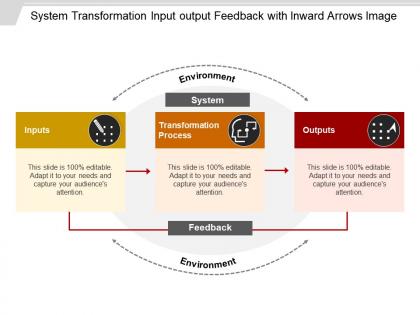
System transformation input output feedback with inward arrows image




Try Before you Buy Download Free Sample Product
 Impress Your
Audience
 100%
Editable
 Save Hours
of Time


Folks get a clear insight of the expectations due to our System Transformation Input Output Feedback With Inward Arrows Image. Following instructions becomes easy.
People who downloaded this PowerPoint presentation also viewed the following :
System transformation input output feedback with inward arrows image with all 5 slides:
Be able to concentrate your energies again with our System Transformation Input Output Feedback With Inward Arrows Image. Bring back that clear focus.



FAQs for System transformation input output feedback with
System dynamics modeling centers on feedback loops, stocks and flows, time delays, non-linearity, and policy structure analysis. These principles enable organizations to understand complex interactions within business systems, supply chains, and organizational processes, with many companies finding that this approach streamlines decision-making, enhances strategic planning, and ultimately delivers sustainable competitive advantage.
System dynamics analyzes complex social issues by mapping interconnected relationships, identifying feedback loops, and modeling long-term behavioral patterns within communities and institutions. Through computer simulations, policymakers can test intervention strategies, predict unintended consequences, and optimize resource allocation, with urban planners and healthcare systems finding that this approach delivers more effective solutions and sustainable outcomes.
Feedback loops are fundamental mechanisms in system dynamics that create circular causal relationships where outputs influence inputs, driving system behavior through reinforcing loops that amplify change and balancing loops that seek equilibrium. These loops enable organizations to understand complex interactions in business processes, supply chains, and market dynamics, with many companies finding that mapping feedback structures reveals leverage points for strategic intervention and sustainable competitive advantage.
System dynamics differs from traditional linear modeling by capturing feedback loops, non-linear relationships, delays, and interconnected variables that evolve over time, rather than simple cause-and-effect sequences. This approach enables organizations in manufacturing, healthcare, and supply chain management to understand complex behaviors like market fluctuations and operational bottlenecks, ultimately delivering more accurate predictions and strategic decision-making capabilities.
Stock and flow diagrams include stocks (accumulations), flows (rates of change), connectors (information links), clouds (sources and sinks), and feedback loops. These components work together by representing system structure, tracking resource movement, and identifying causal relationships, with many organizations finding that visualizing these elements enhances strategic planning and operational efficiency.
System dynamics enhances strategic planning by modeling complex organizational relationships, identifying feedback loops, testing scenarios through simulation, and revealing unintended consequences of decisions. Through dynamic modeling tools, organizations can visualize long-term impacts, optimize resource allocation, and anticipate market changes, with many companies finding that this systematic approach delivers better strategic outcomes and competitive advantage.
Common mistakes include oversimplifying complex relationships, ignoring feedback loops, using linear thinking for nonlinear systems, inadequate stakeholder involvement, and poor model validation. These errors undermine accuracy by creating unrealistic assumptions, missing critical interactions, and reducing buy-in, with many organizations finding that collaborative model building and iterative testing ultimately delivers more reliable insights and strategic decision-making capabilities.
System dynamics assists in understanding climate change by modeling complex interactions between emissions, temperature changes, feedback loops, economic factors, and policy interventions across interconnected global systems. Through comprehensive simulations, organizations and governments can evaluate mitigation strategies like carbon pricing, renewable energy transitions, and adaptation measures, while identifying critical leverage points and unintended consequences, ultimately enabling more effective climate action and resilient planning.
**INPUT**: What software tools are most effective for constructing system dynamics models? **OUTPUT**: Effective system dynamics modeling tools include Vensim, Stella/iThink, AnyLogic, PowerSim, and Insight Maker, each offering unique strengths for different applications. These platforms streamline complex system analysis by enabling visual modeling, scenario testing, and policy simulation, with many organizations in healthcare, supply chain, and financial services finding that these tools ultimately deliver strategic insights and enhanced decision-making capabilities. **Word count: 59 words**
System dynamics facilitates stakeholder engagement by creating visual models that make complex relationships and feedback loops easily understandable to diverse audiences, enabling collaborative problem-solving and shared understanding. Through interactive simulations and causal loop diagrams, organizations can engage stakeholders in scenario planning, policy testing, and strategic discussions, ultimately delivering more inclusive decision-making processes and stronger stakeholder buy-in.
Time delays significantly impact system behavior by creating gaps between actions and their consequences, often leading to policy resistance, oscillations, and unintended outcomes in complex systems. These delays cause organizations to overreact or underreact to problems, with many companies finding that recognizing and managing delays in feedback loops, supply chains, and decision-making processes enables better strategic planning and more stable performance.
System dynamics methodologies integrate with analytical frameworks through complementary modeling approaches, data visualization tools, statistical analysis methods, and simulation platforms. These combinations enhance decision-making by merging system dynamics' feedback loop insights with frameworks like lean six sigma, balanced scorecards, and predictive analytics, with organizations finding that strategic integration delivers comprehensive understanding, improved forecasting accuracy, and enhanced operational efficiency.
System dynamics has driven transformative outcomes across diverse sectors, with notable successes including Ford's supply chain optimization, Singapore's urban planning initiatives, Shell's scenario planning strategies, and healthcare delivery improvements in hospitals worldwide. These implementations demonstrate how mapping complex interdependencies enables organizations to identify leverage points, reduce costs, accelerate decision-making, and ultimately deliver sustainable competitive advantages in increasingly dynamic business environments.
System dynamics contributes to sustainability initiatives by modeling complex environmental interactions, identifying leverage points for resource optimization, and predicting long-term impacts of policy changes. Manufacturing companies use these models to minimize waste streams, energy utilities optimize renewable integration, and supply chain managers reduce carbon footprints, ultimately delivering measurable environmental improvements while maintaining operational efficiency and competitive advantage.
Strategies include rigorous data validation, sensitivity analysis, model testing against historical data, stakeholder feedback integration, and continuous calibration. These approaches enhance model reliability by identifying parameter uncertainties, testing assumptions across different scenarios, and incorporating real-world insights, with many organizations finding that iterative refinement and cross-validation ultimately deliver more accurate predictions and strategic decision-making capabilities.
-
I discovered this website through a google search, the services matched my needs perfectly and the pricing was very reasonable. I was thrilled with the product and the customer service. I will definitely use their slides again for my presentations and recommend them to other colleagues.
-
Great quality product.