


Types Of Elections In The Us Electoral Systems Ppt Slides Example




Try Before you Buy Download Free Sample Product
 Impress Your
 Audience
 100%
100% Editable
 Save Hours
 of Time


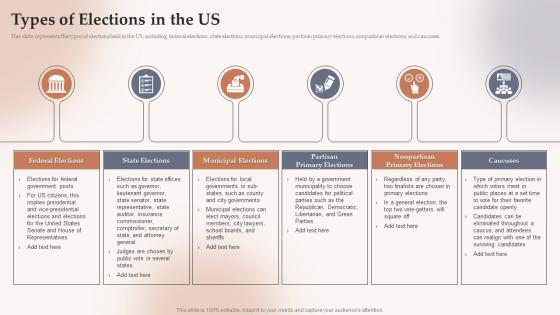
This slide represents the types of elections held in the US, including federal elections, state elections, municipal elections, partisan primary elections, nonpartisan elections, and caucuses.
People who downloaded this PowerPoint presentation also viewed the following :
Types Of Elections In The Us Electoral Systems Ppt Slides Example with all 6 slides:
Use our Types Of Elections In The Us Electoral Systems Ppt Slides Example to effectively help you save your valuable time. They are readymade to fit into any presentation structure.





FAQs for Types Of Elections In The Us Electoral Systems
The main types of elections in the United States include presidential elections, congressional elections, state elections, local elections, and primary elections. These electoral processes enable democratic participation by allowing citizens to select representatives at federal, state, and municipal levels, while primaries streamline candidate selection, ultimately delivering representative governance and ensuring accountability across all levels of American political institutions.
Federal elections focus on choosing presidents, senators, and House representatives with standardized processes across states, while state and local elections select governors, mayors, school boards, and city councils with procedures varying by jurisdiction. Through different ballot structures and voting systems, communities can address region-specific issues like local tax measures, municipal services, and state policies, ultimately delivering more targeted representation alongside national governance.
Primary elections determine which candidates represent each political party in general elections, serving as the crucial first step in candidate selection. These elections enable party members and registered voters to choose their preferred nominees for offices ranging from local positions to the presidency, ultimately shaping the final ballot options and influencing policy directions that reach voters nationwide.
General elections occur every even-numbered year in November, featuring contests for federal positions like President, Senate, and House seats, plus state and local offices including governors, legislators, mayors, and judges. These elections use the Electoral College for presidential races while employing direct popular vote for most other positions, with many states finding that coordinated election timing streamlines voter participation and reduces administrative costs.
Special elections are unscheduled contests held to fill vacant offices or address specific ballot measures outside regular election cycles. They occur when representatives resign, die, or face removal, or when urgent legislative matters require immediate voter input. These elections ensure continuous representation and democratic participation, with states like California and Georgia frequently conducting them to maintain governmental continuity and address time-sensitive issues.
Runoff elections occur when no candidate receives the required majority threshold, typically involving the top two vote-getters in a subsequent election. They're commonly used in primary elections across states like Georgia and Louisiana, and in municipal races, ensuring winners have broader voter support while providing clearer mandates for governance and policy implementation.
Ballot initiatives and referendums enable voters to directly decide on specific policy issues, constitutional amendments, and local measures alongside candidate elections. These direct democracy tools allow citizens to bypass legislative processes on controversial topics like tax policies, infrastructure funding, and social issues, with many states finding that voter-driven measures significantly influence local governance and create pathways for policy changes that enhance community representation and democratic participation.
The Electoral College requires presidential candidates to build geographically diverse coalitions rather than focusing solely on population centers, with swing states like Pennsylvania, Florida, and Wisconsin receiving disproportionate attention during campaigns. This system shapes campaign strategies, resource allocation, and messaging approaches, ultimately determining that candidates must appeal to varied regional interests across multiple states rather than pursuing purely popular vote maximization.
Open primaries allow all registered voters to participate regardless of party affiliation, while closed primaries restrict voting to registered party members only. This distinction significantly impacts candidate selection strategies, voter engagement levels, and electoral outcomes, with many states finding that open systems enhance broader participation and moderate candidate positioning, ultimately delivering more inclusive democratic processes and competitive general elections.
Nonpartisan elections remove party labels from ballots, requiring candidates to run on individual qualifications rather than party affiliation, while traditional elections emphasize party identity and platform alignment. This approach streamlines voter focus on candidate experience and local issues, with many municipalities and judicial systems finding that nonpartisan formats enhance candidate evaluation and reduce polarized voting patterns.
Midterm elections significantly reshape congressional power dynamics, often serving as referendum votes on presidential performance, shifting party control in House and Senate chambers, and altering legislative agendas. These electoral outcomes enable opposing parties to gain strategic advantages through committee leadership changes, budget authorization control, and policy direction influence, ultimately delivering enhanced checks and balances while positioning parties for subsequent presidential campaigns.
Election laws and voting rights vary significantly across states due to federalism, with differences in voter ID requirements, early voting periods, mail-in ballot policies, registration deadlines, and polling hours. While federal laws establish baseline protections, states retain authority over election administration, creating a patchwork of regulations that can affect voter access, with many jurisdictions finding that streamlined processes ultimately enhance democratic participation and electoral efficiency.
Gerrymandering significantly impacts election outcomes by creating "safe" districts that favor specific parties, reducing competitive races, and potentially undermining representative democracy. This practice can lead to decreased voter turnout in non-competitive districts, increased political polarization as candidates appeal to partisan bases rather than moderate voters, and legislative bodies that don't accurately reflect overall population preferences, ultimately affecting policy decisions and democratic accountability.
Early voting has transformed US elections by extending campaign timelines, shifting resource allocation strategies, and enabling higher voter participation rates across diverse demographics. This expanded voting window allows campaigns to mobilize supporters over weeks rather than days, while reducing Election Day bottlenecks, ultimately delivering increased accessibility and operational efficiency that many states find enhances democratic participation.
Recent technological advancements have revolutionized US elections through electronic voting machines, online voter registration systems, digital campaign platforms, real-time result reporting, and enhanced security protocols. These technologies streamline election administration by reducing processing times, minimizing human error, and improving voter accessibility, while enabling candidates to reach broader audiences through targeted digital campaigns, ultimately delivering faster, more efficient electoral processes with enhanced transparency and voter engagement across diverse demographics.
-
“Thanks to SlideTeam. Now I can make smart presentations in a fraction of time without any hassle.”
-
Very unique and reliable designs.