


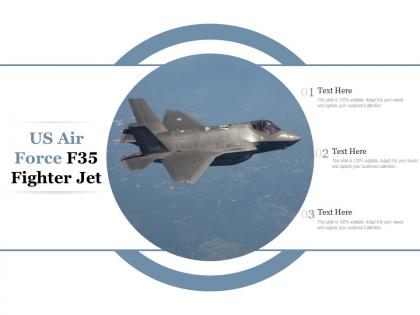
Us air force f35 fighter jet




Try Before you Buy Download Free Sample Product
 Impress Your
 Audience
 100%
100% Editable
 Save Hours
 of Time


Our US Air Force F35 Fighter Jet are explicit and effective. They combine clarity and concise expression.
People who downloaded this PowerPoint presentation also viewed the following :
Us air force f35 fighter jet with all 2 slides:
Give your audience a fulfilling experience. They will find our US Air Force F35 Fighter Jet elevating.
FAQs for Us air force
Dude, the sensor fusion thing is probably the coolest part - it takes all these different data streams and mashes them into one display so pilots aren't juggling a million screens. Those 360-degree cameras are insane too, like having eyes in the back of your head. The helmet display projects everything right onto the visor which is honestly sci-fi level stuff. Oh and the stealth coatings - saw one at an airshow once, looks way smaller than you'd expect. For your brief, just hammer home how it cuts pilot workload while making them way more aware of what's happening around them.
Okay so the F-35 costs like $1.7 trillion over its whole lifespan - totally insane compared to older programs that ran maybe $200-300 billion. But honestly? The tech jump is ridiculous. You're getting stealth, crazy advanced sensors, data fusion that basically makes pilots see everything. Sure, it's been a complete cost disaster with endless delays (don't even get me started on that mess), but the capabilities are genuinely next-level compared to just tweaking old jets. The sticker shock is brutal but the performance gains are actually real.
So the F-35's stealth is pretty wild - it's got these special coatings and weird angular surfaces that bounce radar waves away instead of back to the source. Makes it almost invisible to enemy systems. All the weapons are tucked inside too, no missiles stuck on the wings like older jets. Pilots can basically sneak into heavily defended areas, hit their targets, and slip out before anyone realizes what happened. Way better than having to dodge every surface-to-air missile in the neighborhood. Honestly, it's like playing hide and seek but the other guy's blindfolded.
So the F-35 comes in three flavors depending on which branch needs it. Air Force gets the basic F-35A with normal takeoffs. Marines have the F-35B which can land vertically - honestly that tech still blows my mind. Navy uses the F-35C with beefed-up landing gear for carriers plus wings that fold up. Smart thing is they all share like 80% of their parts and training stuff, so it's way cheaper than building completely separate jets. The whole "joint program" thing was actually pretty clever from a budget standpoint, even if the program's had its drama over the years.
Dude, the F-35's sensor package is honestly insane. Pilots get 360-degree awareness through something called the Distributed Aperture System, plus that AN/APG-81 radar tracks multiple targets without giving away position. The helmet display is straight up science fiction - projects sensor data right onto the visor so you can literally see through the plane. But here's the kicker: all that info gets shared instantly between F-35s and ground units. When you're explaining the crazy price tag to leadership, hammer home that sensor fusion thing - it's what makes each jet part of one big networked system instead of just flying solo.
So basically, allied countries using F-35s can work together way better because everyone's got the same plane. Pilots can hop between different nations' aircraft and know exactly what they're doing. The coolest part is how they all share data automatically during missions - like, the situational awareness is insane. Makes me wonder what pilots did before this tech existed, honestly. Common maintenance stuff means deploying together isn't a logistical nightmare anymore. If you're dealing with international partnerships at work, this whole standardization thing could give you some ideas for smoothing out coordination issues.
Yeah so the F-35 has been a mess cost-wise - went from like $230 billion to over $400 billion. Classic Pentagon math, right? They've had tons of technical headaches too: software bugs, helmet displays acting up, engine problems. Lockheed's fixed most of the operational stuff through updates and design changes. Production ramped up which helped bring costs down a bit. Still crazy expensive though. If you're doing budget stuff for this, just know it'll probably stay controversial politically. The plane actually works now at least!
So the F-35 has this sick system called MADL that automatically shares intel between F-35s - pilots don't even have to do anything. Plus there's Link 16 for connecting with older jets, ships, ground troops, whatever. All this data gets fused together so everyone sees the same battlefield picture at once, which honestly is pretty game-changing. Oh and make sure your other aircraft can actually talk to these systems if you're doing joint ops - otherwise you're missing out on all that sensor data the F-35's collecting.
Dude, that thing guzzles fuel - we're talking 5,600 pounds per hour, way more than older jets. But honestly? The real nightmare is maintenance. All those specialized chemicals and coatings, plus they're constantly swapping out parts. Creates tons of hazardous waste. Flight ops are just part of it - the whole supply chain pumps out carbon emissions. Military's trying some sustainable fuel stuff and better maintenance protocols, but still. Oh, and if you're doing budget planning, don't forget those environmental compliance costs on top of fuel expenses.
So the F-35 is basically like a Swiss Army knife - same airframe, but you swap out weapons and flip software modes depending on what you need. Air-to-air? Load AMRAAMs and set the radar for hunting other jets. Ground missions? Throw on some JDAMs or Hellfires and switch to surface attack mode. That helmet display thing is honestly pretty sick - shows you everything no matter what mission you're running. The whole point is avoiding the nightmare of maintaining like five different aircraft types. One plane does it all, which makes the logistics guys way happier.
So F-35 training is like 6-9 months depending on what you flew before. Academic stuff first, then simulators, then actual flights. Even seasoned pilots say it's brutal - the sensor fusion tech is nuts. You're looking at maybe 20-30 sim sessions plus 10-15 real flights to get mission-ready. The helmet display will mess with your head if you're coming from F-16s or Hornets. Information overload is real. My buddy said it felt like drinking from a fire hose for weeks. Start studying systems now if you can.
Dude, the F-35's logistics are honestly a mess right now. Mission-capable rates sit around 70% when they should hit 80%. That ALIS system they built? Supposed to fix everything but just created new problems instead. Getting parts is a nightmare since they come from all these different international suppliers - good luck when something critical breaks. The stealth coatings need super specialized maintenance too, which most bases can't even do. My buddy works on these and says the downtime is brutal. Bottom line: they're way more expensive and complicated than older fighters. Just something to keep in mind if you're analyzing their ops.
Yeah, the F-35's been in actual combat since around 2018. Israel was first to use them - typical that they won't say much about what they actually did though. After that, the U.S. flew missions in Afghanistan, Iraq, and Syria doing strikes and recon stuff. Britain's gotten theirs into action too, flying off their new carrier. Italy and some other countries have used them operationally as well. For your project, I'd probably stick with the Israeli and American operations since there's way more you can actually find and cite about those.
Yeah, remember how the F-35 was like the worst defense project ever back in 2010? Cost overruns everywhere, missing every single deadline, technical problems out the wazoo. Honestly felt like they'd never get it right. But weird thing is, once these jets actually started flying real missions and other countries got theirs, suddenly everyone's talking about how badass the tech is. Combat effectiveness this, advanced capabilities that. Makes you think twice about judging these massive programs when they're still figuring things out, you know?
So Block 4 is the big modernization push - enhanced sensors, new weapons, better electronic warfare stuff. All rolling out through the 2030s. The adaptive engine upgrade is huge though, should really boost range and performance. Software updates are constant too (wild that jets need patches like your phone, right?). Down the line they're talking hypersonic weapons and AI integration. Honestly, if you're watching budget stuff for your department, Block 4 delays are what I'd worry about. Those timeline slips always mess with procurement schedules.
No Reviews