

Use of funds ppt slides gallery





Try Before you Buy Download Free Sample Product
 Impress Your
Audience
 100%
Editable
 Save Hours
of Time


Declare your devotion to the cause with our Use Of Funds Ppt Slides Gallery. Give folks an example of your commitment.
People who downloaded this PowerPoint presentation also viewed the following :
Use of funds ppt slides gallery with all 5 slides:
Handle emergent conditions with our Use Of Funds Ppt Slides Gallery. Come up with effective counters.
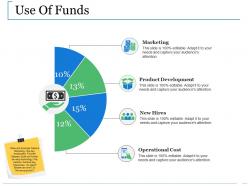


FAQs for Use of funds
A "Use of Funds" section should include capital expenditures, operational expenses, marketing and sales investments, working capital requirements, and debt repayment allocations. These components demonstrate financial transparency and strategic resource allocation, with many investors finding that detailed breakdowns of equipment purchases, hiring plans, and market expansion initiatives ultimately deliver greater confidence and faster funding approvals.
Startups can effectively communicate funding needs by presenting detailed financial projections, clear milestone timelines, specific use of funds breakdown, and realistic ROI expectations with supporting market data. Through compelling storytelling that connects funding requirements to growth objectives, startups demonstrate how investment directly translates to market expansion, product development, and revenue generation, ultimately delivering measurable returns for investors.
Common pitfalls include being overly vague about fund allocation, failing to tie expenses to specific milestones, underestimating operational costs, and lacking contingency planning. Investors increasingly scrutinize presentations that don't demonstrate clear ROI timelines or realistic burn rates, with many finding that successful funding requests balance ambitious growth projections with detailed, defensible financial planning.
Different industries prioritize fund allocation based on their unique operational needs and growth strategies, with technology companies emphasizing R&D and talent acquisition, manufacturing focusing on equipment and supply chain optimization, and healthcare organizations allocating toward compliance and patient care infrastructure. These sector-specific approaches enable organizations to communicate strategic priorities effectively to stakeholders, ultimately delivering enhanced credibility and targeted investment outcomes that align with industry-specific performance metrics and competitive advantages.
Key metrics include revenue growth rate, return on investment (ROI), market share expansion, customer acquisition cost, and operational efficiency improvements. These indicators enable organizations to track how strategic fund allocation drives scalable outcomes, with many companies finding that measuring both financial returns and operational enhancements ultimately delivers comprehensive insights into growth acceleration and competitive positioning.
Visual aids enhance "Use of Funds" presentations by transforming complex financial data into digestible charts, graphs, and infographics that clearly illustrate fund allocation, timeline distributions, and projected outcomes. These tools streamline stakeholder comprehension while building investor confidence, with many financial institutions and startups finding that visual presentations significantly improve funding approval rates and strategic alignment discussions.
Transparency in fund allocation builds investor confidence by providing clear visibility into spending priorities, timeline expectations, and progress milestones, demonstrating responsible financial stewardship. When startups openly communicate resource deployment across operations, marketing, and growth initiatives, investors gain assurance that their capital is strategically managed, ultimately strengthening long-term partnerships and increasing likelihood of future funding rounds.
Companies can prioritize fund allocation by conducting thorough ROI analysis, focusing on high-impact projects, diversifying investments across growth areas, and regularly reviewing performance metrics. Strategic allocation involves balancing short-term operational needs with long-term strategic initiatives, with many organizations finding that data-driven prioritization frameworks enable better resource deployment and ultimately deliver sustained competitive advantage.
Fund tracking tools include QuickBooks, Sage Intacct, NetSuite, Tableau, and Microsoft Power BI, along with specialized platforms like PlanGuru and Adaptive Insights. These solutions streamline financial monitoring by automating expense categorization, generating real-time dashboards, and creating investor-ready reports, with many organizations finding that integrated analytics ultimately deliver enhanced transparency and faster decision-making capabilities.
The purpose of funding significantly shapes fund allocation priorities, with expansion funding emphasizing capital expenditures, market development, infrastructure investments, and growth initiatives. Operational funding focuses on working capital, payroll, inventory management, and maintaining current business functions, with many organizations finding that clearly defining funding purpose enhances investor confidence and strategic resource deployment.
Successful "Use of Funds" presentations include Airbnb's growth trajectory breakdown, Uber's market expansion strategy, and Dropbox's product development roadmap, demonstrating clear allocation across marketing, operations, and technology development. These presentations excel by connecting specific funding amounts to measurable milestones, revenue targets, and competitive positioning, with many investors finding that transparent resource allocation timelines significantly enhance credibility and investment confidence.
Businesses can tailor their "Use of Funds" sections by emphasizing growth potential and scalability for venture capitalists, highlighting stability and cash flow for traditional lenders, and showcasing social impact for impact investors. Through strategic customization, companies demonstrate market expansion plans for equity investors, operational efficiency improvements for debt providers, and measurable outcomes for grant funders, ultimately delivering targeted messaging that resonates with each investor's specific priorities and risk tolerance.
Legal considerations include compliance with securities regulations, accurate financial disclosures, investor protection requirements, anti-fraud provisions, and documentation standards. These frameworks ensure transparency by mandating clear fund allocation details, risk disclosures, and regulatory filings, with many organizations finding that proactive compliance ultimately delivers investor confidence and competitive advantage.
Feedback from previous pitches enhances future fund allocation presentations by identifying messaging gaps, highlighting investor concerns, and revealing which financial projections resonate most effectively. This iterative approach enables entrepreneurs to refine their budget narratives, address due diligence questions proactively, and tailor allocation strategies to specific investor priorities, ultimately delivering more compelling presentations and higher funding success rates.
Businesses can employ cash flow modeling, scenario analysis, sensitivity testing, break-even calculations, and ROI projections to forecast fund impacts on financial health. These strategies enable organizations to evaluate different funding scenarios, assess risks across market conditions, and optimize resource allocation, with many financial institutions and growing companies finding that comprehensive forecasting ultimately delivers better investment decisions and sustained competitive advantage.
-
Excellent template with unique design.
-
Informative presentations that are easily editable.