

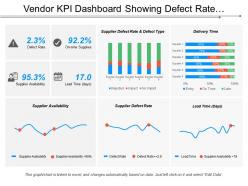
Vendor kpi dashboard showing defect rate on-time suppliers and lead time





Try Before you Buy Download Free Sample Product
 Impress Your
Audience
 100%
Editable
 Save Hours
of Time


Ensure you don't compromise with our Vendor Kpi Dashboard Showing Defect Rate On-Time Suppliers And Lead Time. Get access to the best available.
People who downloaded this PowerPoint presentation also viewed the following :
Vendor kpi dashboard showing defect rate on-time suppliers and lead time with all 6 slides:
Create an equation that helps achieve goals with our Vendor Kpi Dashboard Showing Defect Rate On-Time Suppliers And Lead Time. Figure out the correct formula.




FAQs for Vendor kpi dashboard showing defect rate on-time suppliers
Key vendor performance indicators include delivery timeliness, quality metrics, cost efficiency, compliance rates, and responsiveness to issues. These KPIs enable organizations to optimize supply chains, reduce operational risks, and strengthen partnerships by identifying top performers and addressing underperformance, with many companies finding that comprehensive vendor analytics ultimately delivers better service levels and competitive advantage.
Vendor performance analytics integrates into existing supply chain systems through API connections, data mapping protocols, and middleware solutions that synchronize performance metrics with procurement workflows. Many organizations streamline this integration by leveraging cloud-based platforms that automatically capture supplier data, delivery timelines, and quality scores, ultimately delivering real-time visibility and enhanced decision-making capabilities across their supply networks.
Data visualization transforms complex vendor performance metrics into clear, actionable insights through dashboards, charts, heat maps, and trend analyses that highlight patterns and anomalies. These visual tools enable procurement teams to quickly identify underperforming suppliers, track compliance rates, and monitor cost fluctuations across multiple vendors simultaneously, ultimately delivering faster decision-making and enhanced supplier relationship management.
Vendor performance should be evaluated quarterly for strategic partnerships, with monthly reviews for critical suppliers and annual comprehensive assessments for all vendors. This structured approach enables organizations to identify performance trends, address issues proactively, and optimize contract negotiations, while many companies find that regular evaluation cycles significantly enhance supplier relationships and operational efficiency.
Common challenges include data integration from multiple vendor systems, establishing consistent performance metrics across different service categories, ensuring data quality and accuracy, managing resistance to transparency from vendors, and aligning internal stakeholders on evaluation criteria. While these obstacles can initially slow implementation, organizations increasingly find that strategic planning, phased rollouts, and clear communication frameworks enable successful deployment, ultimately delivering enhanced vendor accountability and improved procurement outcomes.
Small businesses benefit from vendor performance analytics through improved cost control, streamlined supplier relationships, and enhanced operational efficiency, while requiring less complex systems than enterprises. Unlike larger organizations with multiple vendor tiers, small businesses can quickly identify underperforming suppliers, negotiate better terms, and redirect resources more rapidly, ultimately delivering greater agility and competitive advantage in their markets.
Recommended vendor performance analytics tools include SAP Ariba, Oracle Procurement Cloud, Coupa, IBM Emptoris, and Microsoft Power BI, along with specialized platforms like Vendavo and GEP SMART. These solutions streamline vendor evaluation by automating data collection, generating real-time scorecards, and providing predictive insights, with many organizations finding that integrated analytics platforms ultimately deliver enhanced supplier relationships and significant cost optimization.
Predictive analytics enhances vendor selection by analyzing historical performance data, market trends, and risk indicators to forecast future vendor reliability, cost fluctuations, and service quality. Through machine learning algorithms, organizations can identify potential supply chain disruptions, evaluate vendor financial stability, and optimize contract terms, ultimately reducing procurement risks while securing competitive partnerships that deliver consistent value and operational efficiency.
Best practices for communicating vendor performance results include creating standardized dashboards, scheduling regular review meetings, establishing clear KPI frameworks, providing contextual analysis, and implementing tiered reporting structures. These approaches enhance stakeholder engagement by delivering actionable insights, facilitating data-driven decisions, and maintaining transparency, with many organizations finding that consistent communication cycles ultimately strengthen vendor relationships and strategic alignment.
Cultural differences significantly impact vendor performance evaluations through varying communication styles, relationship-building approaches, quality standards, and business practices across regions. While these differences can create challenges in standardizing metrics, they also present opportunities for organizations to develop culturally-sensitive evaluation frameworks, ultimately delivering more accurate assessments and stronger global partnerships.
Vendor performance analytics drive cost savings by identifying underperforming suppliers, optimizing contract terms, and streamlining procurement processes across organizations. Through data-driven insights, companies negotiate better pricing, reduce operational inefficiencies, and minimize supply chain disruptions, with many enterprises finding that strategic vendor optimization delivers 15-25% procurement cost reductions while enhancing service quality.
Organizations ensure data accuracy in vendor performance assessments through automated data collection systems, standardized metrics frameworks, regular data validation processes, and integrated monitoring dashboards that track key performance indicators in real-time. By implementing cross-referencing mechanisms, conducting periodic audits, and establishing clear data governance protocols, companies can minimize errors while enhancing transparency, ultimately delivering more reliable vendor relationships and strategic sourcing decisions.
Compliance and regulatory requirements significantly shape vendor performance metrics by mandating adherence to industry standards, data protection protocols, audit requirements, and reporting obligations. These requirements create additional performance dimensions beyond cost and quality, with organizations in sectors like healthcare, finance, and manufacturing finding that regulatory compliance becomes a critical vendor evaluation criterion, ultimately delivering risk mitigation and operational transparency.
Collaboration and feedback mechanisms improve vendor performance through regular performance reviews, real-time communication platforms, joint problem-solving sessions, and structured feedback loops. These approaches enable organizations to identify performance gaps early, align expectations more effectively, and create development partnerships with vendors, ultimately delivering improved service quality, faster issue resolution, and stronger strategic relationships that drive operational efficiency.
Future trends in vendor performance analytics include AI-powered predictive assessments, real-time risk monitoring, automated compliance tracking, sustainability impact measurements, and integrated supply chain visibility platforms. These technologies enable organizations to anticipate vendor issues before they occur, streamline procurement decisions through data-driven insights, and enhance operational resilience, with many enterprises finding that proactive analytics deliver significant cost reductions and competitive advantages.
-
Colors used are bright and distinctive.
-
Excellent Designs.