


Supply Chain Management Metrics Dashboard Representing Lead Time




Try Before you Buy Download Free Sample Product
 Impress Your
 Audience
 100%
100% Editable
 Save Hours
 of Time


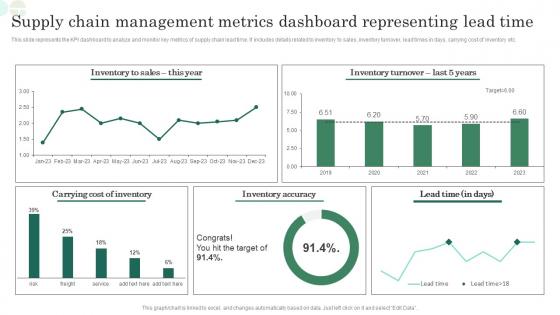
This slide represents the KPI dashboard to analyze and monitor key metrics of supply chain lead time. It includes details related to inventory to sales, inventory turnover, lead times in days, carrying cost of inventory etc.
People who downloaded this PowerPoint presentation also viewed the following :
Supply Chain Management Metrics Dashboard Representing Lead Time with all 7 slides:
Use our Supply Chain Management Metrics Dashboard Representing Lead Time to effectively help you save your valuable time. They are readymade to fit into any presentation structure.





FAQs for Supply Chain Management Metrics Dashboard
Your biggest lead time killers are usually supplier processing, production time, shipping, and quality checks. But honestly, don't sleep on your own order processing - that paperwork drags on way longer than it should. Weather screws things up too, plus customs delays and whether your supplier actually has stock. Track each piece separately though. You'll spot exactly where things get stuck instead of just guessing. Makes it way easier to fix the real problems.
Start with consistent measurement points - when stuff hits each team's queue and when it's done. Different departments work at crazy different speeds (legal is always the slowest, sorry not sorry), but that's actually useful info. Automate the tracking through whatever tools you already have instead of making people log times manually. Handoff points between teams are where things usually get stuck, so focus there. Oh and make the data visible to everyone - teams need to see how their delays mess with everyone else's work downstream.
Dude, automation is seriously a lifesaver for speeding things up. You get rid of all those manual handoffs and human screw-ups that slow everything down. Automated testing, CI/CD pipelines, inventory systems that order stuff before you're even out - it all adds up. The real magic happens when you eliminate those dead zones where work just sits there waiting. Plus you'll actually see where things get stuck instead of guessing. I'd start by looking at your biggest time-wasters first - like, what takes forever that shouldn't? Those manual steps are usually where the gold is hiding.
Start with trade association data and market reports to see what's normal for your industry. Manufacturing is usually 2-4 weeks, custom software more like 8-12 weeks - but honestly, being "average" isn't the goal here. Survey your actual customers about what they can live with. Mystery shop your top competitors or dig through their case studies. I'd aim slightly better than industry average but don't promise what you can't deliver consistently. Track everything starting now and tweak your benchmarks every quarter based on real data. Way better than guessing.
Honestly, the worst mistake I see is teams not agreeing on what they're actually measuring. Like, are you timing from when the customer asks for something to delivery? Or just the dev work? Pick one and stick with it - I've seen so many teams flip-flop and then wonder why their data's all over the place. Also don't mix up waiting time with actual work time, that'll mess up your whole improvement strategy. And resist the urge to throw out outliers just because they look bad. Write down your exact definition first though, that's really the key.
So here's the thing - lead time metrics tell you exactly where stuff gets stuck in your processes. Track how long each step actually takes and you'll see the patterns. That approval thing that always drags on for three extra days? Yeah, now you can fix it before customers get pissed. Honestly, most bottlenecks are pretty obvious once you measure them. When lead times get shorter and more consistent, customers are happier and your team isn't constantly putting out fires. Just start measuring everything end-to-end first, then break it down by stages to find your biggest wins.
Your suppliers basically control a massive piece of your lead times, so when they're late or send you garbage that needs fixing, it screws up everything downstream. Honestly, I've seen suppliers single-handedly destroy otherwise solid metrics. Track their delivery performance separately - you need to know which ones are the problem children. Monitor on-time rates and quality scores so you can jump on issues early. Otherwise you're just sitting there wondering why your numbers look terrible while the real culprit is three steps back in your chain.
Yeah, economic stuff absolutely wrecks lead times. Recessions hit you with supplier delays and material shortages - I've seen timelines triple overnight. Boom times aren't better though, just different chaos when demand spikes overwhelm everything. Your suppliers start consolidating shipments to cut costs during downturns. Transportation gets pricier with inflation too, which is fun. Honestly, the whole "predictable market" thing feels like a joke sometimes. Best move? Track those external indicators with your internal stuff so you can warn stakeholders before everything hits the fan. Way easier than explaining delays after the fact.
Depends what you're working with, but there's plenty out there. Jira and Azure DevOps are solid for dev teams, while Linear's getting popular too. Manufacturing usually goes with the big ERP stuff - SAP, Oracle, that whole world. Project managers seem obsessed with Asana and Monday.com lately. Honestly? A decent spreadsheet works fine when you're starting out. I've seen teams overthink this and pick some crazy complex tool nobody ends up using. Pick whatever your people will actually touch daily. Track stuff for like a month first, then you'll know if you need something fancier.
Honestly, lean principles are your best bet here. Map out your whole process first - you'll spot the bottlenecks right away. Then work on cutting down handoffs and those annoying wait times between steps. Pull systems are clutch for this because they stop work from just piling up everywhere. I swear, some teams I know literally cut their lead times in half doing exactly this stuff. Set up regular check-ins where everyone can call out the biggest time wasters. Oh, and measure the whole end-to-end time, not just individual tasks - that's where you'll actually see if customers are getting stuff faster.
Honestly, map out your current process first - that's where you'll spot the real time wasters. Those approval bottlenecks? Total momentum killers. Try running things in parallel instead of making everyone wait in line. Breaking down silos between engineering, design, and manufacturing makes a huge difference too. I swear, cross-functional teams move so much faster when they actually talk to each other. Rapid prototyping tools are worth the investment for quick iterations. Agile methodologies help if you're not doing that already. But seriously, start with mapping everything out - you'll be shocked where time disappears.
Monthly reviews are ideal, but quarterly is way more realistic tbh. You get enough data to catch trends without obsessing over weird random spikes that'll just stress you out. Consistency matters more than perfection here. High-growth phase or major process changes? Yeah, definitely go monthly then. The real trick is actually sticking to whatever schedule you pick - I swear most teams set these up and then forget about them completely. Put it on everyone's calendar and treat it like any other meeting. Short reviews work fine too, doesn't need to be this whole production.
So for lead time, I'd definitely track it against customer satisfaction - shorter delivery usually equals happier customers. Throughput and cycle times are obvious ones since they're all connected. Oh, and don't forget defect rates because sometimes teams rush and mess up quality trying to hit deadlines (classic mistake). Resource utilization shows you why lead times go crazy sometimes. Honestly, just throw all these on one dashboard so you can see the patterns. Makes it way easier to catch those trade-offs before they bite you.
Oh man, this is such a headache but totally predictable once you know what to watch for. Business hours are wildly different everywhere, plus some places need like 5 people to approve anything while others just go for it. The communication thing is huge too - I've learned suppliers will totally say "yes" just to be nice even when they're already swamped. Then you've got all the holidays nobody thinks about. Chinese New Year basically shuts everything down for weeks, which honestly makes sense but still catches people off guard. My advice? Pad your timelines way more than feels necessary and actually learn their holiday calendar first.
Honestly, just be straight up about timing from day one. Nothing pisses customers off more than broken promises. Tell them 4-5 weeks if that's what it really takes - don't sugarcoat it with "2-3 weeks" BS. Put it in writing too. Give actual dates instead of saying stuff like "soon." I'd set up some basic tracking thing they can check themselves. Updates are huge if anything goes sideways. Look, people can handle waiting if they know what's up. It's the surprises that kill you. Better to underpromise and look like a hero when you deliver early.
-
You know what? I'm so glad I opted for this PPT design. It has been a total game-changer for me and my presentations. Thank you!
-
Best Representation of topics, really appreciable.