


Vendor scorecard walmart powerpoint presentation slides




Try Before you Buy Download Free Sample Product
 Impress Your
 Audience
 100%
100% Editable
 Save Hours
 of Time


Vendor scorecards improve costs, mitigate errors, measure performance, strengthen relationships, etc. The concept is used in companies by preparing scorecards for each activity and ensuring that the performance is working appropriately and consistently. Here is a professionally designed template for the Vendor Scorecard Walmart to establish a clear understanding of what matters most for tracking the performance. It brings out the overview of the project in a creative cum visual look. Using a compliance matrix, a company can demonstrate its evaluation parameters to measure work quality. The module displays the deliverables with their time, cost and location. The products have a breakdown for costs as each element carries equal weightage in deciding the value for credit rating. The Walmart scorecard includes the minutest details of the vendors to examine customer service. Highlights are there for emphasis on team management and approaches used to develop a warm environment at work. The scorecard displays payment terms, quality issues, service quality, etc. The format underlines the critical points of the vendor. Get access to our 100 percent editable Scorecard template and download it now.
People who downloaded this PowerPoint presentation also viewed the following :
Content of this Powerpoint Presentation
Slide 1: This slide introduces Vendor Scorecard Walmart. State Your Company Name and begin.
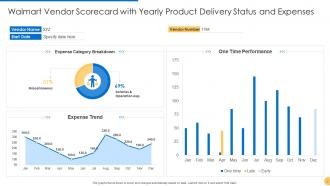
Slide 2: This slide shows Walmart Vendor Scorecard with Yearly Product Delivery Status and Expenses.
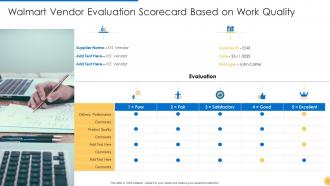
Slide 3: This slide presents Walmart Vendor Evaluation Scorecard Based on Work Quality.
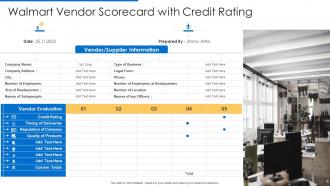
Slide 4: This slide shows Walmart Vendor Scorecard with Credit Rating.
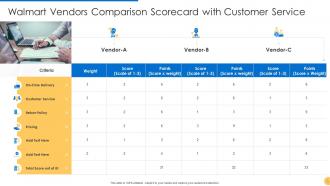
Slide 5: This slide displays Walmart Vendors Comparison Scorecard with Customer Service.
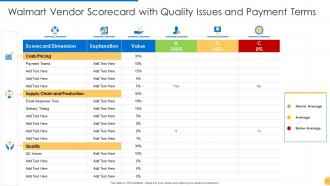
Slide 6: This slide represents Walmart Vendor Scorecard with Quality Issues and Payment Terms.
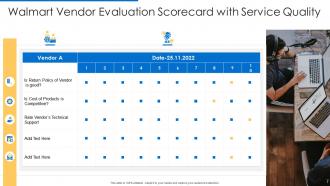
Slide 7: This slide shows Walmart Vendor Evaluation Scorecard with Service Quality.
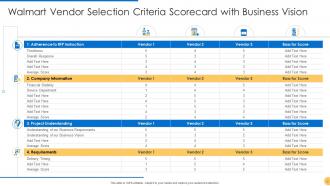
Slide 8: This slide presents Walmart Vendor Selection Criteria Scorecard with Business Vision.
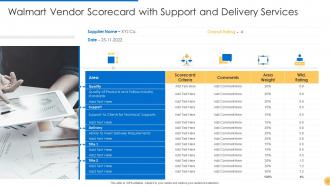
Slide 9: This slide shows Walmart Vendor Scorecard with Support and Delivery Services.
Slide 10: This slide displays Icons for Vendor Scorecard Walmart.
Slide 11: This slide is titled as Additional Slides for moving forward.
Slide 12: This is Our Mission slide with related imagery and text.
Slide 13: This slide presents 30 60 90 Days Plan with text boxes.
Slide 14: This is a Timeline slide. Show data related to time intervals here.
Slide 15: This is an Idea Generation slide to state a new idea or highlight information, specifications etc.
Slide 16: This slide represents Venn diagram with text boxes.
Slide 17: This slide shows Puzzle with related icons and text.
Slide 18: This slide presents Post It Notes. Post your important notes here.
Slide 19: This slide shows Roadmap with additional textboxes.
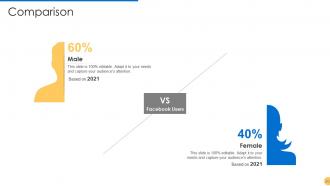
Slide 20: This is a Comparison slide to state comparison between commodities, entities etc.
Slide 21: This is a Thank You slide with address, contact numbers and email address.
Vendor scorecard walmart powerpoint presentation slides with all 21 slides:
Use our Vendor Scorecard Walmart Powerpoint Presentation Slides to effectively help you save your valuable time. They are readymade to fit into any presentation structure.




FAQs for Vendor scorecard walmart
Quality metrics are your bread and butter - definitely start there. Delivery performance and cost stuff matter too, obviously. I always throw in communication scores because vendors who suck at responding drive me crazy. Don't forget compliance tracking and risk factors like financial stability. Honestly, geographic concentration bit us once when a supplier's whole region got hit by flooding. Keep it to 4-6 metrics max at first. You can pile on more later, but people won't use it if it's too complicated right out the gate.
Pick 4-6 metrics that actually matter - on-time delivery, quality scores, cost stuff, responsiveness. More than that and you'll drown in data (learned this the hard way). Set up reviews every month or quarter where you rate each vendor the same way every time. Same metrics, same scale, same schedule - sounds boring but it works. You want solid trend data so you can spot when someone's slipping. Plus having real numbers makes contract renewal conversations way less awkward. Nobody can argue with consistent tracking over time. Just stay systematic about it and you'll be golden.
Start with performance stuff - uptime, response times, whether they actually hit their SLAs. Security compliance is massive right now (honestly can't afford to mess around there). I'd track support quality too - how fast do they fix things and are customers happy? Check if they're keeping up with tech trends or still living in the stone age. Financial stability matters since you don't want them going under halfway through your contract. That happened to my last company and it was a nightmare. Keep it simple though - maybe 5-7 metrics tops until your team gets the hang of it.
So vendor scorecards are pretty clutch for catching red flags early. Track stuff like their finances, security compliance, delivery times - all in one spot instead of juggling random spreadsheets (which I'm definitely guilty of). The scoring helps you see when someone's performance is tanking so you can either help them fix it or start looking elsewhere. Oh, and set up alerts when scores dip too low. Way better than remembering to check everything manually all the time.
You definitely need to talk to everyone who deals with vendors - procurement, project managers, users, finance, sometimes even legal. Each group has totally different pain points and priorities. I've watched scorecards completely flop because some procurement person built it alone in their office without asking anyone what actually matters. The finance team cares about costs, but your project managers might be more worried about delivery timelines. Start by just asking people what drives them crazy about vendors and what makes them love working with certain ones. That's how you figure out which metrics to weight heavily versus the stuff that just looks good but doesn't matter day-to-day.
Honestly, the automation part is a game changer for vendor scorecards. Your ERP and procurement systems can feed data directly into the platform - delivery times, quality scores, invoice accuracy, all that stuff. No more hunting down spreadsheets every month or bugging people for updates. Some tools even pull info from emails and contracts which is actually pretty cool. Real-time data beats stale reports any day. I'd start by figuring out what data sources you can already tap into. Way better than the manual nightmare most people deal with.
Honestly, the two big traps I see people fall into: cramming way too many metrics in there, or tracking stuff that doesn't actually matter. Like, I've watched companies obsess over easy numbers like delivery times while completely ignoring whether their customers are happy or if they're innovating at all. Pretty backwards if you ask me. Don't make it this massive 20-metric monster that nobody wants to look at. Stick with maybe 5-8 things that actually connect to your goals. Otherwise you'll end up with one of those dead spreadsheets gathering digital dust.
Honestly, vendor scorecards are game-changers for keeping relationships healthy. You're not just calling when stuff hits the fan - you're actually talking regularly about how things are going. Think of it like those awkward employee reviews we all hate, but they actually prevent bigger headaches later. Your vendors know exactly what you expect and where they stand. You get better service consistency too. Oh, and don't overcomplicate it at first. Pick maybe 3-4 things that actually matter and do quarterly check-ins. Keeps everyone on the same page without being a pain.
Manufacturing, healthcare, retail, and finance get the most value from vendor scorecards. Makes sense - when a supplier messes up in those industries, it can really snowball into bigger issues. Construction and IT services work well too since they're constantly dealing with tons of different suppliers. You need enough vendors to track where it's actually worth the effort though. Plus the performance differences have to genuinely impact your business. Honestly, I'd start by figuring out which vendor relationships are most critical to you first. Don't try to track everyone right away.
Quarterly is usually the sweet spot for most vendor scorecards. But honestly? It really comes down to how much they matter to your business. Critical vendors or ones giving you headaches should get monthly attention - trust me on this one. Low-risk suppliers can probably slide by with yearly reviews. Whatever schedule you pick, just be consistent about it. That's how you'll actually catch patterns before they bite you. Oh, and definitely do extra reviews when stuff hits the fan or contracts are up for renewal. Set those calendar alerts now or you'll forget.
Honestly, quarterly face-to-face meetings work way better than just emailing spreadsheets and disappearing. Be upfront about how you're scoring things so they're not blindsided later. Here's the thing though - don't just dump problems on them. Give them actual steps to improve, and always mention what they're nailing too. Nobody wants purely negative feedback, you know? Make it feel like you're working together instead of grading them like a teacher. Oh, and definitely do follow-ups on whatever action items you agreed on.
Honestly, the easiest way is just converting that stuff into numbers using 1-5 scales. Pick maybe 3-4 things that actually matter - like how well they communicate or respond to issues. Then rate based on feedback you get from surveys or when problems come up. I get it, turning feelings into math feels strange at first. But once you start doing it consistently, you can compare it right alongside your hard data like delivery times. The trick is being super consistent about how you score things - otherwise you're just making up numbers that don't mean anything.
Heat maps are perfect for this - color coding makes it super easy to spot performance patterns across metrics. Spider charts are honestly my favorite though, they show strengths and weaknesses way better than boring tables. Dashboard layouts with those KPI tiles work well if you're presenting to executives who want quick highlights. Oh, and line charts are solid for showing trends over time, nothing fancy needed there. Keep your colors consistent and don't stuff everything onto one slide or people will just zone out.
Honestly, just pick 3-5 things that actually matter - cost, delivery time, quality, maybe communication. Don't overthink it with complicated scoring systems. A basic spreadsheet beats expensive software every time, trust me. Did they show up on time? Was the stuff good? Are they easy to work with? That's really all you need to track. I'd update it monthly or when you remember to - quarterly works too. You can always add more later if something's missing. The whole point is making smarter choices about who to work with, not drowning yourself in paperwork.
Honestly, Excel or Google Sheets are perfect starting points - most teams begin there anyway. Once you outgrow spreadsheets, check out procurement platforms like SAP Ariba, Coupa, or Ivalua since they've got scorecard features baked in. JAGGAER and VendorHawk are decent too if you want something more specialized for vendor management. My advice? Don't overthink it initially. Build a simple spreadsheet template first, see what works for your team, then move to fancier tools once you actually know what you need. No point paying for features you'll never touch.
-
Great quality product.
-
Very unique, user-friendly presentation interface.