

Shipping vendor scorecard powerpoint powerpoint presentation





Try Before you Buy Download Free Sample Product
 Impress Your
 Audience
 100%
100% Editable
 Save Hours
 of Time


A scorecard is a report that measures and compares performance against business projections and goals. A scorecard facilitates better business alignment and helps connect employees to organizational goals. Here is an efficiently designed template on Shipping Vendor Scorecard that illustrates various charts for performance rating and spending summary. A scorecard for suppliers enables corporate to develop grading scales and set standards for measuring product transportation. A vendor scorecard allows the organization to identify suppliers and business performance measurement indicators. This PowerPoint presentation covers on-time shipment delivery, supply performance metrics, and annual revenue earned. This template discusses service response time, product price performance, and customer satisfaction. Lastly, this presentation includes vendor comparison scorecards based on criteria and monthly product delivery ratings. Download our 100 percent editable and customizable template with assistance from our insightful and powerful research or design team. Get access now.
People who downloaded this PowerPoint presentation also viewed the following :
Content of this Powerpoint Presentation
Slide 1: This slide displays title i.e. 'Shipping Vendor Scorecard'.
Slide 2: This slide introduces Shipping Vendor Scorecard with Total Spend and Ontime Delivery.
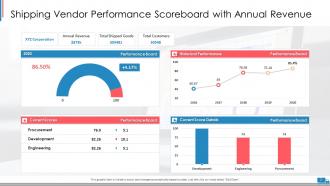
Slide 3: This slide shows Shipping Vendor Performance Scoreboard with Annual Revenue.
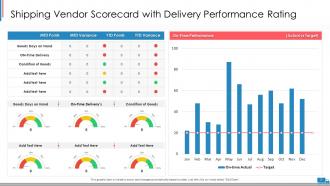
Slide 4: This slide presents Shipping Vendor Scorecard with Delivery Performance Rating.
Slide 5: This slide shows Shipping Vendor Spend Scorecard Summary in Graph.
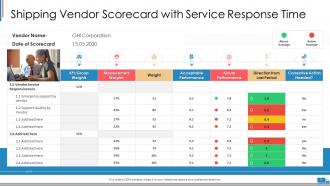
Slide 6: This slide displays Shipping Vendor Scorecard with Service Response Time.
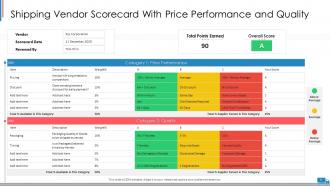
Slide 7: This slide represents Shipping Vendor Scorecard With Price Performance and Quality.
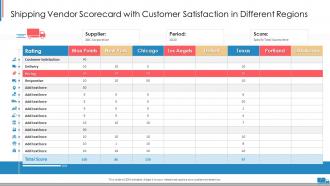
Slide 8: This slide shows Shipping Vendor Scorecard with Customer Satisfaction in Different Regions.
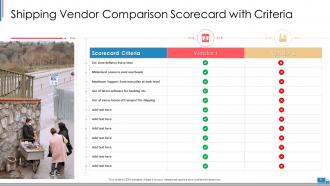
Slide 9: This slide presents Shipping Vendor Comparison Scorecard with Criteria.
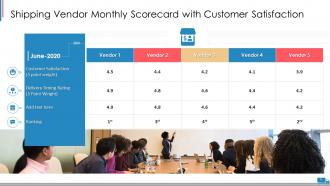
Slide 10: This slide shows Shipping Vendor Monthly Scorecard with Customer Satisfaction.
Slide 11: This slide displays Icon for Shipping Vendor Scorecard.
Slide 12: This slide is titled as Additional Slides for moving forward.
Slide 13: This is a Financial slide. Show your finance related stuff here.
Slide 14: This is a Comparison slide to state comparison between commodities, entities etc.
Slide 15: This is a Timeline slide. Show data related to time intervals here.
Slide 16: This slide displays Post It Notes. Post your important notes here.
Slide 17: This slide represents 30 60 90 Days Plan with text boxes.
Slide 18: This slide shows Roadmap with additional textboxes.
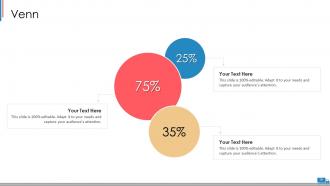
Slide 19: This slide presents Venn diagram with text boxes.
Slide 20: This slide represents Column chart with two products comparison.
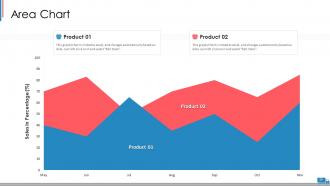
Slide 21: This slide displays Area chart with two products comparison.
Slide 22: This is a Thank You slide with address, contact numbers and email address.
Shipping vendor scorecard powerpoint powerpoint presentation with all 22 slides:
Use our Shipping Vendor Scorecard Powerpoint Powerpoint Presentation to effectively help you save your valuable time. They are readymade to fit into any presentation structure.








FAQs for Shipping vendor scorecard
Track your on-time delivery percentage, shipping costs per unit, and damage rates first - those are the big ones. Customer satisfaction scores matter too, obviously. Transit time consistency is where you'll really see who's reliable vs who just got lucky a few times. Claims resolution speed separates the pros from the amateurs, trust me on that. Order accuracy is massive because shipping wrong items kills everything even if it arrives fast. Honestly, start measuring these monthly and set benchmarks upfront. Six metrics sounds like a lot but you need that visibility to catch problems early.
Start by tracking the basics - on-time delivery, damage rates, cost per shipment. Monthly reports work best, honestly spreadsheets get messy if you try to do too much at once. Zero in on whatever's actually hurting your customers most. Then sit down with your worst-performing vendors and hammer out real improvement plans. I've found you need specific targets like "cut late deliveries by 15% in 90 days" - vague complaints don't change anything. Focus on your top 3 vendors first since that's where you'll see the biggest difference.
On-time delivery is huge - probably the most important metric on any vendor scorecard. Track the percentage hitting deadlines plus any delay patterns you notice. Most companies aim for 95-98% depending on service level, which honestly seems reasonable. You don't want to deal with pissed off customers asking where their stuff is! The trick is measuring consistently across all vendors so you can actually compare performance. Makes contract decisions way easier when you've got solid data. Oh, and it directly affects customer satisfaction and your planning - kind of obvious but worth mentioning.
Pick your KPIs first - on-time delivery, damage rates, cost per shipment, whatever matters to you. Then don't change them halfway through (seriously, I've watched companies totally screw this up). Use the same measurement methods every single time. Monthly or quarterly scorecards work great if you stick to identical templates. Document how you're scoring things so anyone on your team can replicate it later. The key is being boring and consistent - same data sources, same timeframes, same criteria. Otherwise your trend analysis becomes useless and you can't actually tell if vendors are improving or getting worse.
Dude, automate everything you can - pull straight from your TMS, WMS, and carrier APIs instead of dealing with manual reports. Track the usual stuff like on-time delivery and damage rates, plus grab customer complaints and claims data. Spreadsheets turn into absolute chaos fast, trust me on that one. Get dashboards that update themselves and make sure everyone defines metrics the same way - "on-time" can't mean different things to different vendors, you know? Oh, and definitely loop in your warehouse and customer service people since they catch problems that won't show up in your data.
Make a template with the same metrics for everyone - delivery times, costs, damage rates, customer satisfaction. That way you're actually comparing apples to apples. Weight them based on what matters most to your business. Honestly, most people screw this up by using random different metrics for each vendor, which defeats the whole point. Score everything on the same scale, like 1-10. Do quarterly reviews so you can see who's crushing it versus who needs a reality check conversation. Oh and keep it simple - I've seen people overcomplicate this stuff.
Honestly, quarterly email reports are fine for the basic metrics and trends, but the real magic happens during follow-up calls. That's where you can actually dig into the why behind the numbers. I've noticed vendors respond way better when you schedule regular face-to-face review meetings instead of just dropping reports on them and walking away. Make sure you include specific action items with actual timelines too. The trick is framing it as teamwork - like "here's how we can tackle this together" rather than just calling out what went wrong. Way more effective that approach.
Give your scorecard different weights based on what matters most - like 40% cost, 40% quality, 20% delivery stuff. Don't just chase the cheapest vendor though, that's a mistake I've seen bite people hard. Quality issues downstream will cost you way more than you saved upfront. Look at total cost of ownership instead of just unit price. Track things like damage rates and customer complaints too. The goal isn't finding vendors who are perfect at one thing, but ones who balance both well. Oh and adjust those percentages every quarter based on how things are actually going.
Honestly, switching to automated vendor tracking was a game changer for us. Real-time dashboards pull data straight from your carriers - delivery times, damage rates, costs, all that stuff. Way better than drowning in spreadsheets every week. The cool thing is it'll actually predict delays and catch vendors slipping before they screw you over. You can set alerts when someone misses your KPIs too, which saves me from babysitting everything constantly. Oh, and don't try to do everyone at once - start with your top 3 carriers first or you'll go crazy.
Dude, scorecards are gold for negotiations. Pull out those delivery times and damage rates when you're talking to vendors - suddenly they can't BS you with vague promises anymore. I've seen suppliers totally change their tune when you show them actual numbers comparing them to competitors. Top performers? Negotiate better rates with them. Underperformers need to step up their game or you'll find someone who will. Honestly, starting negotiations with "here's your current performance data" instead of "what's your best offer" completely flips the script. Makes the whole conversation way more productive too.
Honestly, keep it simple - like 5-7 key metrics max. You'll get buried in numbers otherwise. Track stuff like on-time delivery, damage rates, cost performance. Mix in some forward-looking indicators too, not just the backward-looking ones. I've watched companies build these gorgeous scorecards that were completely pointless because they missed the actual business drivers. Weight things based on what you really care about. Oh, and set up regular reviews so you're not just creating another document that sits there. Start basic, see what works, then tweak it. Much better than trying to be perfect from day one.
You'll want to track stuff like on-time delivery, damage claims, and how fast they respond to issues. Monthly reviews help you catch problems before they screw over your customers. Honestly, I've seen vendors who look amazing upfront but their data tells a different story entirely. Look for patterns - maybe one shipper is consistently late on Fridays or another one's damage rates are creeping up. It's basically like monitoring your shipping partners' health. When you spot red flags early, you can start lining up backup options or have those awkward conversations before things get worse.
Monthly is usually your sweet spot, maybe weekly if you're shipping tons of stuff or handling super time-sensitive deliveries. Don't go quarterly though - that's way too slow and you'll miss catching problems early. Monthly gives you enough data to see actual patterns instead of just random daily weirdness. Honestly, the biggest thing is just being consistent about it. I'd set a calendar reminder because otherwise (trust me) you'll keep saying "oh I'll do it next week" and suddenly three months have passed. Stick to whatever schedule you pick and you'll be fine.
Numbers don't tell the whole story, you know? Your scorecard might say 95% on-time delivery, but it won't catch that their drivers are jerks to your warehouse team. Or that they actually give you a heads up about delays before they happen. Communication style, how they handle problems, relationship stuff - that's where the real value is. I'd probably set up some kind of quarterly survey for your ops people. Get their take on the soft skills alongside all those hard metrics. Trust me, that relationship piece matters way more than most people realize.
Honestly, customer satisfaction matters just as much as cost when you're picking shipping vendors. Track stuff like delivery ratings, damage complaints, and how they communicate during delays. A vendor might nail all their deadlines but still suck if customers keep complaining about crushed boxes or jerky drivers - which happens more than you'd think. Pull data from surveys, support tickets, whatever feedback you can get. Don't just look at whether packages arrive on time. The whole experience counts, so work those satisfaction scores into your vendor evaluations.
-
It saves your time and decrease your efforts in half.
-
Innovative and attractive designs.
-
Great experience, I would definitely use your services further.
-
Out of the box and creative design.
-
Very unique and reliable designs.
-
Excellent template with unique design.