


Voice Modulation Communication Effective Variation Icon Intonation




Try Before you Buy Download Free Sample Product
 Impress Your
 Audience
 100%
100% Editable
 Save Hours
 of Time


Get applauded with our Voice Modulation Communication Effective Variation Icon Intonation. They will congratulate you on your ideas.
People who downloaded this PowerPoint presentation also viewed the following :
Voice Modulation Communication Effective Variation Icon Intonation with all 12 slides:
Get clearly ahead with our Voice Modulation Communication Effective Variation Icon Intonation. Be alert to take the advantage.





FAQs for Voice Modulation Communication Effective
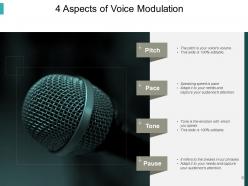
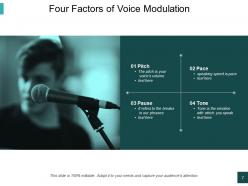
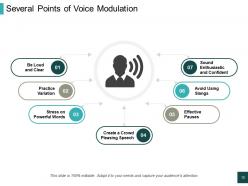
Key elements of voice modulation that enhance audience engagement include pitch variation, pace control, volume adjustments, strategic pauses, and tonal emphasis. These techniques enable presenters to maintain attention, highlight critical points, and create emotional connections, with many business leaders finding that varied delivery significantly improves message retention and audience response rates.
Pitch variation significantly enhances emotional impact by creating dynamic contrast, establishing emphasis on key points, conveying underlying emotions, and maintaining audience engagement throughout delivery. Higher pitches often signal excitement or urgency while lower tones suggest authority or gravity, with many professional speakers finding that strategic pitch modulation increases message retention by up to 40%, ultimately delivering more persuasive and memorable communications.
Voice modulation emphasizes essential points through strategic changes in pace, volume, pitch, and tone to capture audience attention and highlight critical information. Speakers can slow down during key concepts, increase volume for important statements, or lower their pitch for gravitas, with many professionals in sales, education, and leadership finding that these techniques significantly enhance message retention and audience engagement.
Speakers can effectively practice voice modulation through daily vocal exercises, recording and analyzing their speech patterns, practicing with varied content types, and incorporating breathing techniques. Through consistent rehearsal with different scenarios, professionals enhance their pitch control, pacing variety, and emotional range, while many presenters find that targeted practice with storytelling and technical content ultimately delivers more engaging presentations and stronger audience connection.
Pacing in voice modulation controls speech rhythm and timing, directly impacting comprehension and engagement through strategic pauses, accelerated explanations, and deliberate emphasis points. Effective pacing enhances audience retention by creating natural breathing moments, building anticipation during key revelations, and preventing cognitive overload, with many presenters finding that varied tempo keeps listeners actively engaged throughout extended presentations.
Pauses in presentations create dramatic emphasis, allow audience processing time, demonstrate speaker confidence, and provide natural breathing opportunities for vocal control. Through strategic silence, presenters punctuate key messages, build anticipation before important announcements, and reset their vocal tone, with many speakers finding that well-timed pauses enhance audience engagement and message retention significantly.
Volume regulation techniques include strategic projection, dynamic range variation, microphone positioning, breath support optimization, and audience-size adjustment. These methods enhance clarity by ensuring consistent audibility, creating emphasis through volume shifts, and maintaining vocal stamina, with many speakers finding that deliberate volume control significantly improves audience engagement and message retention.
Cultural differences significantly influence acceptable voice modulation through varying preferences for volume, pace, emotional expression, and emphasis patterns across regions. While Western cultures often favor dynamic variation and assertive delivery, many Asian cultures prefer measured, respectful tones, with Middle Eastern and Latin American contexts embracing more passionate expression, ultimately requiring presenters to adapt their vocal strategies for maximum audience engagement and credibility.
Common voice modulation mistakes include monotone delivery, speaking too rapidly, inconsistent volume levels, overusing filler words, and failing to match tone with content. These errors significantly impact audience engagement and message clarity, with many professional speakers finding that practicing varied pitch patterns, strategic pausing, and conscious pace control ultimately delivers more compelling presentations and stronger audience connection.
Voice modulation techniques definitely vary between virtual and in-person presentations, requiring distinct approaches for microphone sensitivity, acoustic environments, and audience engagement methods. Virtual presentations demand more pronounced vocal variety and strategic pausing to compensate for screen-mediated communication, while in-person formats allow for subtler modulation that works with natural acoustics, with many presenters finding that mastering both approaches significantly enhances their overall communication effectiveness.
Breath control enables effective voice modulation by providing steady airflow for consistent tone, supporting volume variations without strain, and allowing strategic pauses for emphasis. Through proper diaphragmatic breathing techniques, presenters maintain vocal stability across longer presentations, deliver powerful emphasis on key points, and project confidence, ultimately enhancing audience engagement and message retention.
Voice modulation exercises include diaphragmatic breathing, pitch variation drills, pace control practice, volume dynamics training, and tongue twisters for articulation clarity. These techniques enhance professional communication by developing vocal range, improving audience engagement, and building speaker confidence, with many presenters and public speakers finding that consistent practice ultimately delivers more compelling presentations and stronger executive presence.
Audience feedback is crucial for effective voice modulation, enabling presenters to adjust pace, volume, tone, and emphasis in real-time based on engagement cues, facial expressions, and body language. Through attentive observation, speakers can enhance clarity during complex segments, increase energy when attention wanes, and modify delivery style, ultimately creating more impactful presentations that resonate with diverse audiences.
Technology enhances voice modulation through high-quality microphones that capture vocal nuances, sound processors that adjust tone and pitch in real-time, and advanced audio systems that optimize delivery across different environments. These tools enable speakers to maintain consistent vocal clarity, control amplitude variations, and adapt their voice for various settings, with many professional presenters and educators finding that strategic technology integration significantly improves audience engagement and communication effectiveness.
Emotional intelligence significantly enhances voice modulation by enabling speakers to recognize audience emotions, adapt their vocal tone accordingly, and create deeper connections through strategic pitch, pace, and volume adjustments. Leaders with high emotional intelligence demonstrate superior presentation skills, with many finding that their ability to read room dynamics and modify vocal delivery creates more persuasive communications, ultimately delivering stronger audience engagement and more successful business outcomes.
No Reviews