

Warehouse management system dashboard inbound outbound logistics management process ppt grid





Try Before you Buy Download Free Sample Product
 Impress Your
Audience
 100%
Editable
 Save Hours
of Time


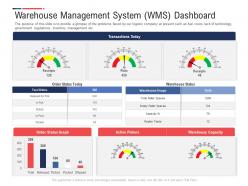
The purpose of this slide is to provide a glimpse of the problems faced by our logistic company at present such as fuel costs, lack of technology, government regulations, inventory management etc.
People who downloaded this PowerPoint presentation also viewed the following :
Warehouse management system dashboard inbound outbound logistics management process ppt grid with all 2 slides:
Use our Warehouse Management System Dashboard Inbound Outbound Logistics Management Process Ppt Grid to effectively help you save your valuable time. They are readymade to fit into any presentation structure.

FAQs for Warehouse management system dashboard inbound outbound logistics management
A comprehensive WMS should include real-time inventory tracking, automated stock replenishment, barcode or RFID scanning, demand forecasting analytics, and multi-location management capabilities. These features streamline operations by reducing manual errors, optimizing storage space, and accelerating order fulfillment, with many retailers and distributors finding that integrated systems ultimately deliver significant cost savings and improved customer satisfaction.
A WMS improves order fulfillment by automating inventory tracking, optimizing pick paths, reducing manual errors, and providing real-time visibility across warehouse operations. Through barcode scanning and systematic workflows, distribution centers achieve 99%+ accuracy rates while reducing fulfillment times by 30-40%, ultimately delivering faster customer service and lower operational costs.
Real-time tracking revolutionizes modern warehouse operations by providing instant visibility into inventory movements, order status, and resource allocation throughout the supply chain. Through RFID sensors, barcode scanning, and IoT devices, warehouses achieve seamless coordination between picking, packing, and shipping processes, while minimizing errors and optimizing labor efficiency, ultimately delivering faster fulfillment and enhanced customer experiences.
Integrating barcode scanning with a WMS enhances productivity by eliminating manual data entry, reducing picking errors, and accelerating inventory tracking across warehouse operations. Through real-time scanning capabilities, distribution centers and retail warehouses achieve faster order fulfillment, improved accuracy rates, and streamlined receiving processes, ultimately delivering operational efficiency and reduced labor costs.
Cloud-based Warehouse Management Systems deliver enhanced scalability, reduced IT infrastructure costs, automatic software updates, real-time accessibility from multiple locations, and faster implementation compared to on-premise solutions. These systems enable organizations to streamline operations, minimize maintenance overhead, and respond quickly to seasonal demands, with many retail and manufacturing companies finding that cloud WMS solutions ultimately provide greater flexibility and competitive advantage.
A WMS facilitates better space utilization by providing real-time inventory tracking, optimizing storage locations based on product velocity, and implementing dynamic slotting algorithms that maximize cubic capacity. Through automated space allocation and intelligent picking path optimization, warehouses achieve 20-30% improved storage density while reducing retrieval times, ultimately delivering enhanced operational efficiency and lower storage costs.
Automation significantly enhances warehouse management systems by streamlining inventory tracking, reducing manual errors, and accelerating order fulfillment processes. Through robotics and AI-driven systems, warehouses achieve faster picking speeds, optimized storage allocation, and real-time inventory visibility, with many logistics companies finding that automated systems reduce operational costs while improving accuracy and delivery times.
A WMS supports multi-channel distribution by providing unified inventory visibility, automated order routing across channels, real-time stock allocation, and integrated fulfillment workflows. Through centralized inventory management, retailers streamline e-commerce, in-store, and wholesale operations simultaneously, while optimizing picking routes and delivery scheduling, ultimately delivering faster order processing and enhanced customer experiences across all sales channels.
Key WMS metrics include inventory accuracy, order fulfillment speed, warehouse space utilization, picking efficiency, labor productivity, and cost per shipment. These performance indicators enable businesses to identify bottlenecks, optimize resource allocation, and enhance operational efficiency, with many logistics companies finding that tracking these metrics delivers improved customer satisfaction and competitive advantage.
A WMS adapts to changing business needs through modular architecture, cloud-based infrastructure, configurable workflows, API integrations, and scalable processing capabilities. These systems enable organizations to adjust inventory parameters, accommodate seasonal fluctuations, and expand operations seamlessly, with many retail and manufacturing companies finding that modern WMS solutions deliver enhanced operational efficiency and competitive advantage in increasingly dynamic markets.
Common WMS implementation challenges include data migration complexities, employee resistance to new processes, integration difficulties with existing systems, unexpected customization costs, and extended training periods. While these obstacles can initially slow operations, companies in manufacturing, retail, and logistics increasingly find that thorough planning and phased rollouts ultimately deliver streamlined workflows, improved accuracy, and enhanced operational efficiency.
Data analytics from a WMS helps make informed business decisions by providing real-time insights into inventory levels, order patterns, warehouse efficiency metrics, and operational bottlenecks. Through predictive analytics and performance dashboards, businesses can optimize stock allocation, reduce carrying costs, and enhance fulfillment speed, with many logistics companies finding that data-driven decisions ultimately deliver competitive advantage.
A WMS improves supply chain collaboration by providing real-time inventory visibility, automated reorder notifications, shared forecasting data, and integrated communication platforms that connect vendors and partners seamlessly. Through these capabilities, organizations enable faster response times, reduce stockouts, and enhance coordination, with many retailers and manufacturers finding that improved visibility ultimately delivers stronger partnerships and competitive advantage.
AI and machine learning enhance WMS functionalities through predictive analytics, automated inventory optimization, intelligent demand forecasting, dynamic routing algorithms, and real-time anomaly detection. These technologies streamline warehouse operations by reducing manual errors, minimizing stockouts, and accelerating order fulfillment, with many distribution centers finding that AI-driven systems deliver significantly improved operational efficiency and cost reduction.
Mobile technology integrates within WMS through handheld scanners, tablets, smartphones, and wearable devices that enable real-time inventory tracking, order processing, and task management. These mobile solutions streamline operations by eliminating paper-based processes, reducing data entry errors, and providing instant access to warehouse information, ultimately delivering faster order fulfillment and enhanced operational efficiency.
-
Very unique, user-friendly presentation interface.
-
Commendable slides with attractive designs. Extremely pleased with the fact that they are easy to modify. Great work!
-
Informative design.
-
Use of different colors is good. It's simple and attractive.