


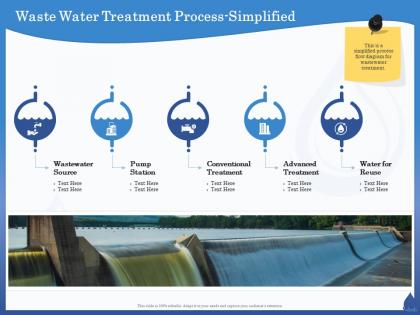
Waste water treatment process simplified reuse ppt powerpoint presentation infographic template images




Try Before you Buy Download Free Sample Product
 Impress Your
 Audience
 100%
100% Editable
 Save Hours
 of Time


Our Waste Water Treatment Process Simplified Reuse Ppt Powerpoint Presentation Infographic Template Images are topically designed to provide an attractive backdrop to any subject. Use them to look like a presentation pro.
People who downloaded this PowerPoint presentation also viewed the following :
Waste water treatment process simplified reuse ppt powerpoint presentation infographic template images with all 2 slides:
Use our Waste Water Treatment Process Simplified Reuse Ppt Powerpoint Presentation Infographic Template Images to effectively help you save your valuable time. They are readymade to fit into any presentation structure.

FAQs for Waste water treatment process simplified reuse ppt powerpoint presentation
Wastewater treatment objectives include removing contaminants, protecting public health, preserving environmental quality, enabling water reuse, and ensuring regulatory compliance. These processes streamline operations by reducing pollutants, minimizing environmental impact, and recovering valuable resources, with many municipalities and industries finding that modern treatment systems ultimately deliver cost savings and sustainable water management solutions.
Biological treatment uses living microorganisms to break down organic pollutants naturally, while chemical treatment relies on added chemicals like chlorine, coagulants, and flocculants to neutralize contaminants. Many municipalities and industrial facilities find that biological systems, though slower, deliver lower operational costs and environmental sustainability, while chemical methods provide faster processing and precise contaminant removal for immediate compliance needs.
The activated sludge method involves aeration, mixing, sedimentation, sludge return, and waste sludge removal as its core processes. These biological treatment stages work by introducing oxygen to promote microbial growth, separating treated water from biomass, and recycling active microorganisms, with many municipal facilities finding that this approach delivers consistent pollutant removal and cost-effective operations.
Emerging contaminants in wastewater can be effectively addressed through advanced oxidation processes, membrane bioreactors, activated carbon filtration, nanofiltration systems, and electrochemical treatment technologies. These methods streamline contaminant removal by targeting pharmaceuticals, microplastics, and industrial chemicals, with many water utilities finding that strategic combinations ultimately deliver enhanced water quality and regulatory compliance.
Microorganisms play a crucial role in wastewater treatment by breaking down organic pollutants, removing nitrogen and phosphorus compounds, and converting harmful substances into harmless byproducts through biological processes. These naturally occurring bacteria, fungi, and protozoa enable treatment facilities to achieve regulatory compliance while reducing operational costs, with many municipal and industrial plants finding that optimized microbial communities deliver enhanced efficiency and environmental protection.
Advanced wastewater treatment technologies deliver significant cost savings through reduced operational expenses, lower regulatory compliance costs, resource recovery opportunities, and decreased infrastructure maintenance requirements. These systems enable municipalities and industries to generate revenue through water reuse, biogas production, and nutrient recovery, while minimizing long-term capital expenditures and creating competitive advantages in increasingly regulated environments.
Industrial wastewater treatment differs from municipal treatment through specialized processes targeting specific contaminants, higher pollutant concentrations, and industry-specific regulatory requirements. While municipal systems handle general household waste through standardized biological processes, industrial facilities like chemical plants, refineries, and manufacturing operations require customized treatment technologies, advanced filtration systems, and specialized chemical processes to address unique pollutants, ultimately delivering compliance and environmental protection.
Current wastewater recycling innovations include membrane bioreactors, advanced oxidation processes, smart sensors for real-time monitoring, AI-driven treatment optimization, and decentralized treatment systems. These technologies streamline operations by reducing energy consumption, improving water quality, and enabling automated system management, with municipalities and industrial facilities finding that strategic implementation delivers significant cost savings and enhanced environmental compliance.
Wastewater discharge standards include the Clean Water Act's NPDES permits in the US, EU Water Framework Directive in Europe, and country-specific regulations like India's Pollution Control Board guidelines. These regulatory frameworks streamline compliance by establishing clear discharge limits, monitoring requirements, and treatment specifications, with many municipalities and industries finding that standardized approaches ultimately deliver operational efficiency and environmental protection.
Wastewater treatment facilities can reduce their environmental footprint through energy-efficient technologies, renewable energy integration, advanced nutrient recovery systems, and sustainable sludge management practices. These approaches streamline operations by minimizing energy consumption, capturing biogas for power generation, and recycling treated water for industrial use, ultimately delivering cost savings and enhanced regulatory compliance.
Challenges include limited infrastructure access, higher per-unit treatment costs, skilled operator shortages, regulatory compliance difficulties, and seasonal population fluctuations. These obstacles create both operational and financial barriers, with many rural communities finding that decentralized treatment systems, combined with innovative financing models and remote monitoring technologies, can deliver cost-effective solutions while ensuring environmental compliance and sustainable water management.
Wastewater treatment significantly enhances public health by removing harmful pathogens, chemicals, and contaminants that cause waterborne diseases like cholera, typhoid, and hepatitis. Through advanced filtration, biological processing, and chemical disinfection, treatment facilities protect communities from contaminated water supplies, reduce disease transmission rates, and ensure safe drinking water access, ultimately delivering healthier populations and lower healthcare costs.
Natural wastewater treatment systems, like constructed wetlands, offer significant environmental and economic benefits including lower energy consumption, reduced operational costs, minimal chemical requirements, enhanced biodiversity, and effective pollutant removal. These systems enable municipalities and industries to achieve sustainable water management while delivering long-term cost savings, with many facilities finding that natural treatment approaches provide reliable performance and community acceptance.
Community awareness and engagement enhance wastewater management through education campaigns, volunteer monitoring programs, and public participation in policy development. These initiatives drive behavioral changes like proper disposal practices, reduce contamination sources, and build support for infrastructure investments, with many municipalities finding that engaged communities achieve significantly better treatment outcomes and long-term sustainability.
Technologies for monitoring treated wastewater quality include real-time sensors, automated sampling systems, spectroscopy analyzers, biological monitoring tools, and IoT-enabled data platforms. These systems streamline compliance tracking, enhance operational efficiency, and ensure environmental safety by providing continuous water quality assessment, automated reporting, and predictive maintenance capabilities, with many municipal facilities and industrial plants finding that integrated monitoring delivers faster regulatory responses and reduced operational costs.
-
Presentation Design is very nice, good work with the content as well.