

Evaluación de la calidad del agua presentación de diapositivas





Try Before you Buy Download Free Sample Product
 Impress Your
Audience
 100%
Editable
 Save Hours
of Time


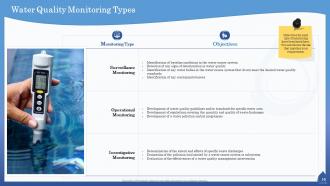
Presentación de diapositivas de PowerPoint sobre la evaluación de la calidad del agua. Nuestros diseños de diapositivas de PowerPoint del sistema de monitoreo de agua disponible proporcionan una descripción general del tamaño del mercado, la tasa de crecimiento y los gastos de capital. Demuestre la división del mercado de tratamiento de aguas residuales editando nuestro conjunto de diapositivas de PowerPoint listo para el contenido de control de calidad del agua. Puede presentar fácilmente las estadísticas clave que desempeñan un papel vital en el análisis de la industria del agua utilizando esta presentación de PowerPoint sobre el tratamiento del agua. Es fácil presentar las tendencias clave que influirán en la industria del agua en el futuro, como el aumento de la regulación, la infraestructura deficiente, una mayor conservación y eficiencia, etc. Muestre los principales factores que afectarán el desempeño del mercado de tecnología del agua utilizando visuales de PowerPoint de aseguramiento de calidad del agua listos para el contenido. Puede editar los temas de presentación de PowerPoint de pruebas de calidad del agua para presentar las fuentes de contaminación del agua. Resalte los procesos naturales y los procesos humanos que afectan la calidad del agua. Proporcione una descripción general de la optimización del deterioro de la calidad del agua. También puede presentar los contaminantes químicos y biológicos que deterioran la calidad del agua. Muestre los tipos de monitoreo de calidad del agua y sus objetivos descargando nuestras diapositivas de PowerPoint sobre monitoreo de calidad del agua que llaman la atención visualmente.
People who downloaded this PowerPoint presentation also viewed the following :
Contenido de esta presentación de Powerpoint
El agua, la poción mágica de la vida, sin la cual ningún ser vivo puede sobrevivir, merece la mejor conservación que la humanidad pueda darle. Pero, ¿qué debemos hacer como primer paso para salvaguardarla? La evaluación de la calidad del agua es la respuesta.
Monitorear la calidad del agua ayuda a rastrear las fuentes de su contaminación. La demostración de la evaluación de la calidad del agua es significativa, para que puedas elaborar estrategias de mitigación para combatir la contaminación y asegurar que no cree problemas importantes.
Si deseas hacer una diapositiva de PowerPoint, has llegado al lugar correcto. SlideTeam ha preparado algunas diapositivas de PowerPoint listas para usar para la evaluación de la calidad del agua. Puedes delinear los elementos esenciales en el proceso de verificación de la calidad del agua. Hemos creado un conjunto de diapositivas con impresionantes y creativas visualizaciones, gráficos y diagramas. Puedes editar la información, ya que cada plantilla es 100% editable y personalizable.
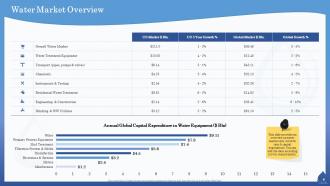
Plantilla 1: Visión general del mercado del agua
Crea un esquema del mercado del agua con esta diapositiva de PowerPoint que también te proporciona un gráfico listo para usar con cinco columnas y ocho filas. Cada fila demostrará el mercado del agua, incluyendo equipos de tratamiento de agua, transporte, químicos, instrumentos y pruebas, tratamiento de agua residencial, ingeniería y construcción, y agua potable y servicios públicos, junto con su participación en el mercado estadounidense, porcentaje de crecimiento y mercado global.
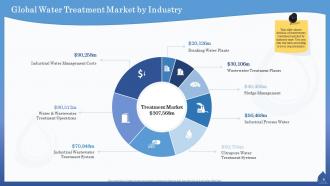
Plantilla 2: Mercado global de tratamiento de agua por industria
El mercado del tratamiento de agua es vasto, y esta plantilla te ayuda a demostrarlo a través de sus industrias. El gráfico ayuda a delinear los mercados de tratamiento de agua en industrias como el manejo de lodos, las operaciones de tratamiento de agua y aguas residuales y la gestión del agua industrial. Obtén esta diapositiva en particular para proporcionar un breve resumen del mercado global de tratamiento de agua.
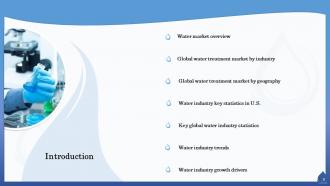
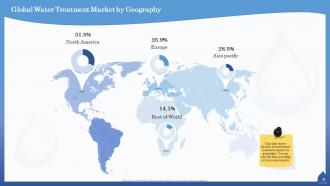
Plantilla 3: Mercado global de tratamiento de agua por geografía
Demuestra el mercado global de tratamiento de agua según su ubicación geográfica. Esta diapositiva destacará los mercados de tratamiento de agua en áreas del mundo. Por ejemplo, puedes ilustrar el tratamiento de agua en los continentes.
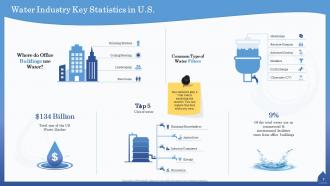
Plantilla 4: Estadísticas clave de la industria del agua en los EE.UU.
Esta diapositiva está diseñada para ayudarte a delinear las estadísticas clave de la industria del agua en cualquier país. Puedes resaltar los lugares a donde va el agua de los edificios de oficinas, los tipos comunes de filtros de agua, el tamaño total del mercado y los principales usos del agua a través de impresionantes visualizaciones y gráficos.
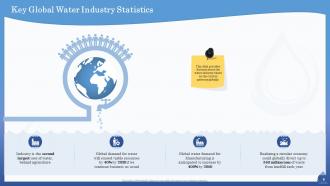
Plantilla 5: Estadísticas clave de la industria global del agua
La industria global del agua es gigantesca, e ilustrar esto es importante si estás presentando una evaluación de la industria global del agua; esta plantilla te ayudará a delinear que esta industria es el segundo uso más grande de agua y cómo la demanda global de agua excede los recursos viables a través de íconos creativos e innovadores.
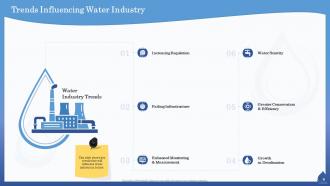
Plantilla 6: Tendencias que influyen en la industria del agua
Delinea las tendencias que influyen en la industria del agua a través de este PowerPoint. Puedes definir tendencias, como el aumento de la regulación, la seguridad del agua, la infraestructura fallida, el crecimiento en la desalinización y el monitoreo y medición mejorados. Obtén esta plantilla para delinear las tendencias de la industria del agua.
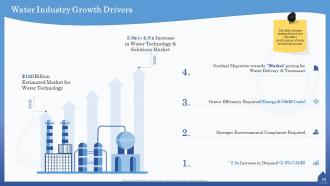
Plantilla 7: Impulsores de crecimiento de la industria del agua
Algunos impulsores clave impulsan a este sector esencial hacia un crecimiento significativo. Esta plantilla ayuda a demostrar el aumento en la demanda para el crecimiento de la industria del agua, los precios para la entrega y el tratamiento del agua, y la eficiencia requerida a través de gráficos y visualizaciones creativas.
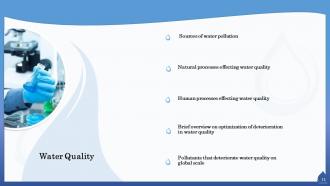
Plantilla 8: Calidad del agua
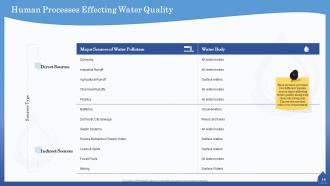
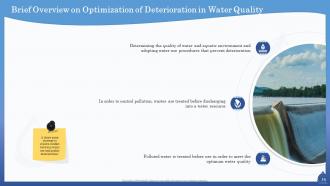
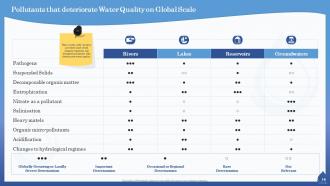
Esta plantilla en particular te ayudará a demostrar los factores que afectan la calidad del agua. A través de esta diapositiva, puedes representar y estudiar las fuentes de contaminación del agua. Además de esto, la diapositiva también proporcionará una visión general de la optimización del deterioro en la calidad del agua y los contaminantes responsables de ello a escala global.
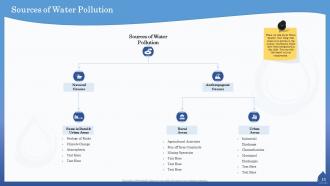
Plantilla 9: Fuentes de contaminación del agua
Resalta las fuentes de contaminación del agua usando esta plantilla y un diagrama de flujo. Puedes arrojar luz sobre los factores que pueden causar contaminación, como las causas naturales. Esta plantilla te brindará la oportunidad de mencionar más factores que causan contaminación, y también en áreas rurales y urbanas. Aprovecha la oportunidad de delinear los factores que causan contaminación a través de un diagrama de flujo.
Plantilla 10: Procesos naturales que afectan la calidad del agua
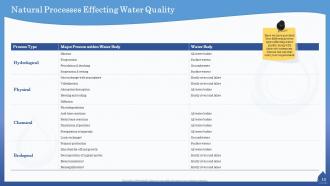
Crea un gráfico para demostrar los procesos naturales que afectan la calidad del agua. Resalta los tipos de procesos y los principales procesos dentro de los cuerpos de agua que impactan la calidad del agua. Esta diapositiva te ayuda a proporcionar información sobre los procesos que afectan la calidad del agua a través de un diagrama de flujo.
MANTENER LA CALIDAD DEL AGUA ES CRÍTICO
Los recursos hídricos son vitales y mantener su calidad es esencial para la salud humana y ambiental. La evaluación, como se realiza a través del conjunto completo, identificará áreas críticas y te ayudará a demostrarlas de acuerdo con los datos que completes. Obtén estas plantillas para mejores Diapositivas de Presentación de PowerPoint para la Evaluación de la Calidad del Agua.
Evaluación de la calidad del agua presentación de diapositivas de PowerPoint con las 76 diapositivas.
Utiliza nuestras Diapositivas de Presentación de Evaluación de Calidad del Agua para ayudarte de manera efectiva a ahorrar tiempo valioso. Están listas para encajar en cualquier estructura de presentación.




FAQs for Water quality assessment
Start with pH and dissolved oxygen - those are your bread and butter. Temperature and turbidity round out the basics. Monthly testing works for most water sources, though you might need more if there's sketchy stuff upstream. Nitrogen and phosphorus will show you nutrient problems, plus E. coli for any nasty contamination. Oh, and conductivity is actually pretty clutch even though people sleep on it - tells you about dissolved solids. Heavy metals matter if you're anywhere near industry. Honestly just grab a basic test kit first. You can always add more tests once you see what's going on.
So pH measures if your water's acidic or basic, and fish are super picky about it. They need that 6.5-8.5 range or they'll get stressed and sick. Acidic water can actually eat away at their gills - pretty brutal stuff. Basic water makes ammonia way more toxic, which is bad news. I've watched whole lakes go to hell when the pH crashed! You should test it with temperature and oxygen levels since they all affect each other. Oh, and if your numbers look weird, check what's happening upstream first.
So heavy metals are basically the big red flags for water contamination - lead, mercury, cadmium, all that nasty stuff. They don't break down naturally and just keep building up in your system over time, which is why even tiny amounts matter. The annoying thing is that "safe" levels totally depend on what you're using the water for. Drinking water? Super strict limits. Watering crops? Way more relaxed standards. You'll need really precise testing since we're talking trace amounts here. Just make sure you're checking against the right guidelines for whatever you're actually doing with the water - I've seen people mess that up before.
So basically macroinvertebrates are like little water quality indicators - you find different bugs depending on how clean the stream is. Mayflies and caddisflies? Your water's in great shape. Only seeing worms and midge larvae means there's probably pollution upstream. Honestly I was skeptical at first but it actually works really well. You don't even need fancy lab stuff, just collection containers and ID guides. Oh and definitely sample multiple spots both upstream and downstream from wherever you think contamination might be coming from - gives you way better data than just one location.
Nitrogen and phosphorus are the big culprits - mostly from farm runoff and sewage. E. coli shows up from animal waste, heavy metals come from industrial stuff. Construction sites dump tons of sediment too. Pharmaceuticals in water are honestly pretty wild when you think about it. Microplastics are everywhere now. Pesticides and oil/grease wash off roads and parking lots. Here's what I'd do - check out the land use around where you're sampling first. Farms nearby? Expect nutrients. Industrial area? Look for metals. It's like a cheat sheet before your lab results come back.
So basically nitrates and phosphates act like plant food for algae and aquatic plants. Too much of either one triggers crazy algal blooms. Those blooms suck up all the oxygen when they die off, which creates dead zones - fish literally can't survive there. Phosphates are usually what limits growth in lakes and rivers, but nitrates are the big problem in ocean water. I'd definitely keep an eye on both though, honestly even tiny spikes can flip an entire ecosystem and good luck fixing that mess once it starts.
So for water sampling, grab samples work fine for surface water, but groundwater's a pain - you'll need to pump from monitoring wells. The actual testing part is usually easier than getting good samples, honestly. You'll want spectrophotometry for nutrients, ion chromatography for the major ions, plus membrane filtration if you're checking for bacteria. Oh, and definitely measure pH, dissolved oxygen, and conductivity right there in the field since those change fast. Chain of custody paperwork is annoying but don't skip it, and watch those lab holding times or you'll have to resample everything.
Ugh, climate change is totally screwing up water testing right now. Temps are higher so you get way more algae blooms and bacteria. Then there's the crazy weather - either massive floods or droughts that mess with contaminant levels in ways nobody can predict. Your old seasonal sampling schedule? Pretty much useless at this point since "normal" doesn't exist anymore. Oh, and if you're near the coast, saltwater's creeping into freshwater sources too. Honestly, I'd start tweaking your monitoring plans now and maybe test for more stuff than usual.
So basically, whatever's happening on land upstream totally messes with water quality. Farms are the worst offenders - all those fertilizers and pesticides just wash straight into streams and create nasty algae blooms. Cities aren't much better though. All that pavement means stormwater picks up oil, chemicals, random trash, you name it. Trees actually do the heavy lifting when it comes to filtering out pollutants naturally, which is why cutting them down sucks. Oh and industrial areas? They're leaking heavy metals and toxic crap all the time. Pro tip: always check what's upstream first - it'll save you tons of guesswork about contamination.
Honestly, the coolest stuff happening right now is IoT sensor networks and optical sensors. Companies are dropping smart buoys everywhere that detect pH, heavy metals, you name it - all in real-time. Optical sensors are wild because they use light wavelengths to spot contaminants without sending anything to a lab. Machine learning can even predict problems before they hit by watching your data patterns. Oh, and AI analytics platforms are getting scary good at this stuff. If you're upgrading, definitely look at Hach or YSI's wireless packages first. They've gotten way cheaper and actually make sense to use now.
Honestly, getting the community involved in testing their own water is way better than having some government agency swoop in once a year. People actually care more when it's their responsibility, you know? They'll spot problems faster too since they're checking regularly. Plus locals already know all the weird seasonal stuff - like when the creek gets funky after heavy rains or whatever. You just need to train them properly and give them decent testing equipment that won't break. Otherwise the data becomes useless. It's pretty smart actually - you get way more coverage and people who are genuinely invested in keeping their water clean.
Cities are brutal - you've got industrial stuff, storm drains, and pollution sources changing constantly throughout the day. The infrastructure's so complex that contamination could literally be coming from anywhere. Rural spots seem easier but they're not really. Agricultural runoff is all over the place depending on the season, there's way fewer places to actually monitor, and getting to those remote sites? Total pain. Oh and timing matters everywhere, just for completely different reasons. Honestly I'd just focus your sampling plan around whatever pollution patterns you think you'll see in each area.
So basically the government sets legal limits on how much contamination can be in water and makes everyone test it regularly. Laws like the Clean Water Act force cities to treat water properly and stop factories from dumping nasty stuff. Pretty smart system honestly - without it, companies would just cut costs and screw over public health. There's penalties if you don't follow the rules too. Both federal and state have different requirements depending on what you're doing, so definitely check what applies to your situation first. It's way more detailed than most people realize.
Honestly, getting communities involved is like having a massive network of free monitors everywhere. Regular people spot pollution way faster than any official agency could - they're already out there living near the water. You set up easy reporting systems and teach folks what warning signs to watch for. Here's the thing though: people actually give a damn about protecting their local water once they understand the impact. Oh, and definitely follow up when someone reports something - otherwise they'll stop bothering to help. Citizen science programs work great too for basic data collection.
Your water quality matters way more than most people think - you're drinking whatever's in there, good or bad. Contaminated stuff can mess with your stomach right away or cause serious long-term problems from chemicals and metals you can't even see. Clean-looking doesn't mean clean, unfortunately. I've seen links to kidney issues and developmental problems in kids. If you've got well water, definitely test it regularly. Municipal water? Check those quality reports they send out. Honestly, a decent filter isn't a bad investment either way.
-
Appreciate the research and its presentable format.