


Weekly Training Performance Progress Status Report




Try Before you Buy Download Free Sample Product
 Impress Your
 Audience
 100%
100% Editable
 Save Hours
 of Time


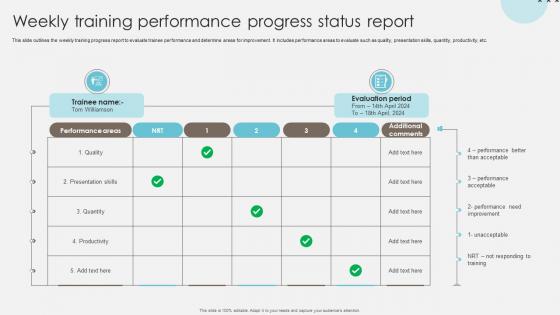
This slide outlines the weekly training progress report to evaluate trainee performance and determine areas for improvement. It includes performance areas to evaluate such as quality, presentation skills, quantity, productivity, etc.
People who downloaded this PowerPoint presentation also viewed the following :
Weekly Training Performance Progress Status Report with all 6 slides:
Use our Weekly Training Performance Progress Status Report to effectively help you save your valuable time. They are readymade to fit into any presentation structure.





FAQs for Weekly Training Performance
Track completion rates and assessment scores first - those are your bread and butter. Time-to-completion matters too. Honestly, learner satisfaction is huge because miserable people don't retain anything. Follow-up assessments show if knowledge actually stuck. Then look at behavioral changes back at work - did skills transfer? ROI stuff like productivity gains or fewer mistakes helps justify the program. Oh, and engagement data reveals where people drop off. Start simple with these, then add whatever your boss actually wants to see. You can always get fancier later.
Honestly, visualization tools are game-changers for training data. Raw spreadsheets are the worst - you can stare at them forever and miss obvious stuff. But throw that data into charts and dashboards? Suddenly everything clicks. Heat maps show exactly where people are getting stuck, which is clutch for fixing problem spots fast. I'd start simple though - basic bar charts for completion rates, line graphs for tracking progress over time. Interactive dashboards are cool too since you can zoom from big picture down to individual learner details. Trust me, once you visualize it, patterns jump out immediately.
Honestly, mix it up to get decent feedback. Post-training surveys are solid - just keep them short with some ratings plus open questions. I also like doing quick polls during longer sessions (because let's face it, people zone out). The follow-up surveys 30-60 days later? Those are actually gold since that's when you know if anything stuck. Oh, and grab a few people for one-on-ones afterward - you'll get way better insights than surveys alone. Don't go crazy though. Pick 2-3 methods max or you'll burn everyone out.
First thing - grab some industry benchmarks from training associations or LinkedIn Learning's data. ATD and Brandon Hall reports are solid gold for this, though some need membership (annoying, I know). Match metrics to your situation: completion rates, time-to-competency, retention scores. When comparing your numbers, factor in company size and training complexity since that stuff matters. Can't find exact matches? Hit up your network or join training communities where people share anonymized data. Honestly, the key is starting your baseline collection now. Otherwise you're flying blind on improvements later.
Honestly, engagement is your biggest clue about whether training actually works. People who jump into discussions and ask questions? They retain way more than someone just zoning out in the back row. Track attendance, how much they participate, whether they finish activities - even their body language if you can swing it (though that's harder to measure, obviously). High engagement almost always means better results on the job later. I'd definitely watch those engagement numbers alongside your other metrics. Low participation is like a red flag that your content might be boring or your delivery needs work.
Dude, those training reports are seriously useful if you actually dig into them. Look at completion rates and quiz scores - they'll show you exactly where people are struggling or losing interest. Time-spent data is huge too. I swear, most companies just ignore this goldmine of info. Short bursts work better than marathon sessions, at least in my experience. You can spot knowledge gaps, see if your content's too hard or too easy, and figure out which delivery methods actually work. Then just tweak your curriculum based on what the data's telling you.
So for tracking what people actually remember after training - pre/post tests are probably your best bet. Test them before, test them after, compare the scores. Also try follow-up quizzes at 30/60/90 days, but honestly good luck getting everyone to actually do those lol. Practical demos work well too - have people show they can actually apply the stuff. Confidence surveys are decent for gauging how people feel about what they learned. Don't go overboard though. Pick maybe 2-3 methods and bake them into your training schedule from the start. Way easier than trying to figure it out later.
Stop tracking completion rates - nobody cares if everyone finished the course if sales didn't improve. Map your training stuff directly to business numbers instead. Revenue, productivity, customer scores, whatever your boss actually looks at. The magic happens when you show before/after performance data. Like, did call center training actually reduce complaint calls? Did the sales workshop boost quarterly numbers? I always ask stakeholders upfront what metrics they care about most, then work backward from there. Honestly, most training reports are pretty useless because they don't connect learning to real business impact. You've got to prove ROI or you're just checking boxes.
Honestly, getting people to give you real feedback is brutal - they either lie to be nice or just ignore your surveys completely. Different departments track stuff their own way, so your data's all over the place. Plus timing is weird because you need both immediate reactions AND long-term results. Linking training to actual performance? Good luck with that mess of variables. I'd say standardize how you collect everything from day one. Maybe throw in small incentives for participation - nothing crazy, just something that shows you care. Trust me, people respond better when there's something in it for them.
Monthly is your best bet - catches problems before they get messy but won't drown your team in reports. If it's super high-stakes training though, weekly makes sense so you can pivot fast. Quarterly? Forget it, way too slow. Honestly I'd rather get slightly too much data than miss something important. Start monthly then see how it feels - maybe your team loves the detail or maybe they're like "this is too much." Oh and definitely set a calendar reminder or you'll totally forget. Include a few action items each time so people know what to actually do with all this info.
So you'll want to grab learner feedback themes and note what engagement looked like. Did people struggle with the same stuff? Which activities actually worked? I love documenting those lightbulb moments - they're gold for figuring out what's landing. Honestly, the unexpected questions are sometimes more valuable than the planned content. They show you blind spots you didn't even know existed. Any barriers that popped up are worth noting too. The whole point is capturing the messy human side behind your numbers so you can tweak things better next round.
Check your performance reports for patterns - when multiple people tank the same areas, that's your answer right there. Like if everyone nails technical skills but completely fails customer service scenarios. I'd pull these monthly honestly, saves you headaches later. Look at completion rates and assessment scores, then compare individuals against team averages. Time-to-competency is huge too. Toss it all in a basic spreadsheet to track problem spots. Makes the whole analysis thing way less painful when you've got actual data instead of just guessing who needs help with what.
Skip the boring spreadsheets - stakeholders will literally zone out. Go visual instead with dashboards showing before/after metrics, completion rates, that stuff. Color-code everything (red/yellow/green is foolproof) and always compare to previous periods. Lead with your biggest win or most shocking finding right up front to grab attention. Real employee quotes make the data way more relatable than just numbers. Executive summaries should hit ROI first, then get into details. Honestly, case studies work better than raw analytics for getting buy-in. Keep spreadsheets as backup only.
Honestly, forget about those immediate test scores after training - they don't tell you much. What you really want is the long-term stuff: productivity bumps, whether people actually stick around, who's getting promoted. Revenue per employee is huge if you can connect it to specific programs. I mean, it's a pain to track all this data but totally worth it. Compare your trained people against the ones who didn't get training. Oh, and don't sleep on cost savings - like fewer mistakes or faster onboarding times. Just pick one or two metrics your bosses actually care about to start.
Pick 3-4 metrics that match your training goals and stick with them. Knowledge retention and skill demos show if people actually learned anything. Engagement rates matter too - bored trainees don't retain squat. Then track real-world impact like job performance changes and error rates. Oh, and completion rates tell you if your content's actually decent or if everyone's bailing halfway through. The tricky part is balancing learning metrics with business results. You'll want both, but don't go overboard tracking everything under the sun.
-
They helped us design the pamphlets for our church’s food drive! The people loved the design, and I’m happy to say it was successful. Thank you, SlideTeam!
-
“Superb. What a great finding. Thankful for SlideTeam. We were paying people to make slides which went all in vain. We are so happy to have found you.”