


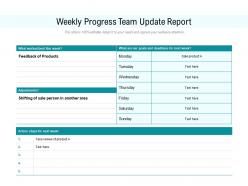
Weekly progress team update report





Try Before you Buy Download Free Sample Product
 Impress Your
 Audience
 100%
100% Editable
 Save Hours
 of Time


Our Weekly Progress Team Update Report are topically designed to provide an attractive backdrop to any subject. Use them to look like a presentation pro.
People who downloaded this PowerPoint presentation also viewed the following :
Weekly progress team update report with all 2 slides:
Use our Weekly Progress Team Update Report to effectively help you save your valuable time. They are readymade to fit into any presentation structure.
FAQs for Weekly progress
Team progress reports should include task completion rates, milestone achievement status, budget utilization, quality metrics, team velocity, and risk indicators. These metrics enhance project visibility by tracking deliverables against timelines, monitoring resource allocation, and identifying bottlenecks early, with many organizations finding that comprehensive reporting ultimately delivers better project outcomes and strategic decision-making capabilities.
Visual aids enhance progress report data by transforming complex metrics into easily digestible charts, graphs, timelines, and infographics that highlight key trends and milestones. These visual elements streamline stakeholder comprehension, facilitate faster decision-making, and enable teams to identify bottlenecks or achievements at a glance, ultimately delivering more impactful and actionable progress communications.
Best practices for summarizing team achievements include highlighting quantifiable results, connecting accomplishments to strategic objectives, showcasing individual contributions, identifying key milestones reached, and demonstrating progress toward goals. These approaches enhance transparency by presenting clear metrics, celebrating team member successes, and providing stakeholders with comprehensive visibility, ultimately delivering accountability and maintaining momentum while building confidence in the team's strategic value and operational effectiveness.
Progress reports should be generated weekly for most teams to maintain optimal transparency, with daily stand-ups for agile projects and monthly summaries for executive leadership. This strategic combination enables real-time issue identification, consistent stakeholder alignment, and proactive resource allocation, with many organizations finding that regular reporting cycles ultimately enhance team accountability and project delivery timelines.
Feedback plays a crucial role in refining team progress reports by identifying gaps in communication, highlighting relevant metrics, and improving clarity for stakeholders. Through regular input from team members, managers, and clients, organizations can streamline reporting formats, enhance data accuracy, and ultimately deliver more actionable insights that drive better decision-making and strategic outcomes.
Team members can collaboratively contribute to progress reports through shared digital platforms, rotating presentation responsibilities, structured feedback sessions, and cross-functional input gathering that captures diverse perspectives and expertise areas. This inclusive approach enables comprehensive reporting by incorporating frontline insights, departmental updates, and varied viewpoints, ultimately delivering more accurate assessments and fostering team engagement across all organizational levels.
Common pitfalls include vague language without specific metrics, overloading with unnecessary details, failing to highlight key achievements and challenges, and lacking clear next steps or actionable recommendations. Teams across industries find that focusing on measurable outcomes, maintaining consistent formatting, and balancing comprehensive updates with executive-level clarity ultimately delivers more effective stakeholder communication and project alignment.
Progress reports can be tailored by adjusting content depth, focus areas, and presentation format to match each stakeholder's priorities and decision-making needs. For management, reports emphasize high-level metrics, budget impacts, timeline adherence, and strategic outcomes, while team member reports focus on task-specific progress, resource needs, immediate blockers, and operational details, ultimately enabling more targeted communication and faster issue resolution across organizational levels.
**INPUT**: What tools and software are most effective for creating visually engaging team progress reports? **OUTPUT**: Effective tools for visually engaging team progress reports include Microsoft Power BI, Tableau, Google Data Studio, Monday.com, and presentation platforms like PowerPoint with advanced templates. These solutions streamline reporting by automating data visualization, enabling real-time updates, and delivering professional dashboards, with many organizations finding that integrated analytics ultimately enhance stakeholder communication and decision-making efficiency. [Word count: 56 words]
A progress report can address team challenges by acknowledging obstacles transparently while immediately connecting them to actionable solutions, lessons learned, and strategic pivots that strengthen future outcomes. This balanced approach demonstrates accountability and resilience, with many organizations finding that honest challenge-identification paired with clear mitigation strategies ultimately enhances stakeholder confidence and team credibility.
Setting clear goals in team progress reports enables accurate measurement of achievements, identifies areas needing attention, and maintains strategic alignment across all team members. These defined objectives streamline performance evaluation, enhance accountability, and facilitate data-driven decision making, with many organizations finding that clear goal-setting ultimately delivers improved project outcomes and stronger team coordination.
Storytelling elements can be incorporated through narrative arcs showing project journeys, character-driven updates highlighting team member contributions, challenge-resolution frameworks, and milestone celebrations that create emotional connections. These approaches transform dry data into compelling narratives, with many organizations finding that story-driven reports increase stakeholder engagement, improve retention of key information, and ultimately foster stronger team alignment and project buy-in.
Delayed progress reports create communication gaps, erode stakeholder confidence, hinder decision-making processes, complicate resource allocation, and reduce project transparency within organizations. These timing issues ultimately compromise team accountability and strategic oversight, with many businesses finding that consistent reporting delays lead to missed opportunities, budget overruns, and diminished competitive advantage in increasingly fast-paced markets.
Team progress reports foster accountability by creating transparency around individual contributions, establishing clear performance benchmarks, and encouraging peer-to-peer responsibility through shared visibility of outcomes. These reports enable teams to track commitments against deliverables, identify performance gaps early, and maintain momentum through regular check-ins, with many organizations finding that consistent reporting cycles significantly enhance collaboration and drive higher completion rates across projects.
Progress reports contribute to long-term strategic planning by providing data-driven insights, identifying emerging trends, tracking resource allocation effectiveness, and revealing strategic gaps before they become critical issues. These comprehensive assessments enable organizations to adjust strategic priorities, reallocate investments, and anticipate market shifts, with many companies finding that regular progress analysis ultimately delivers competitive advantage and more agile strategic positioning.
No Reviews