


Workflow Of Order Progress Status Flow Chart




Try Before you Buy Download Free Sample Product
 Impress Your
 Audience
 100%
100% Editable
 Save Hours
 of Time


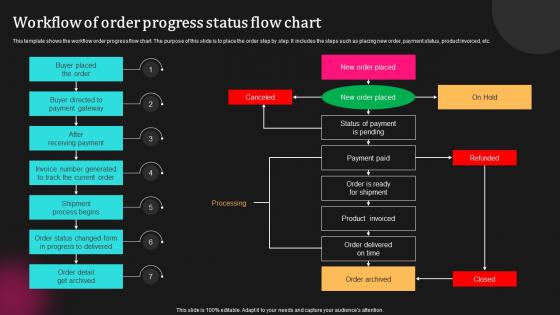
This template shows the workflow order progress flow chart. The purpose of this slide is to place the order step by step. It includes the steps such as placing new order, payment status, product invoiced, etc.
People who downloaded this PowerPoint presentation also viewed the following :
Workflow Of Order Progress Status Flow Chart with all 6 slides:
Use our Workflow Of Order Progress Status Flow Chart to effectively help you save your valuable time. They are readymade to fit into any presentation structure.





FAQs for Workflow Of Order Progress
Ok so basically you've got four main steps: getting the order, checking it's legit, actually fulfilling it, then confirming delivery. I'd grab and validate those order details first - saves you headaches later. Fulfillment is honestly where most companies screw up, but it's just picking, packing, shipping. Nothing crazy. Then delivery confirmation wraps everything up. Oh and definitely set up those automated status emails because customers get weird when they don't know where their package is. Make sure someone owns each step too - that's huge.
Dude, you'll probably cut your order processing time by like 60-80% with automation - it's honestly crazy how much faster things get. The system just handles everything: payment processing, inventory updates, fulfillment triggers, customer tracking emails. All that repetitive stuff that used to eat up hours. Your team stops making those annoying data entry mistakes too. Plus when someone calls in sick, it doesn't totally screw up your workflow anymore. The best part? Your people can actually focus on the weird edge cases and angry customers instead of typing order numbers all day. I'd start with whatever order types you see most - those are the easiest wins.
Your customers are literally telling you what's broken in your workflow. Late deliveries? Damaged stuff? Confusing tracking? That's them pointing out exactly where things go wrong. Honestly, they're way better at spotting issues than you are since they're on the receiving end. Set up follow-up surveys and actually read your reviews - you'll start seeing patterns. Maybe your packaging sucks, or your delivery partners are trash. Support tickets are goldmines too. The complaints might sting, but they're free consulting on how to fix your process.
APIs are your best bet - connect your order system straight to inventory. Most systems already have integrations or webhook support. When orders hit, inventory updates automatically. Way better than doing it by hand (seriously, that gets old fast). Zapier works for connecting different platforms. If you're on Shopify, they play nice with TradeGecko or Cin7 already. Just make sure stock levels sync both directions so you don't accidentally oversell stuff. First step? Map out what data goes where. Sounds boring but it'll save you headaches later.
Honestly, manual handoffs between teams are the worst - that's where orders disappear into the void. Map out your current process first so you can spot where info gets stuck. You need clear ownership at every step, plus real-time visibility so nobody's playing the "where's my order?" guessing game. Duplicate data entry will kill your team's productivity (seriously, why do we still do this to ourselves?). When orders blow up, have actual escalation paths ready. Don't wing it. Poor communication between departments creates those nightmare customer calls nobody wants to handle.
So basically, data analytics shows you what's actually happening with your orders in real-time - where things get stuck, when you get slammed with volume, all that stuff. Once you start seeing the patterns, it's honestly pretty cool how obvious some issues become. Like you'll notice certain products always cause delays or whatever. Instead of just guessing why everything's backing up, you actually have numbers to work with. It helps you nail down better inventory levels and spot where your process is breaking down. My advice? Pick your worst 3 problems and start tracking those first.
Honestly, SAP or NetSuite are probably your best bet for full tracking - they handle everything end-to-end. ShipStation and Ordoro are solid too if you want something more focused on order management. Real-time visibility is huge now since everyone wants to stalk their packages lol. Shopify's built-in stuff actually works fine for smaller operations though. Just make sure whatever you pick talks to your current systems - nothing's worse than data sitting in silos. I'd start by checking what you already have and see what integrates well before throwing more tools at the problem.
Your order workflow is basically what makes or breaks customer relationships. Smooth processes mean people get accurate updates and faster delivery - zero headaches. But mess this up? You'll have confused, angry customers bouncing to your competitors. Happy customers don't just come back, they tell their friends too (which is honestly the best marketing you can get). I'd focus on two things: streamline how your departments talk to each other and automate those status updates. Those changes alone will transform how people feel about buying from you.
Honestly, hands-on practice with real orders beats PowerPoint every time. Split it up over a few days instead of one brutal all-day session - nobody retains anything when they're brain-dead by hour six. Give them cheat sheets they can actually use at their desks. Pair newbies with someone who knows the system inside and out for those first couple weeks when everything feels overwhelming. Oh, and don't just abandon them after training! Circle back in a month to catch any issues and go over the stuff that's still tripping people up.
Build the compliance stuff right into each step instead of tacking it on later. Automate checks for pricing limits, approvals, regulatory stuff - whatever applies to your business. People will skip steps when they're stressed or rushing (I've seen it happen so many times), so make the controls impossible to bypass. Role-based permissions work great - only certain people can approve big orders or special cases. Track everything with audit trails. Oh, and start by figuring out your biggest compliance risks first, then work backwards from there.
Honestly, I'd start with just three things: how long orders take from start to finish, how often you mess them up, and what each order costs you. Customer satisfaction scores are huge too - they'll show you problems before you even realize they exist. Don't try tracking everything right away though, you'll just drown in data. Get your timing and accuracy solid first, then worry about the fancy stuff. Once you can actually fix what's broken, then pile on more metrics. Order errors will probably surprise you with how much they reveal about your weak spots.
Yeah, so it really depends on what kind of business you're running. Manufacturing deals with crazy supply chains and long lead times. E-commerce is all about speed and getting stuff out the door fast. Healthcare moves slower because of all the compliance stuff - which honestly makes sense. B2B usually needs like three people to approve everything before anything happens (so frustrating). Restaurants are totally different since they're worried about food going bad and timing everything perfectly. You can't just copy what Amazon does, you know? Figure out what regulations you have to follow, what your customers actually expect, then build around that.
Honestly, the coolest stuff happening right now is AI that can predict demand spikes before they actually hit - pretty mind-blowing when you see it work. Real-time inventory sync is huge too. Some platforms now automate literally everything from validating orders to printing shipping labels. No human needed, which feels weird but saves tons of time. Machine learning is getting scary good at catching fraud and tweaking delivery routes instantly. Oh, and definitely look into your platform's API options first - you can probably add most of these tools without rebuilding everything from scratch.
Dude, flowcharts are a game-changer for this stuff. Way better than those massive text docs nobody reads anyway. You'll spot bottlenecks instantly and see exactly where teams hand things off to each other. Dependencies become super obvious too. Start with a basic swimlane diagram - shows who's responsible for what at each step. Trust me, I've watched too many people struggle through confusing workflow descriptions that could've been solved with one simple visual. Your team will actually understand the process instead of just nodding along pretending they get it.
Dude, the AI stuff is wild - predictive inventory and smart routing that adjusts on the fly will totally change your order game. Voice commerce is blowing up too. People are literally saying "Hey Alexa, reorder my usual" and your systems need to handle that. Sustainability isn't optional anymore either, which honestly makes sense. You're also gonna see crazy personalized fulfillment options. Build flexible systems now because whatever you design today? It'll need major updates in like two years max. The speed of all this is actually kind of insane.
-
I discovered some really original and instructive business slides here. I found that they suited me well.
-
Professionally designed slides with color coordinated themes and icons. Perfect for enhancing the style of the presentations.