


0714 the process of binary fission medical images for powerpoint




Try Before you Buy Download Free Sample Product
 Impress Your
 Audience
 100%
100% Editable
 Save Hours
 of Time


Harmony is created by our 0714 The Process Of Binary Fission Medical Images For Powerpoint. All actions get focused on a common goal.
People who downloaded this PowerPoint presentation also viewed the following :
Content of this Powerpoint Presentation
Description:
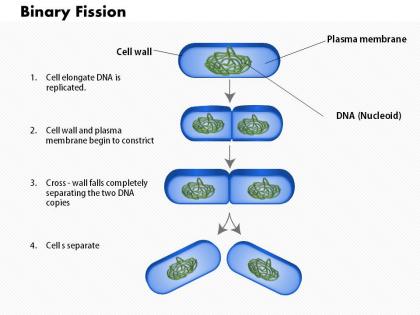
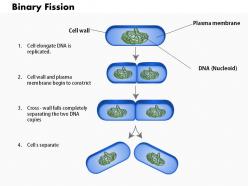
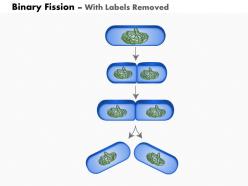
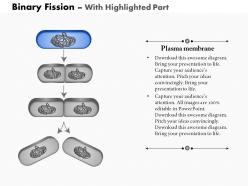
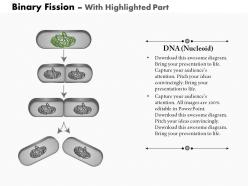
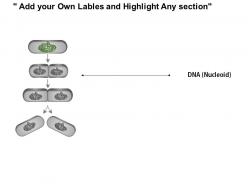
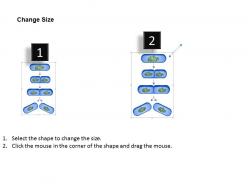
This image depicts the process of binary fission, a method of asexual reproduction most commonly observed in prokaryotes such as bacteria. The image shows four stages of the process in sequential order, highlighting the division of a single cell into two genetically identical daughter cells. Each stage outlines a different part of the binary fission process:
1. The first stage illustrates the elongation of the cell and the replication of its DNA.
2. The second stage shows the start of cytoplasmic division as the cell wall and plasma membrane begin to constrict.
3. The third stage depicts the complete development of a cross-wall, which results in the full separation of the two DNA copies.
4. The final stage demonstrates the separation of the two new cells, each containing a copy of the original cell's DNA.
The clear labeling of the cell wall, plasma membrane, and DNA (nucleoid) further assists in understanding where these components are located within the cell throughout the process.
Use Cases:
Based on the specificity and scientific nature of the content, slides like this can be utilized in various industries and scenarios:
1. Education:
Use: Teaching basic microbiology and cell division
Presenter: Biology Teacher
Audience: Students
2. Biotechnology:
Use: Training on microbial reproduction for R&D teams
Presenter: Research Scientist
Audience: Biotech professionals
3. Healthcare:
Use: Understanding the spread of bacterial infections
Presenter: Healthcare Educator
Audience: Medical staff
4. Pharmaceuticals:
Use: Drug development targeting bacterial division
Presenter: Pharmaceutical Researcher
Audience: Drug development team
5. Agriculture:
Use: Explaining bacterial effects on crops and soil
Presenter: Agronomist
Audience: Farmers and agricultural workers
6. Publishing:
Use: Illustrating scientific textbooks or articles
Presenter: Author or Editor
Audience: Readership
7. Environmental Science:
Use: Studying the role of bacteria in ecosystems
Presenter: Environmental Scientist
Audience: Environmentalists and conservationists
0714 the process of binary fission medical images for powerpoint with all 9 slides:
Go across borders with our 0714 The Process Of Binary Fission Medical Images For Powerpoint. Fulfill your dreams of global expansion.

FAQs for 0714 the process of binary fission medical
So binary fission is just how bacteria split themselves in half to reproduce. Super straightforward compared to what our cells do. The bacterial chromosome copies itself, sticks to the cell wall, then gets yanked apart as the cell stretches out. No weird spindle fibers or chromosomes doing some choreographed dance like in mitosis. It's honestly kind of brilliant how simple it is. Prokaryotes don't have all our messy nucleus stuff to deal with, so they can just... split. Way faster too. My bio prof always said think of it like this: bacteria = binary fission, everything else = mitosis.
So binary fission is what bacteria and some single-celled stuff like amoebas use to reproduce - they literally just split in half to make copies of themselves. Pretty wild when you think about it. The crazy part is how fast it happens, like bacteria can double every 20 minutes when conditions are good. That's why they spread so quickly and take over environments before other organisms even know what hit them. If you're looking at microbial growth for your project, just remember that exponential rate makes a huge difference in your calculations.
So basically bacterial cells copy their DNA first, then the chromosome sticks to different parts of the cell membrane. The cell stretches out and splits in half - boom, you've got two identical cells. It's honestly way less complicated than human cell division (thank god we don't have to memorize all those phases). Since bacteria only have one chromosome, there's less that can go wrong. The attachment thing is what you should really understand though - that's how each new cell ends up with the same genetic stuff. Makes sense why bacteria multiply so crazy fast.
Okay so basically each cell splits into two identical copies, which means your population doubles every single time. Start with one bacterium - boom, now you've got 2. Then 4, 8, 16... the numbers explode ridiculously fast. Under perfect conditions this happens every 20-30 minutes, so you're talking millions of cells from just one parent in a matter of hours. That's exactly why bacterial infections hit you so hard so quickly. Also explains why I can never leave leftovers out for "just a few hours" without regretting it later. In lab work, you've really got to stay on top of controlling those populations.
So basically, bacteria need the right conditions before they'll actually divide - nutrients, decent temperature, proper pH, that whole deal. No good environment? No reproduction. It's kinda like how I can't function without my coffee in the morning lol. Stress from extreme temps or toxins will totally shut down the process or mess up their DNA copying. But here's the cool part - when conditions are perfect, they'll reproduce way faster. That's why lab work is so much about controlling temperature and nutrients. You literally control how fast they multiply just by tweaking their environment.
So basically, when bacteria reproduce through binary fission, any resistant ones multiply crazy fast - we're talking every 20-30 minutes. One resistant bacterium becomes millions in just hours. Pretty wild, right? The antibiotic kills off the normal bacteria, but these resistant ones keep doubling. That's why doctors are so annoying about finishing your whole prescription even when you feel fine. I used to skip the last few pills too, but now I get why that's such a bad idea. You don't want to leave any survivors to build up an army.
So live microscopy is your best bet - you literally watch the cells divide in real-time and it's weirdly satisfying. Phase-contrast or fluorescence microscopy work great for tracking individual bacteria. Time-lapse photography captures everything step by step. Flow cytometry's useful too for analyzing cell sizes during division. Oh, and fluorescent protein tagging lets you follow specific parts as they separate (pretty cool actually). For lab work, I'd just start with E. coli under phase-contrast. It's super straightforward and you'll get clear visuals of the whole division thing without overcomplicating it.
So basically there are three main proteins you need to know - DnaA kicks off DNA replication, FtsZ forms that ring thing that pinches the cell, and SeqA stops everything from happening too early. The cell has these checkpoints built in so it won't divide until the DNA's copied and positioned right. DnaA building up is what triggers the whole cycle to start. Honestly the way they all work together is pretty cool - like this tight network. Oh and pro tip: don't just memorize what each protein does, focus on how they interact with each other. That's what'll actually make sense of it all.
So basically, binary fission is how you get from a tiny starter culture to massive cell populations in fermentation. Your bacteria or yeast just keep doubling - one E. coli can become millions in hours if conditions are right. That's honestly pretty wild when you think about it. Without this exponential growth, large-scale production would be way too expensive. Whether you're making insulin or beer, it's all about optimizing conditions so cells divide fast while keeping product quality decent. The whole biotech industry kind of depends on this process working efficiently.
So binary fission actually helps biofilms form! When bacteria divide, the new daughter cells don't just float away - they stick around together. That clustering becomes the base for biofilms. The cells start pumping out this gooey matrix stuff that glues them all together. Pretty smart survival strategy if you ask me. All that rapid division also creates the cell density needed for quorum sensing to kick in. Then that triggers even more biofilm production. It's like a snowball effect - binary fission gives you both the cells and that initial grouping that gets everything started.
Oh yeah, binary fission is way faster than mitosis. Bacteria can double in like 20-30 minutes while eukaryotic cells take hours just for the actual division part. It's basically just copying DNA and splitting - no complicated checkpoints or phases to mess with. Mitosis has all this error-checking stuff which makes it more reliable but super slow. That's honestly why bacterial infections can get out of hand so fast. You're dealing with something that reproduces crazy efficiently compared to our cells. Pretty wild when you think about it.
So binary fission is basically prokaryotes' cheat code for evolution. They can multiply crazy fast - like one cell becomes millions in just hours if conditions are good. No energy wasted on finding mates either (thank god, right?). When they copy themselves exactly, all the good DNA gets passed down perfectly. The speed thing is what really matters though. Abundant resources? They'll explode in numbers and crush anything that reproduces slower. You've probably seen those exponential growth charts in bio class - that's this advantage playing out in real time.
Binary fission is basically cloning - daughter cells get identical DNA from the parent. Pretty limiting for genetic diversity, right? But bacteria aren't totally screwed because they've got other tricks up their sleeves. Horizontal gene transfer, conjugation, mutations - that's where the real variation comes from. The fission itself? Just makes copies. I always thought it was weird how something so simple could work so well, but those other mechanisms are what actually drive bacterial evolution and antibiotic resistance. So don't blame the splitting process for lack of diversity.
So bacteria basically cheat at evolution through sheer numbers. They double every 20-30 minutes when conditions are good, which is honestly ridiculous when you think about it. All those beneficial mutations spread crazy fast - we're talking thousands of generations while you're deciding what to have for dinner. When environmental pressure hits (antibiotics, temperature swings, whatever), there's usually some variant that's already ready to handle it. The speed is what makes them so brutal to deal with. That's why bacterial resistance is such a nightmare - they're literally evolving faster than we can develop new treatments.
Most kids think binary fission is just a bacteria thing, but tons of single-celled organisms do it - protists, even mitochondria. They mix it up with mitosis all the time (which makes sense honestly). But binary fission is way more straightforward - no spindle fibers or crazy phases like mitosis has. Oh, and they assume the daughter cells come out different sizes. Nope, they're identical twins basically. I'd show diagrams comparing the two processes side by side. That visual really helps them see how much simpler binary fission actually is.
-
Great quality product.
-
Awesomely designed templates, Easy to understand.