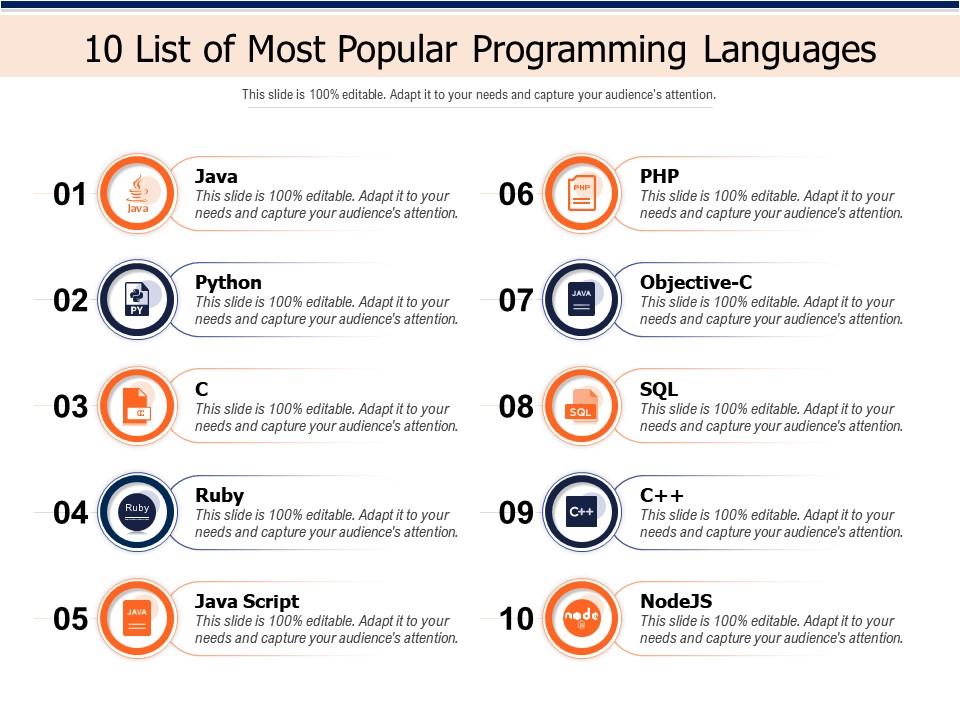
10 list of most popular programming languages

Rating:
90%
10 list of most popular programming languages
Slide 1 of 2
Favourites Favourites

Try Before you Buy Download Free Sample Product

Audience Impress Your
Audience
Editable 100%
Editable
Time Save Hours
of Time
The Biggest Sale is ending soon in
0
0
:
0
0
:
0
0
Rating:
90%
Presenting this set of slides with name 10 List Of Most Popular Programming Languages. This is a ten stage process. The stages in this process are Java, Python, PHP, SQL, Ruby . This is a completely editable PowerPoint presentation and is available for immediate download. Download now and impress your audience.

FAQs for 10 list of most

So basically, compiled languages like C++ translate your whole program into machine code upfront - kinda like getting a book fully translated before you read it. Python and JavaScript work differently though, they translate each line as the program runs. Compiled stuff runs way faster since the heavy lifting's already done, but with interpreted languages you can just make a change and immediately see what happens. No waiting around for compilation. Honestly, I'd go compiled if speed matters, but interpreted languages are perfect when you're just trying stuff out or need to move fast on a project.

Yeah, language choice matters but honestly not as much as you'd think. C++ and Rust are crazy fast since you control memory directly. Python's slower but you'll ship code way quicker. JavaScript used to suck performance-wise but modern engines are actually pretty decent now. Here's the thing though - most apps I've worked on, the real slowdown is always database queries or some terrible API call, not the language. I'd just pick whatever your team already knows well. Seriously, I've seen more projects die from people obsessing over "optimal" choices than from using Python instead of C++.

Functional's great for heavy data stuff, math computations, or when you need serious concurrency. Haskell and Elixir are perfect here - immutability cuts down bugs like crazy, and no side effects makes testing so much cleaner. Honestly, once you experience debugging without state mutations, you'll never want to go back. Perfect for systems handling massive parallel requests or complex data pipelines. But here's the thing - if it's just regular CRUD work or your team's never touched functional programming? Don't torture yourselves. OOP will get the job done faster.

So Python and JavaScript are super flexible - you can change variable types whenever, prototype crazy fast, way less boilerplate. No compilation either, which is nice. But Java or TypeScript? They'll catch your bugs before runtime and the IDE support is *chef's kiss* - autocomplete, refactoring, all that good stuff. I swear I've wasted entire afternoons hunting down errors that static typing would've flagged instantly. For quick scripts or experiments though, dynamic languages are clutch. Really depends what you're building - big serious project? Go static. Just messing around or need something fast? Dynamic all the way.

So basically, different programming paradigms change how you approach your whole project. OOP makes you think in classes and objects - really modular stuff that's great for bigger teams. Functional programming is all about pure functions and immutable data, which honestly makes debugging way less of a headache. Procedural is simple to start with but gets chaotic quick once your project grows. The weird thing is each paradigm kind of pushes you toward different development styles too. Like OOP works great with agile and test-driven development, while functional programming tends to be more mathematical. Just pick whatever fits your problem and what your team's actually good at.

So programming languages are your main tools for data science and ML stuff. Python's huge right now - pandas, scikit-learn, TensorFlow, all that good stuff. R used to be the go-to for stats but Python kinda ate its lunch. SQL you'll need for databases obviously. JavaScript's great for web visualizations, and there's Scala or Julia if you're doing massive data processing (though I haven't touched Julia much personally). Really depends what you're working on. But honestly? Start with Python. The community's massive and it handles most everything you'll throw at it.

Honestly, I'd look at whether the language has staying power first. Python and JavaScript? They're rock solid. But I've been burned picking trendy stuff that dies out - wasted like 3 months on this one framework nobody uses anymore. Check if big companies are actually using it and hiring for it. GitHub activity tells you if it's still growing or basically dead. Your team's gotta learn it too, so don't pick something super niche unless you have time to burn. Ten years of history is my rule now. Maybe try a quick prototype before you dive in headfirst.

Honestly, I'd go with open-source stuff like Python or JavaScript most of the time. You can mess around with the code however you want and never get stuck paying some company forever. MATLAB and those proprietary languages have better support, sure, but man - once you're in their ecosystem, good luck getting out. Plus the costs add up fast. The main thing is what your team already knows though. If everyone's comfortable with a paid option and you've got the budget, sometimes it's worth it for the stability. But for most projects? Open-source all the way.

So languages change when developers give feedback and new features get added - like how Python got async/await or JS keeps getting updated syntax. What makes them popular though? Honestly, it's weird - sometimes it's just timing and luck. Easy to learn helps, but mostly it's about solving the right problems at the right moment. JavaScript blew up because of web dev, and having big companies behind you doesn't hurt either. My advice? Don't chase trends. Pick what fits your projects and career goals instead.

Honestly, just stick with one language until you actually get it before moving on. I'd go from Python to JavaScript instead of jumping straight to something like C++ - way less of a headache. Build the same project in different languages and you'll see how stuff translates over. Don't chase every shiny new framework that blows up on Twitter (I'm guilty of this too). Master the boring fundamentals like data structures first since they work everywhere. Pick your next language based on what you want to build, not what's trendy.

Yeah, syntax totally affects how fast you code, but not in obvious ways. Python's clean style means less time fighting with brackets and more time actually solving stuff. Java makes you write a ton of boilerplate upfront - though honestly, good IDEs handle most of that grunt work now. Here's the thing though: whatever you already know will always feel fastest. If you're used to C-style languages, JavaScript feels smooth even when it's kind of a mess compared to Python. But real talk? Your team's experience trumps everything. Just go with what everyone already knows well.

Honestly, JavaScript's your best bet since you'll need it no matter what. Works for frontend, backend with Node.js, the whole thing. Python's really beginner-friendly too - Django and Flask make building stuff pretty straightforward. I know PHP gets hate but it's still everywhere and ridiculously easy to deploy. Start with HTML, CSS, and plain JavaScript before diving into React or whatever. Oh, and don't sleep on PHP if you want something that just works. I'd go JavaScript first, then maybe Python depending on what you're actually building.

Honestly, community is huge when picking a language. Python and JavaScript got popular partly because their communities actually help people - like when you're debugging at 2am and need answers on Stack Overflow. Good documentation matters too. With a strong ecosystem, you'll find libraries for basically everything instead of building from scratch. Before starting your next project, I'd check the GitHub activity and see how active their forums are. JavaScript's community can be a bit chaotic but they're everywhere, which helps. Also peek at their package repositories to see what's available.

So basically, type safety is like having your code double-checked before it runs. The compiler catches you when you're trying to use a string as a number or whatever - stops those crashes dead. Honestly, it feels annoying at first (especially coming from JavaScript where anything goes), but you'll debug way less weird stuff later. Rust is super anal about it, TypeScript too. Python's more chill. My advice? Just roll with the compiler complaints early on. Way better than hunting down some random runtime error at 2am because you mixed up your data types.

You'll see low-level programming everywhere - embedded systems, OS development, device drivers, real-time stuff where you need to talk directly to hardware. IoT gadgets, medical devices, cars, game engines, firmware. C and C++ dominate here, sometimes even assembly. Oh, and crypto mining too since performance matters so much there. Honestly? Start with C if you're curious. Memory management is annoying at first but it'll make you way better at coding overall. Even when you're back to Python or whatever, you'll actually understand what's happening under the hood. Makes debugging so much easier.

Ratings and Reviews

90% of 100
Review Form
Write a review
Most Relevant Reviews
  1. 100%

    by Curtis Herrera

    Innovative and Colorful designs.
  2. 80%

    by Clifford Powell

    Graphics are very appealing to eyes.
  3. 100%

    by Dion Dunn

    Easily Understandable slides.
  4. 80%

    by Cruz Hayes

    Nice and innovative design.

4 Item(s)

per page: