


3D Printing In Manufacturing IT Powerpoint Presentation Slides




Try Before you Buy Download Free Sample Product
 Impress Your
 Audience
 100%
100% Editable
 Save Hours
 of Time


Gain valuable insights into the role of IT in the manufacturing industry with our thoughtfully designed 3D Printing in Manufacturing template. This PowerPoint presentation provides a concise overview of the industrys evolution from Manufacturing 1.0 to 4.0, highlighting the technologies employed to address production challenges. Our AI in Manufacturing module explores various technologies utilized in the manufacturing sector, including Robotics, Artificial Intelligence AI, and Explainable AI. The deck also introduces the manufacturing industry, highlighting its features and significance. Furthermore, our Smart Manufacturing section offers market insights, such as size, share, and global spending, along with detailed information on application areas, types, impact, working principles, and safety measures of these technologies. It also emphasizes the role of cybersecurity in smart manufacturing, provides a 30 60 90 days plan, and proposes a training program to enhance cybersecurity awareness among employees. Our template includes a comprehensive budget for training and technology pricing, as well as a timeline and roadmap for implementing IT in the manufacturing industry. Additionally, the IoT in Manufacturing module features a predictive analytics dashboard to monitor manufacturing operations. Get access to this invaluable resource now and stay ahead in the manufacturing industry.
People who downloaded this PowerPoint presentation also viewed the following :
Content of this Powerpoint Presentation
Slide 1: This slide introduces 3D Printing in Manufacturing (IT). State your company name and begin.
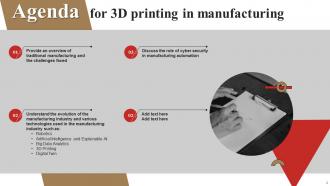
Slide 2: This slide depicts the Agenda of the presentation.
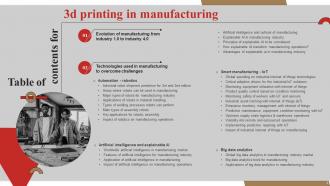
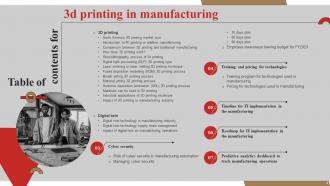
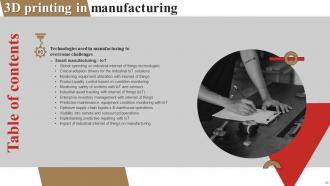
Slide 3: This slide shows Table of Content for the presentation.
Slide 4: This is another slide continuing Table of Content for the presentation.
Slide 5: This slide highlights the Title for the Topics to be covered next.
Slide 6: This slide depicts the evolution of manufacturing from industry 1.0 to industry 4.0, including the technologies such as steam, hydropower, electrical power, etc.
Slide 7: This slide exhibits the Heading for the Contents to be discussed further.
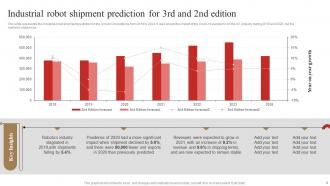
Slide 8: This slide elucidates the Industrial robot shipment prediction for 3rd and 2nd edition.
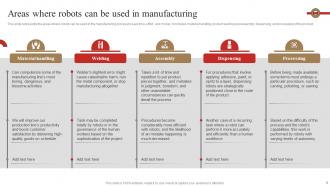
Slide 9: This slide represents the areas where robots can be used in the manufacturing process to save time, effort, and money.
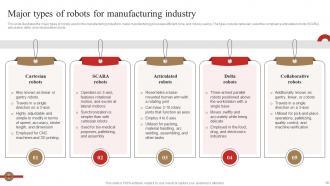
Slide 10: This slide illustrates the major types of robots used in the manufacturing industry to make manufacturing processes efficient, time, and money-saving.
Slide 11: This slide outlines the applications of robots in material handling chores, and it includes packaging products, transferring parts, etc.
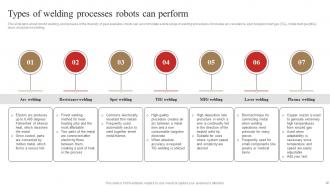
Slide 12: This slide talks about robotic welding, and because of the diversity of gear available, robots can accommodate a wide range of welding procedures.
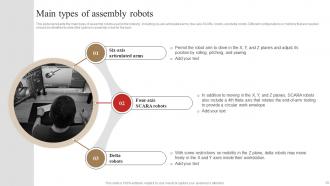
Slide 13: This slide discusses the Main types of assembly robots.
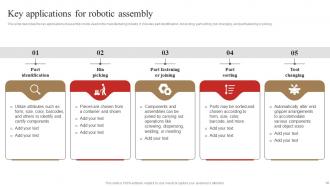
Slide 14: This slide describes the key applications of assembly robots used in the manufacturing industry.
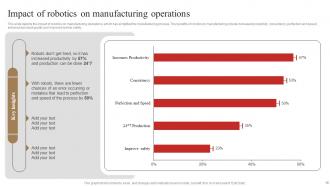
Slide 15: This slide highlights the Impact of robotics on manufacturing operations.
Slide 16: This slide elucidates the Heading for the Contents to be discussed next.
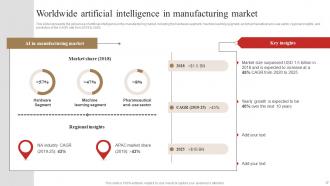
Slide 17: This slide focuses on the Worldwide artificial intelligence in manufacturing market.
Slide 18: This slide exhibits the Features of artificial intelligence for manufacturing industry.
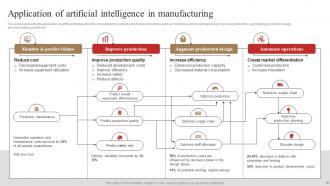
Slide 19: This slide focuses on the Application of artificial intelligence in manufacturing.
Slide 20: This slide highlights the Impact of artificial intelligence on manufacturing operations.
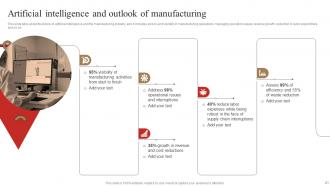
Slide 21: This slide deals with the Artificial intelligence and outlook of manufacturing.
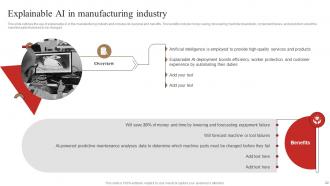
Slide 22: This slide outlines the use of explainable AI in the manufacturing industry and includes its overview and benefits.
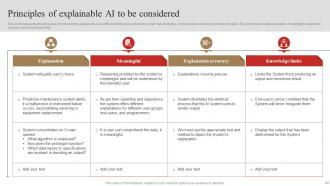
Slide 23: This slide represents the principles of implementing explainable AI in artificial intelligence systems for smart manufacturing, and the system should obey these principles.
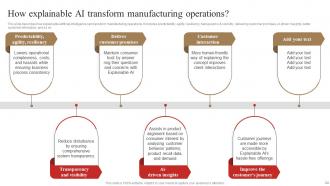
Slide 24: This slide describes how explainable artificial intelligence can transform manufacturing operations.
Slide 25: This slide showcases the Advantages of explainable AI in manufacturing industry.
Slide 26: This slide elucidates the Title for the Ideas to be discussed further.
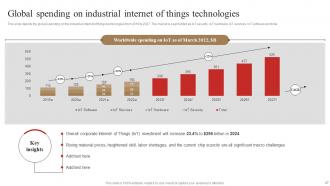
Slide 27: This slide depicts the global spending on the industrial internet of things technologies from 2019 to 2027.
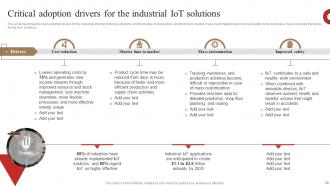
Slide 28: This slide describes the main adoption drivers for the industrial internet of things solutions.
Slide 29: This slide depicts the use of the internet of things in monitoring equipment utilization, and the process starts with collecting information from sensors, SCADA or DCS systems.
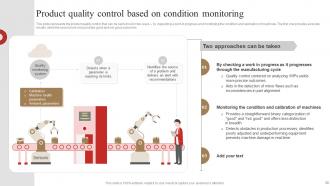
Slide 30: This slide represents the product quality control that can be carried out in two ways – by inspecting a work in progress and monitoring the condition and calibration of machines.
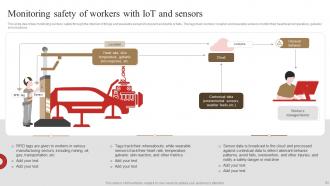
Slide 31: This slide focuses on Monitoring safety of workers with IoT and sensors.
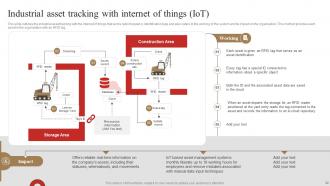
Slide 32: This slide outlines the industrial asset tracking with the internet of things that works radio frequency identification tags and also caters to the working of the system and its impact on the organization.
Slide 33: This slide shows the Enterprise inventory management with internet of things.
Slide 34: This slide represents the predictive maintenance and equipment condition monitoring with the internet of things, including its working and impact on the industry.
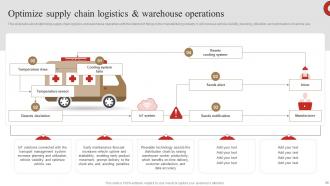
Slide 35: This slide talks about optimizing supply chain logistics and warehouse operations with the internet of things in the manufacturing industry.
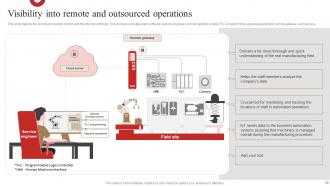
Slide 36: This slide depicts the remote production control with the internet of things.
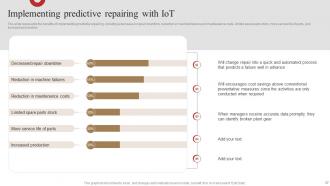
Slide 37: This slide focuses on Implementing predictive repairing with IoT.
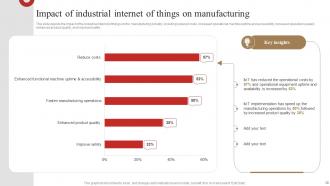
Slide 38: This slide highlights the Impact of industrial internet of things on manufacturing.
Slide 39: This slide showcases the Heading for the Components to be covered further.
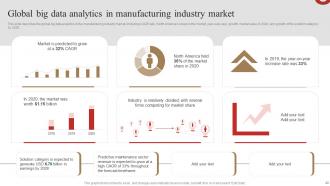
Slide 40: This slide describes the global big data analytics in the manufacturing industry market, including CAGR rate, North America's share in the market, year-over-year growth, etc.
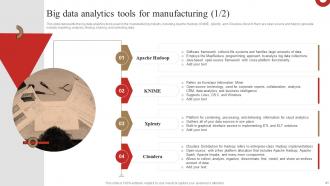
Slide 41: This slide represents the big data analytics tools used in the manufacturing industry, including Apache Hadoop, KNIME, Xplenty, and Cloudera.
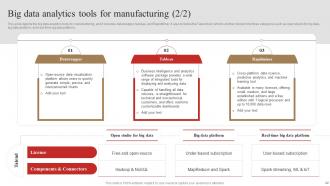
Slide 42: This is yet another slide continuing the Big data analytics tools for manufacturing.
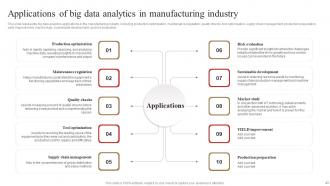
Slide 43: This slide highlights the Applications of big data analytics in manufacturing industry.
Slide 44: This slide elucidates the Title for the Topics to be discussed next.
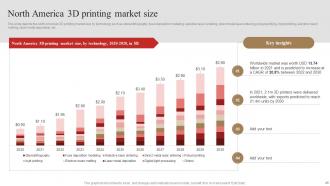
Slide 45: This slide depicts the north American 3D printing market size by technology such as stereolithography, fuse deposition modeling, etc.
Slide 46: This slide shows the introduction to 3D printing, also known as additive manufacturing.
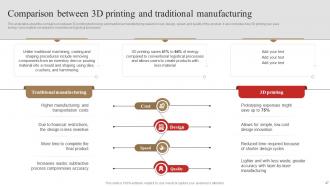
Slide 47: This slide talks about the comparison between 3D printing technology and traditional manufacturing based on cost, design, speed, and quality of the product.
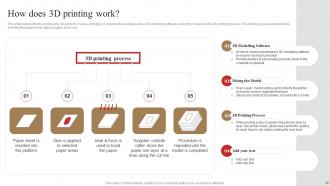
Slide 48: This slide presents the working of a 3D printer to make a prototype.
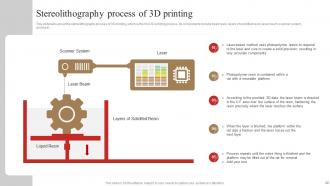
Slide 49: This slide showcases the Stereolithography process of 3D printing.
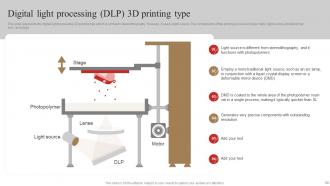
Slide 50: This slide reveals the digital light processing 3D printing type which is similar to stereolithography.
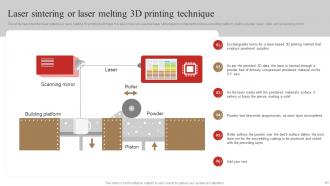
Slide 51: This slide describes the laser sintering or laser melting 3D printing technique.
Slide 52: This slide outlines the fused deposition modeling 3D printing process, also known as extrusion and freeform fabrication.
Slide 53: This slide talks about the inkjet binder jetting 3D printing process, including its working and benefits.
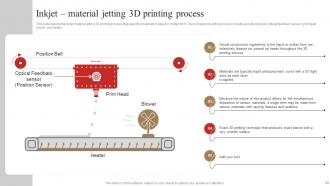
Slide 54: This slide depicts the inkjet material jetting 3D printing process that uses the materials in liquid or molten form.
Slide 55: This slide describes the selective deposition lamination 3D printing process that builds parts layer by layer on regular copier paper.
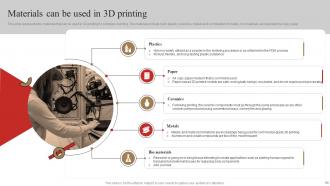
Slide 56: This slide represents the materials that can be used in 3D printing for prototype building.
Slide 57: This slide highlights the industrial applications of 3D printing technology in the medical and dental, automotive industry, aerospace, and defence.
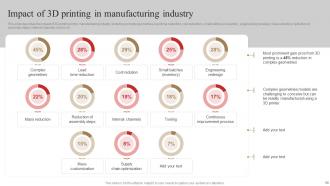
Slide 58: This slide elucidates the Impact of 3D printing in manufacturing industry.
Slide 59: This slide incorporates the Heading for the Ideas to be discussed next.
Slide 60: This slide contains the application of digital twin technology in manufacturing industries by depicting the benefits in product design, quality management, process optimization, and predictive maintenance.
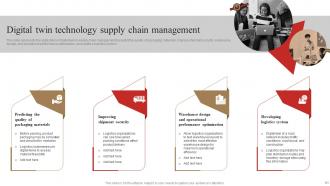
Slide 61: This slide showcases the Digital twin technology supply chain management.
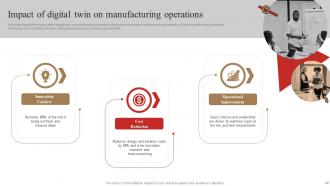
Slide 62: This slide depicts the impact of the digital twin on manufacturing operations that include innovation catalyst and cost reduction.
Slide 63: This slide highlights the Title for the Topics to be covered further.
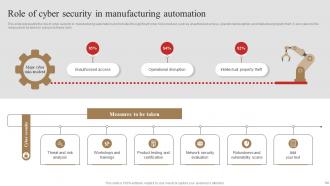
Slide 64: This slide reveals the Role of cyber security in manufacturing automation.
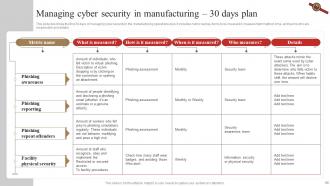
Slide 65: This slide describes the first 30 days of managing cyber security in the manufacturing operations plan.
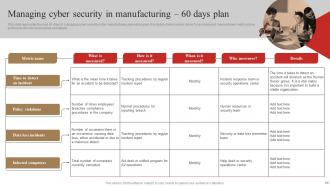
Slide 66: This slide deals with the next 60 days of managing cyber security in the manufacturing operations plan.
Slide 67: This slide depicts the next 90 days of managing cyber security in the manufacturing operations plan.
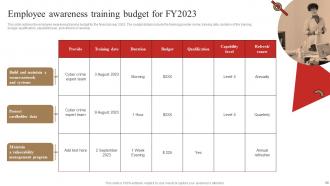
Slide 68: This slide outlines the employee awareness training budget for the financial year 2023.
Slide 69: This slide incorporates the Title for the Topics to be discussed in the upcoming template.
Slide 70: This slide displays the training program for technologies used in the manufacturing industry, including automation, artificial intelligence & explainable AI, etc.
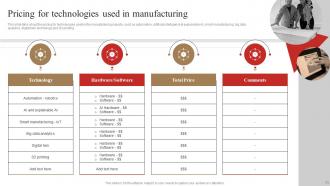
Slide 71: This slide talks about the pricing for technologies used in the manufacturing industry, such as automation, artificial intelligence & explainable AI, etc.
Slide 72: This slide lists the Heading for the Components to be covered in the upcoming template.
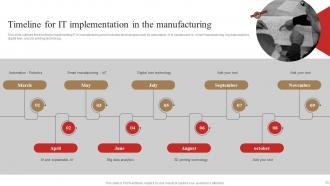
Slide 73: This slide outlines the timeline to implementing IT in manufacturing and it includes technologies such as automation, AI & explainable AI, smart manufacturing, etc.
Slide 74: This slide highlights the Title for the Ideas to be discussed next.
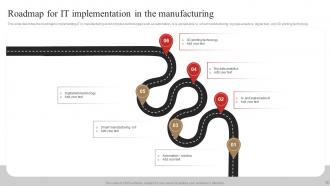
Slide 75: This slide presents the roadmap to implementing IT in manufacturing and it includes technologies such as automation, AI & explainable AI, smart manufacturing, and many more.
Slide 76: This slide contains the Heading for the Components to be covered in the forth-coming template.
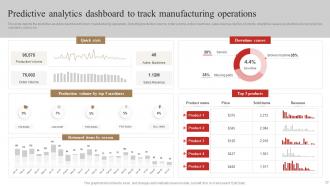
Slide 77: This slide reveals the predictive analytics dashboard to track manufacturing operations, including production volume, order volume, downtime causes, etc.
Slide 78: This slide contains all the icons used in this presentation.
Slide 79: This slide is titled as Additional Slides for moving forward.
Slide 80: This slide presents New business model for service business.
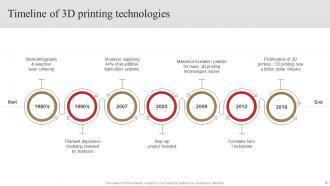
Slide 81: This slide displays Timeline of 3D printing technologies.
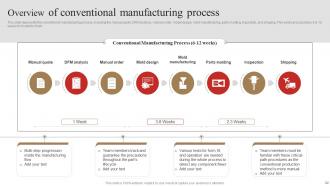
Slide 82: This slide represents Overview of conventional manufacturing process.
Slide 83: This slide showcases Challenges with traditional manufacturing system.
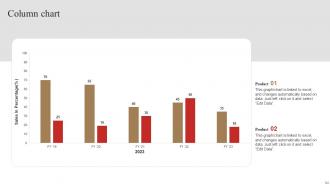
Slide 84: This slide displays Column chart with two products comparison.
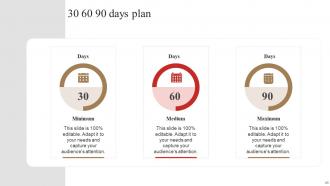
Slide 85: This slide provides 30 60 90 Days Plan with text boxes.
Slide 86: This slide showcases Magnifying Glass to highlight information, specifications etc
Slide 87: This slide depicts Venn diagram with text boxes.
Slide 88: This slide shows Post It Notes. Post your important notes here.
Slide 89: This is an Idea Generation slide to state a new idea or highlight information, specifications etc.
Slide 90: This is Our Goal slide. State your firm's goals here.
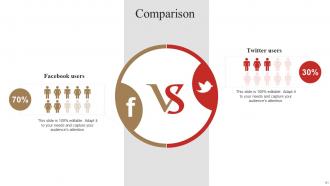
Slide 91: This is a Comparison slide to state comparison between commodities, entities etc.
Slide 92: This is a Thank You slide with address, contact numbers and email address.
3D Printing In Manufacturing IT Powerpoint Presentation Slides with all 97 slides:
Use our 3D Printing In Manufacturing IT Powerpoint Presentation Slides to effectively help you save your valuable time. They are readymade to fit into any presentation structure.

























FAQs for 3D Printing In Manufacturing IT
Dude, the speed is insane - you can print something, test it, tweak the design and print again all in one day. No waiting weeks for tooling or paying for expensive molds. Complex shapes that would cost a fortune to machine? Easy. I got totally hooked on that whole rapid iteration thing once I started. Low-volume stuff is where it really shines, especially if you need customization. Oh, and definitely start with just prototyping to learn the workflow before jumping into anything bigger.
So 3D printing is pretty game-changing for inventory stuff. No more sitting on piles of parts you might never use - you just print what you need. Warehousing costs drop big time, and you don't get stuck with obsolete junk. Plus you can manufacture way closer to where you actually need the parts, which honestly makes so much sense. The best part? Forget those crazy minimum orders of like 10,000 pieces. Print five if that's all you need. Only downside is materials still cost more per unit than traditional manufacturing for big runs, so definitely crunch those numbers first.
For manufacturing 3D printing, you're looking at engineering plastics - PEEK, PEI, carbon fiber composites. Metals too: titanium, aluminum, stainless steel. Honestly, these can be just as strong as traditional materials, sometimes stronger since you can mess with the internal structure. Cost and speed are still the main downsides compared to conventional manufacturing, but that's changing pretty quickly. I'd start by looking at your current parts - see which ones could actually benefit from the crazy design flexibility 3D printing gives you. That's where it really shines.
Dude, 3D printing is a game changer for custom stuff. No more retooling your whole setup every time someone wants something different. Custom phone cases, medical implants that actually fit right - you can literally print whatever size or feature someone needs. The cool part? You're not stuck making like 10,000 identical widgets hoping people buy them. One customer wants purple, another wants their initials? Easy. Honestly feels like cheating sometimes. Plus small orders actually make money now since you don't need those crazy minimum quantities anymore.
Aerospace and automotive are killing it with 3D printing right now. Healthcare too - custom prosthetics and surgical stuff is huge money. Jewelry's doing better than you'd expect, honestly. Car companies use it mainly for prototypes and small batch parts. The thing is, it only makes financial sense if you need crazy complex shapes, lots of customization, or you're not making thousands of units. Oh, and dental work - forgot about that one but they're all over it. If your industry checks those boxes, definitely worth looking into. Short runs are where the magic happens.
Honestly, 3D printing is a total game-changer for prototypes - you'll save like 60-90% on tooling since there's no need for expensive molds. We're talking days instead of weeks to get parts in hand. I've literally seen teams print working prototypes overnight, which is wild. The downside? It gets expensive fast for high-volume stuff compared to regular manufacturing. But for small batches or complex parts, it's perfect. I'd start by looking at whatever's taking forever to prototype or costing a fortune in tooling - that's where you'll see the biggest wins.
Honestly, 3D printing is pretty amazing for going green. Instead of cutting away tons of material like normal manufacturing, you only use exactly what you need - it's called additive manufacturing. No more making way too many parts that just sit around collecting dust. You can print stuff on-demand instead. The designs can be super lightweight too, which saves material. Oh, and here's what I think is the coolest part - you can literally recycle old prints back into new filament. Even print with recycled plastic! If you're trying to make your manufacturing more eco-friendly, I'd start by figuring out what parts you could 3D print instead of machining them the old way.
Honestly, you've gotta nail three things here. First - get your materials consistent. Crappy filament or powder that's all over the place will screw everything up later. Machine calibration is huge too, so stay on top of maintenance and don't let temperatures swing around. For quality checks, test at multiple points - while it's printing, after for dimensions, and material properties if it's critical stuff. Oh and temperature swings are seriously annoying to deal with. Statistical process control will save your butt by catching issues early instead of finding problems at the very end.
Honestly, speed's your biggest headache - we're talking hours per part instead of minutes like normal manufacturing. Material choices are pretty meh too, especially if you need fancy metals or high-performance stuff. Surface finish usually looks rough without extra work afterward. Temperature and humidity mess with consistency more than you'd think, which is annoying. But for prototypes and small batches? It's actually perfect. Cost gets weird at higher volumes though. I'd figure out how many parts you actually need first - that'll basically tell you if it's worth it or if you should just go traditional.
Honestly, pick one specific thing to test first - like prototyping or making custom tools. Don't try to 3D print everything right away, that's where companies mess up. Look for stuff you're already outsourcing that's expensive or takes forever to get back. Train your people early because someone's gotta actually run these things. Oh, and do the real math on costs - materials, labor, fixing broken printers (because they will break). The vendor demos make it look way easier than it actually is. Once you nail that first use case, then think about expanding.
So it really depends what you're making. Medical stuff? FDA has specific 3D printing guidelines you'll want to check out. Aerospace uses AS9100 standards, automotive has ISO/TS 16949. Material certs are massive - especially metals and polymers where they need full traceability. The whole regulatory thing is honestly still playing catch-up with the tech in some areas, which is kind of wild when you think about it. ISO 9001 quality management applies pretty much everywhere though. I'd figure out which industry standards hit your specific project first, then work backwards from there.
Honestly, the stuff happening with multi-material and metal printing is wild - metal's finally getting affordable. Speed improvements are insane too, like actual production speeds instead of waiting around forever. AI design optimization is pretty cool but maybe overhyped? Mass customization is the real game changer though. You can make personalized stuff without completely redoing your whole setup. Sustainability angle is solid - way less waste, make things on-demand, manufacture closer to where people actually live. I'd mess around with mixing traditional and 3D printing workflows now since that's probably where everyone's heading anyway.
Dude, 3D printing is incredible for prototyping. Hours instead of weeks to go from your CAD file to something you can actually hold. Test it, spot the problems, tweak your design, and print again that same day. Traditional manufacturing? You'd be waiting forever for tooling and stuff. What's really cool is you can print multiple versions at once without breaking the bank. I usually start with crappy low-res prints just to check if everything looks right, then do the nice high-res version once I'm happy with it. Those quick iteration cycles where you keep improving based on each print - that's where the magic happens.
Honestly, the money hits first - equipment costs are brutal upfront. Speed's another killer since traditional manufacturing still crushes 3D printing for high volumes. Your materials are limited too, can't always get the same strength as conventional parts. The learning curve though? Way steeper than anyone warns you about. Workers need completely different training, quality standards flip, plus you're buying new software. I'd probably mess around with small pilot projects first instead of going all-in. Don't try revolutionizing your whole operation overnight - that's how companies tank themselves.
Honestly, 3D printing changed everything for us. You can print stuff overnight instead of waiting weeks for parts. Your design and engineering people actually start talking to each other because they're holding the same physical thing, not staring at different CAD screens. Engineers catch manufacturing problems way earlier. Designers see if their ideas actually work in the real world - sometimes they don't, which is awkward but better to know now. The conversations get so much better when everyone's touching the prototype. Just start small with some random project so people get used to the whole rapid prototyping thing.
-
Excellent design and quick turnaround.
-
Their templates are super easy to edit and use even for the one like me who is not familiar with PowerPoint. Great customer support.