


Jidoka process powerpoint presentation slides





Try Before you Buy Download Free Sample Product
 Impress Your
 Audience
 100%
100% Editable
 Save Hours
 of Time


Jidoka Process PowerPoint Presentation Slides helps your business maintain the quality of machine design. Our intelligent automation PPT highlights its potential in lean manufacturing. Jidoka PPT covers core areas of the process, such as the pillars of lean production. The lean manufacturing method PowerPoint template offers a stepwise guide with cyclic visual elements to fascinate and inform the audience. The lean production system PPT slides showcase the advantages of adopting active human elements to sustain healthy manufacturing procedures. The principles of the Jidoka PowerPoint template brief employees about detection, intervention, and correction of operational flaws. Besides the automobile and manufacturing industry, the six sigma PowerPoint Template deck offers insights to software developers and IT professionals. If you are struggling with productivity issues, this Jidoka style of automation PPT can inform your employees on how to maintain workflow. Every business suffers from production abnormalities, use the production efficiency presentation slides to showcase ways to deal with such problems. Download our intelligent automation PowerPoint deck to save manpower and create happy customers.
People who downloaded this PowerPoint presentation also viewed the following :
Content of this Powerpoint Presentation
Slide 1: This slide introduces Jidoka Process. State Your Company Name and begin.
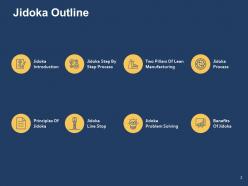
Slide 2: This slide shows Jidoka Outline of the presentation.
Slide 3: This slide presents Jidoka Introduction with related imagery and text.
Slide 4: This slide displays Jidoka Step by Step Process describing- Set Goals & Expectations, Plan Logistics & Timing, Document Reality, Plan Counter-Measures, Check Reality, Identify Waste, Do it Again, Celebrate Success, Standardize Process, Measure Results, Make Changes, Verify Change/Modify.
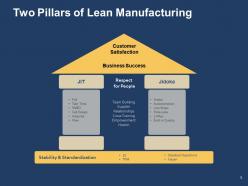
Slide 5: This slide represents Two Pillars of Lean Manufacturing.
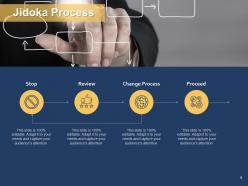
Slide 6: This slide showcases Jidoka Process describing- Stop, Review, Change Process, Proceed.
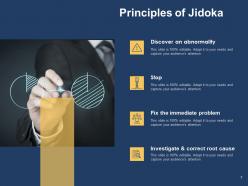
Slide 7: This slide shows Principles of Jidoka describing- Discover an abnormality, Stop, Fix the immediate problem, Investigate & correct root cause.
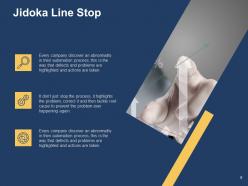
Slide 8: This slide presents Jidoka Line Stop with related imagery.
Slide 9: This slide displays Jidoka Problem Solving.
Slide 10: This slide showcases Benefits of Jidoka with related imagery and text.
Slide 11: This slide displays Jidoka Process Icons.
Slide 12: This slide is titled as Additional Slides for moving forward.
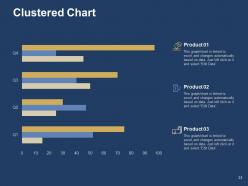
Slide 13: This slide presents Clustered chart with three products comparison.
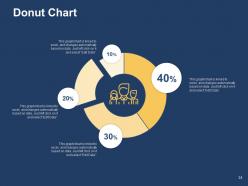
Slide 14: This slide displays Donut Chart with data in percentage.
Slide 15: This is About Us slide to show company specifications etc.
Slide 16: This is Meet Our Team slide with names and designation.
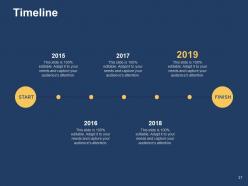
Slide 17: This is a Timeline slide to show information related with time period.
Slide 18: This slide shows Mind Map for representing entities.
Slide 19: This is Our Target slide. State your targets here.
Slide 20: This slide is titled as Important Notes. Post your important notes here.
Slide 21: This is a Puzzle slide with text boxes to show information.
Slide 22: This is an Idea or Bulb slide to state a new idea or highlight information, specifications etc.
Slide 23: This is a Thank You slide with address, contact numbers and email address.
Jidoka process powerpoint presentation slides with all 23 slides:
Use our Jidoka Process Powerpoint Presentation Slides to effectively help you save your valuable time. They are readymade to fit into any presentation structure.













FAQs for Jidoka process
Jidoka is basically "automation with a human touch" - you stop production the second you catch a defect, figure out what caused it, then make sure it won't happen again. Picture giving your whole production line the power to slam the brakes when something's off. Any worker can stop everything if they spot trouble (which honestly makes way more sense than pretending problems don't exist). Way cheaper than fixing bad parts later down the line. You're building quality into the process instead of just checking it at the end. Don't just patch things up and keep going - dig into why it happened first.
So jidoka is all about catching problems right when they happen, not at the end. Your workers can literally stop the entire production line the second they spot something off - sounds scary but it's actually genius. Instead of quality control happening later, you build it into every single step. Think car assembly line where anyone can pull the cord and everything halts. Yeah, stopping production feels weird at first, but trust me - fixing one bad part beats dealing with hundreds of screwed up products later. Train your team to actually use this power and watch your quality issues disappear.
So basically, jidoka stops the whole line when defects happen - no more churning out garbage that just gets tossed later. Your workers can actually hit the brakes and fix root causes instead of watching problems spiral out of control. Way better than finding issues weeks down the road, trust me. The efficiency boost comes from tackling problems right where they start. No more rework headaches or angry customers calling. Training your team to stop production feels weird initially - like, shouldn't we keep things moving? But once they get comfortable with it, you'll wonder why you didn't do this sooner.
So basically you need four things: automatic stops, spotting problems right away, figuring out what caused it, and fixing it for good. When something's wrong, production just stops - like hitting the brakes hard. Andon lights work great for alerting everyone there's an issue. Then you dig into why it happened instead of just slapping a band-aid on it. Honestly, preventing defects from moving down the line is the whole game here. I'd start with adding automatic stops wherever you can in your current setup. That's probably your easiest win to begin with.
So here's the thing - you gotta let your frontline people actually stop the line when they see defects. Train them on quality standards first, obviously. Give them real authority to hit that andon cord without getting in trouble for it. The hardest part? Breaking that "keep moving no matter what" mentality. Put up visual systems so problems are super obvious to everyone walking by. Quick response teams need to jump on issues fast when things do stop. Oh, and celebrate when people pull the cord - sounds weird but those stops save you from way bigger messes later.
So Jidoka is basically about making your machines smart enough to hit the brakes when they mess up. You build detection right into the equipment - kind of like having a quality checker that never blinks. When something goes wrong, boom, everything stops automatically. No defects slip through to the next step. Honestly, it's genius because you're not replacing people, just catching problems faster than any human could. The machine handles the "stop" part, but you still need people to actually fix whatever went sideways. Quick thought for your process design: how could you make it self-aware enough to pause when quality tanks?
So with Jidoka, you stop production the second something goes wrong instead of waiting to catch defects at the end. Way smarter than the old method where you'd make everything then deal with the mess later. Your workers can actually halt the whole line when they see a problem - honestly, this saves so much time and waste. You fix the root cause right away instead of pumping out tons of bad products. I learned this the hard way at my last job lol. Next time you spot a quality issue, just stop everything and investigate immediately rather than letting it go.
So Toyota's the famous one - workers pull a cord to stop the whole assembly line when they spot defects. Kinda crazy to halt thousands of cars being made, right? McDonald's automated fryers do the same thing, shutting down when food cooks wrong. Amazon's conveyor belts automatically stop if packages jam up. Even software teams use this - they'll halt deployments when tests fail. Honestly, you could apply this anywhere in your work. Just build in automatic stops whenever quality drops below your standards. It's surprisingly effective once you get used to it.
Oh totally! Those two work great together actually. When your line stops from a Jidoka issue, that's honestly the best time to jump into problem-solving mode. Get your team together right then and do a quick Kaizen session while everyone's still fired up about what just happened. Way better than scheduling some meeting three weeks later when nobody remembers the details, you know? I've seen teams catch patterns super fast this way. Each stop becomes like a mini improvement session - sounds kind of intense but it really works.
Honestly, the hardest part is convincing people to actually stop the line when something's wrong. Workers have been trained to keep things moving no matter what, so they'll push back initially. Management gets nervous too since productivity tanks while everyone's learning. Some people just can't make that mental switch from "we'll deal with it later" to stopping everything right now. The training process is pretty time-intensive - not gonna lie about that. I'd definitely start with just one department first to show it actually works before expanding.
So jidoka lets workers pull the andon cord and stop the whole line when they catch defects - pretty cool power, right? No more watching bad stuff roll by while feeling helpless. Workers become the quality police basically. The trick is making sure everyone knows that hitting the brakes is totally fine, not something they'll get in trouble for. My old manager used to say "stop it to fix it" which sounds cheesy but honestly makes sense. It flips the whole thing - instead of just standing there, they're actually in control of keeping quality up.
So you wanna know if Jidoka's actually doing anything? Track how fast your team spots defects at each station and escalates them. First-pass yield is huge too - plus whatever defect rates customers are seeing. Here's what I'd really watch though: are people proactively stopping the line or just catching crap later? That tells you if the culture's shifting. Problem resolution times matter, and whether the same issues keep popping up. Oh, and honestly? Don't overthink it at first. These basics will show you pretty quick if you're heading in the right direction.
So basically you can use IoT sensors to create this massive early warning system for your production line. They'll catch machine issues, quality problems, weird vibrations - all that stuff - before it becomes a bigger mess downstream. Honestly, it's like having a thousand watchful eyes on everything at once. When something goes wrong, they either alert your operators or just stop the line automatically. Takes all the guesswork out of it, which is huge. My advice? Don't try to do everything at once - just pick your most critical quality checkpoints and start there with a pilot program.
Honestly, the hardest part is convincing people to actually stop working when something's wrong - which sounds crazy since most jobs train you to just push through problems. You'll need to teach them how to spot issues and do basic root cause stuff, but the real challenge is the mental shift. Workers have to trust that catching defects early beats sending garbage down the line. Management backing is everything here because if someone gets in trouble for stopping production, game over. I'd start small with maybe one team and make a big deal when they catch problems - builds momentum, you know?
Look, jidoka forces you to deal with problems right when they happen instead of ignoring them. Super uncomfortable at first - who wants to be the person stopping everything? But here's the thing: when you can't just work around issues anymore, your team actually starts fixing root causes. The stops become learning moments instead of failures. You get better at spotting problems early, solutions stick better, and honestly? People get weirdly competitive about finding issues first. Main rule though - celebrate when someone hits the brakes, don't make them feel bad about it.
-
Easy to edit slides with easy to understand instructions.
-
Topic best represented with attractive design.
-
Use of different colors is good. It's simple and attractive.
-
Amazing product with appealing content and design.
-
Great product with highly impressive and engaging designs.