


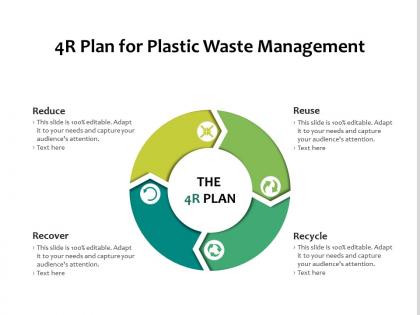
4r plan for plastic waste management




Try Before you Buy Download Free Sample Product
 Impress Your
 Audience
 100%
100% Editable
 Save Hours
 of Time


Our 4R Plan For Plastic Waste Management are topically designed to provide an attractive backdrop to any subject. Use them to look like a presentation pro.
People who downloaded this PowerPoint presentation also viewed the following :
4r plan for plastic waste management with all 2 slides:
Use our 4R Plan For Plastic Waste Management to effectively help you save your valuable time. They are readymade to fit into any presentation structure.

FAQs for 4r plan for
So the 4R Plan is Resources, Roles, Responsibilities, and Reporting - pretty much covers everything you need before starting any project. First figure out what you'll need (people, money, tools), then nail down who's doing what and what they actually own. Don't forget the reporting structure either. I know it sounds boring as hell, but I've seen so many projects implode because teams skip this part and jump straight into the fun stuff. Trust me, spending time upfront getting everyone on the same page saves you from those super awkward moments later where nobody knows who was supposed to handle something.
Yeah, the 4R Plan adapts pretty well to whatever industry you're in. Manufacturing companies usually focus hard on cutting waste and being more efficient with resources. Tech companies? They're all about innovation and going digital - makes sense. Retail is different though - they care more about customer experience and getting their supply chains right. Honestly, the framework itself doesn't change, but what you prioritize totally depends on your sector. Just figure out which of the four R's would actually solve your biggest headaches right now and start there.
Look, your 4R plan won't work without getting people involved first. Map out who's actually affected - employees, suppliers, customers, community folks, even those annoying regulators (they sometimes have good ideas though). Listen to what they're saying. You'll find opportunities you never thought of, plus people will actually support the changes instead of fighting them. Regular check-ins are key here. Honestly, most companies skip this step and wonder why their sustainability efforts flop. Get everyone talking early and keep those conversations going.
So the 4R thing basically stops everyone from pointing fingers later. Each person knows their exact role - who's doing the work, who gets consulted, who just needs updates, and who's ultimately on the hook. Honestly, it's a lifesaver for avoiding those "wait, wasn't that your job?" disasters. Regular check-ins become automatic instead of scrambling when stuff hits the fan. Try mapping it out for whatever project you're working on next - I bet you'll notice way less confusion and back-and-forth nonsense.
Oh totally, the 4R Plan fits great with agile! During sprint cycles, you can just weave in those Review, Refine, Redesign, and Rebuild phases naturally. Teams I've worked with love using it for retrospectives—honestly way better than the usual "what went well" format that gets boring. Since you're already reviewing and refining stuff constantly in agile anyway, it's not really adding extra work. Map each R to different sprint activities, or sometimes dedicate whole sprints to redesign when things need a bigger overhaul. Give it a shot in your next retro. The structure actually keeps people focused instead of rambling.
So for your 4R thing, I'd probably start with Asana or Monday.com to track everything - the reduce, reuse, recycle stuff. Honestly though? A basic spreadsheet might be all you need at first. Google Sheets or Airtable work great for tracking your waste data. Slack's perfect for keeping everyone on the same page. Oh, and maybe grab some simple mobile apps so people can actually log their activities without it being a huge pain. My coworker tried to go super fancy right away and it was a disaster. Start with tools your team already uses, then get fancier later.
Honestly, the worst part is always people fighting change - they're so stuck in their ways. Communication between teams falls apart fast too. You'll probably struggle with budget since these projects cost money upfront before you see any payoff. Everyone wants results yesterday but real change takes time, which creates this annoying pressure. Oh and good luck keeping documentation organized without someone actually owning that mess. Leadership support makes or breaks everything though - if they're wishy-washy about it, you're screwed. I'd say test it small first, maybe just one department, then expand once you've got some wins to show off.
You need both hard numbers and people feedback to see if this thing's actually working. Track stuff like waste reduction percentages, cost savings, and how many employees are participating. But honestly, the employee surveys matter just as much - they'll catch problems your data might miss. Set your baseline measurements first though, otherwise you're just guessing at progress. I'd do quarterly check-ins rather than waiting a whole year to see results. Oh, and don't sleep on resource efficiency improvements - those numbers can be pretty telling about whether you're on the right track.
So with the 4R thing - watch out for rebound symptoms during Remove if you quit cold turkey. Replace is honestly where most people bail because new supplements can mess with your stomach or trigger food reactions. When you hit Reinoculate, expect some weird bloating while the good bacteria settle in (totally normal btw). The Repair phase gets tricky if you're juggling multiple supplements - they can interact in funky ways. Just track everything so you'll know when to tweak dosages or timing.
So the 4R Plan basically gets you thinking about sustainability without being preachy about it. You reduce waste by planning better upfront. Reuse stuff you already have instead of starting over. Recycle whatever materials make sense. Then redesign your whole process to be less wasteful - honestly, that last part's where the magic happens. It forces you to ask "do we actually need this?" before throwing money at something. I started with just one R on my last project (the reuse part) and it saved us like $2k. Pick one area this week and try it out.
The 4R thing basically forces you to actually stop and check if you're making progress instead of just spinning your wheels. You go through Review, Reflect, Revise, Repeat - sounds obvious but honestly most of us skip the reflection part and wonder why we keep hitting the same walls. That's where you figure out WHY something worked or bombed, not just what happened. Then you adjust and try again. Pretty simple cycle but it stops you from being stuck with crappy methods for months. Oh, and try doing it weekly instead of monthly - way better results in my experience.
Honestly, the key is mapping each R back to what your company actually wants to achieve. Figure out your org's main goals first, then work backwards from there. I've watched so many teams get pumped about these amazing green projects that leadership couldn't care less about - total waste of effort. Your Reduce, Reuse, Recycle, and Rethink stuff needs to hit the targets that matter upstairs. Check in with stakeholders regularly so you don't go off course. And track metrics that actually move the needle, not just whatever's easiest to measure.
Oh man, Minnesota's 4R program is exactly what you want to look at. Their farmers cut nitrogen by 15-20% without losing yields - honestly pretty impressive stuff. Iowa and Illinois have similar success stories, but Minnesota's the real deal. They nailed all four R's and actually saved money while cleaning up their watersheds. The Red River Valley data breaks down costs vs benefits super clearly, which I know you'll love since you're all about the numbers. Definitely start there - their statewide results are way more comprehensive than the other Midwest studies I've seen.
Cultural context is huge for the 4R Plan - what works in one place can totally blow up in another. Some cultures are all about group accountability while others want individual ownership. The repair phase is tricky since every culture handles conflict differently (honestly, this part trips up a lot of people). You'll need to adjust your communication style and timing based on local norms. Also think about which stakeholders to involve - that varies a ton by culture. My advice? Do some research on the cultural dynamics first. Don't just dive into the four R's without understanding the context you're working in.
Skip the theory stuff and jump straight into real examples from your actual workplace - that's what makes the 4R thing (Reduce, Reuse, Recycle, Rethink) click for people. Nobody wants to sit through another death-by-PowerPoint session, trust me. Break it into bite-sized chunks instead. Maybe 15-20 minutes over a few days? Give everyone a little cheat sheet for their desk too. The real magic happens when you make them practice each R with their daily tasks. That's when people finally get it and stop asking you to explain it again later.
-
Great quality slides in rapid time.
-
Qualitative and comprehensive slides.