


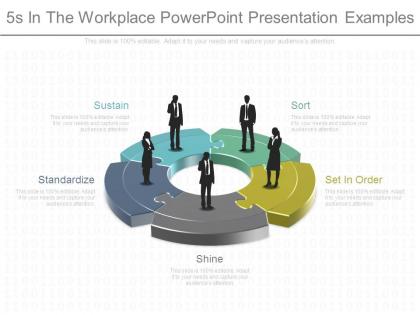
5s in the workplace powerpoint presentation examples




Try Before you Buy Download Free Sample Product
 Impress Your
 Audience
 100%
100% Editable
 Save Hours
 of Time


Give them a burst of fun with our 5s In The Workplace Powerpoint Presentation Examples. They ensure a cracker of an event.
People who downloaded this PowerPoint presentation also viewed the following :
5s in the workplace powerpoint presentation examples with all 7 slides:
March forward with our 5s In The Workplace Powerpoint Presentation Examples. They are aware of the exact drill.
FAQs for 5s in the workplace
The 5S method's core principles are Sort (eliminating unnecessary items), Set in Order (organizing essential items), Shine (maintaining cleanliness), Standardize (establishing consistent procedures), and Sustain (ensuring long-term adherence). These principles streamline workplace efficiency by reducing waste, improving safety protocols, and enhancing productivity, with many manufacturing facilities and healthcare organizations finding that systematic implementation delivers faster operations and competitive operational advantage.
The 5S method improves efficiency by systematically organizing workspaces through Sort, Set in Order, Shine, Standardize, and Sustain, eliminating waste and streamlining operations. This approach enables organizations to reduce search times, minimize errors, and enhance workflow consistency, with manufacturing facilities and healthcare institutions finding that structured environments ultimately deliver faster production cycles and improved employee productivity.
Common challenges when adopting 5S methodology include resistance to change from employees, lack of sustained management commitment, insufficient training and understanding of principles, difficulty maintaining improvements over time, and inadequate resource allocation for implementation. While these obstacles can initially slow progress, organizations across manufacturing, healthcare, and office environments increasingly find that addressing cultural barriers through consistent leadership support, comprehensive training programs, and regular auditing systems ultimately delivers improved workplace efficiency, reduced waste, and enhanced operational performance.
The 5S approach fosters continuous improvement by establishing systematic workplace organization, standardizing processes, and encouraging employee ownership of their work environment. Through Sort, Set in Order, Shine, Standardize, and Sustain practices, organizations create visual management systems that reveal inefficiencies and waste, ultimately enabling teams to identify improvement opportunities and maintain momentum toward operational excellence.
The 5S method translates effectively to non-manufacturing environments like offices, hospitals, and service centers by organizing workspaces, standardizing procedures, and eliminating inefficiencies. Healthcare facilities use 5S for medical supply organization and patient flow optimization, while offices apply these principles for document management and workspace efficiency, ultimately delivering improved productivity, reduced waste, and enhanced service quality across diverse organizational settings.
Employee training serves as the foundation for successful 5S implementation by teaching proper sorting, organizing, cleaning, standardizing, and sustaining practices while building cultural commitment to continuous improvement. Through comprehensive training programs, organizations ensure consistent application across departments, reduce resistance to change, and empower workers to identify inefficiencies, ultimately delivering enhanced productivity and sustainable workplace transformation.
Technology enhances 5S practices through digital visual management systems, mobile audit applications, RFID tracking for inventory organization, and automated workflow monitoring tools. These solutions streamline workplace organization by enabling real-time compliance tracking, instant visual feedback, and data-driven performance insights, with manufacturing facilities and warehouses finding that digital 5S implementation delivers faster audits, improved sustainability, and measurable operational efficiency gains.
5S implementation success can be measured through workplace organization scores, waste reduction percentages, safety incident rates, employee productivity metrics, and audit compliance ratings. These measurements enable organizations to track operational efficiency improvements, cost savings, and employee satisfaction levels, with many manufacturing and healthcare facilities finding that consistent 5S metrics ultimately deliver enhanced workflow optimization and competitive operational advantage.
The 5S system serves as a foundational element that enhances other Lean tools like Kanban, Total Productive Maintenance, and Value Stream Mapping by creating organized, standardized workspaces. Through systematic workplace organization, manufacturers streamline visual management systems, reduce setup times for continuous improvement initiatives, and enable more effective problem identification, ultimately delivering enhanced operational efficiency and supporting comprehensive Lean transformation across production environments.
Toyota pioneered 5S implementation across manufacturing operations, achieving significant waste reduction and operational efficiency improvements that became industry benchmarks. Companies like Nike, Boeing, and Caterpillar have successfully adopted these methodologies in their production facilities, while healthcare organizations and financial services firms increasingly leverage 5S principles to streamline workflows, enhance productivity, and deliver competitive advantages.
Management can foster 5S engagement through comprehensive training programs, clear communication of benefits, employee involvement in implementation planning, and recognition systems for participation. By demonstrating leadership commitment, providing adequate resources, and showcasing early wins from pilot areas, organizations create momentum that encourages broader adoption, with many manufacturing and healthcare facilities finding that peer champions and regular feedback sessions ultimately deliver sustained employee buy-in and operational improvements.
Sustaining 5S practices over the long term creates a foundation for continuous operational excellence, enhanced productivity, improved safety standards, and consistent quality outcomes. This disciplined approach enables organizations to maintain competitive advantage through reduced waste, streamlined workflows, and strengthened workplace culture, with many manufacturing and service companies finding that sustained implementation delivers measurable cost reductions and operational efficiency.
Leaders can identify prime 5S opportunities by conducting workplace assessments focusing on areas with excessive waste, safety incidents, inefficient workflows, and employee frustration points. Manufacturing floors, healthcare facilities, and office environments often reveal the greatest potential through direct observation, employee feedback, and productivity metrics, with many organizations finding that high-traffic operational areas deliver the most significant efficiency gains and competitive advantages.
**INPUT**: What are the key differences between 5S and other workplace organization techniques like Kaizen? **OUTPUT**: 5S focuses specifically on workplace organization through sorting, setting order, shining, standardizing, and sustaining, while Kaizen emphasizes continuous improvement across all business processes. These approaches complement each other strategically, with manufacturing facilities and healthcare organizations finding that 5S creates the foundation for systematic organization, while Kaizen drives ongoing process enhancement, ultimately delivering both immediate workspace efficiency and long-term operational excellence. [Word count: 60]
Visual management practices enhance 5S implementation through color-coded storage systems, floor markings for designated areas, shadow boards for tool placement, and digital dashboards tracking compliance metrics. These visual cues streamline workplace organization by reducing search time, minimizing errors, and ensuring consistent adherence to 5S standards, with manufacturing and healthcare facilities finding that visual indicators ultimately deliver improved efficiency and sustained organizational behaviors.
-
Very well designed and informative templates.
-
Easily Understandable slides.