


6 element slide with options numbering




Try Before you Buy Download Free Sample Product
 Impress Your
 Audience
 100%
100% Editable
 Save Hours
 of Time


Immediately answer emerging apprehensions with our 6 Element Slide With Options Numbering. It enables instant gratification.
People who downloaded this PowerPoint presentation also viewed the following :
Content of this Powerpoint Presentation
Description:
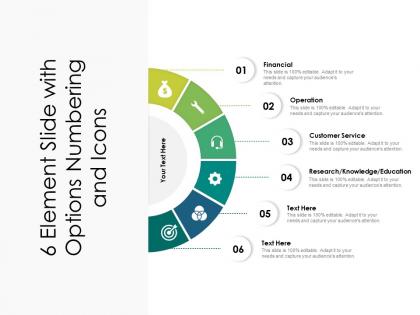
The PowerPoint slide is designed with a circular flow diagram featuring six elements, each represented by a distinct icon and accompanied by a numerical identifier, ranging from 01 to 06. The design suggests a process or a series of steps. Each element is labeled with a different function, namely Financial, Operation, Customer Service, Research/Knowledge/Education, with two additional placeholders for further content.
Use Cases:
This type of slide can be utilized across various industries for multiple purposes:
1. Banking:
Use: Explaining the process flow of financial services.
Presenter: Bank Manager.
Audience: Clients, stakeholders.
2. Manufacturing:
Use: Outlining the operational workflow in a factory setting.
Presenter: Operations Manager.
Audience: Production team, floor managers.
3. Retail:
Use: Describing the customer service journey.
Presenter: Customer Service Manager.
Audience: Sales associates, service staff.
4. Academic Institutions:
Use: Detailing educational frameworks and research methodologies.
Presenter: Academic Researcher.
Audience: Students, faculty.
5. Marketing:
Use: Discussing marketing strategies and customer engagement.
Presenter: Marketing Director.
Audience: Marketing team, advertisers.
6. Healthcare:
Use: Mapping patient care and service delivery.
Presenter: Healthcare Administrator.
Audience: Medical professionals, administrative staff.
7. Information Technology:
Use: Illustrating IT support and service management procedures.
Presenter: IT Manager.
Audience: IT support team, end-users.
6 element slide with options numbering with all 2 slides:
Deliver instant advice with our 6 Element Slide With Options Numbering. Immediately give the guidance desired.
FAQs for 6 element slide
So atoms are basically what make up elements - but here's the key thing: all atoms of the same element have identical proton counts. Like carbon always has 6 protons, no matter what. You can mess around with neutrons (that's how you get isotopes), but touch those protons? Now it's a completely different element. Honestly, it's kinda wild that something so simple defines everything around us. The atomic number on the periodic table? That's literally just counting protons. Makes chemistry feel way less intimidating once you get that.
So basically, it all comes down to protons. Each element has a different number - hydrogen's got 1, carbon has 6, oxygen has 8, you get the idea. That number determines how many electrons they have, which is what makes them act totally different chemically. Honestly, it's kind of crazy how just adding or removing protons creates completely new stuff. The electrons are what matter most for bonding and reactions. Oh, and here's a tip - just look at where something sits on the periodic table. That position tells you almost everything about how it'll behave.
Think of elements like ingredients in cooking - they're what make compounds behave the way they do. Their electron setups and how they bond basically control everything. Reactivity, stability, you name it. So when you're looking at any compound, check out which elements are in there first. That'll give you hints about what reactions it can do and how it'll play with other stuff. The periodic table position matters too - tells you about electronegativity and bonding preferences. Honestly, once you get the hang of reading element properties, predicting compound behavior becomes way easier.
So basically, they organize everything by atomic number - that's just how many protons each element has. The rows are periods, columns are groups or families. Here's the cool part: elements in the same column act super similar. Like those noble gases on the right? Total loners, barely react with anything. The table splits things into metals, nonmetals, and metalloids too. Honestly, once you get this pattern, predicting behavior gets way easier - just check what's in the same group and you'll get a good idea of how they'll bond or react.
Dude, isotopes totally flip how you see elements. Same element, different masses - wild stuff. Carbon-12 and Carbon-14 are chemically identical but only one's radioactive. That mass difference doesn't change chemical behavior (same electrons) but physical properties? Completely different story. Half-lives, stability, decay rates - it's all over the place depending on which isotope you've got. Dating fossils, medical scans, nuclear stuff - the isotope matters way more than people realize. I always forget to check which one I'm actually working with and it bites me every time. Mass isn't everything, but it sure changes the game.
So basically you're following atoms around ecosystems like a detective - carbon, nitrogen, sulfur, all that stuff. It's kinda like tracking money through the economy but way nerdier. You can see how nitrogen from fertilizers ends up in groundwater, or watch mercury build up in fish. Carbon bouncing between oceans and atmosphere is huge for climate stuff. Honestly it's pretty cool once you get into it. When you're looking at environmental problems, just think about which elements are moving where and you'll start seeing the bigger picture.
Oh man, there are some crazy rare ones! Helium-3 is basically impossible to find here but the moon's loaded with it. Then you've got rhenium - super rare naturally occurring element. Francium is absolutely insane though, it's so radioactive it only lasts like 22 minutes before disappearing. There's probably less than an ounce of it in Earth's entire crust right now! They're rare because of weird formation conditions or just straight up instability. Aerospace and medical imaging use some of these, but honestly? Check prices first if you're thinking about anything - they swing wildly.
So basically atoms bond because their outer electron shells are incomplete - they're trying to get stable. There are three ways this happens: covalent bonds where they share electrons, ionic bonds where one atom steals electrons from another, and metallic bonds where electrons just float around freely. The periodic table is honestly your best friend here because it shows you exactly how many outer electrons each element has. That number determines everything about how it'll bond and what it bonds with. Once you get the hang of reading the table, predicting reactions becomes way easier.
Okay so basically everything alive is made of elements from the periodic table. Carbon, oxygen, hydrogen, nitrogen - those are your big players for structure and metabolism. But don't forget the tiny ones like iron (carries oxygen in blood) and zinc (helps enzymes work). It's actually crazy how missing just a little bit of one element can screw up your whole system. Oh and they control how proteins fold and DNA forms too. Honestly whenever I'm stuck on a bio problem, I just look at what elements are involved and their amounts - usually explains what's going on.
Finding new elements is such a game-changer for science and tech. Each one brings totally unique properties we've never seen before. Technetium completely transformed medical imaging once we figured it out. The crazy thing is, most discoveries seem pointless at first - then BAM, someone finds an incredible use decades later. Those super heavy synthetic elements? They've pushed our understanding of atoms way further and helped us build better particle accelerators. I swear the superheavy element research happening now is wild if you're into that stuff.
So trace elements are these micronutrients your body needs in super tiny amounts - we're talking milligrams or even less. But don't let that fool you, they're actually crucial. Iron helps carry oxygen around, zinc keeps your immune system happy, selenium does antioxidant stuff. The classic example everyone knows is iron deficiency anemia - that's what happens when you don't get enough. Here's the weird part though: too much can be toxic with some of them. Honestly, I'd just focus on eating a variety of whole foods instead of popping a bunch of supplements. Your body absorbs nutrients from actual food way better anyway.
Think of elements as your material design toolkit. Each one has its own quirks - like how carbon makes steel crazy strong, or how adding chromium prevents rust. When you're picking materials for a project, you're basically mixing and matching these properties. Want flexibility? Grab elements that bend. Need heat resistance? There are elements for that too. I learned this the hard way when I picked the wrong alloy once and it corroded way faster than expected. The cool part is you can actually predict how materials will act under stress if you understand what's happening at the atomic level. Pretty neat stuff.
Dude, these superheavy elements are ridiculously unstable - they literally fall apart in microseconds. You're basically smashing lighter nuclei together with massive accelerators, hoping to create maybe a few atoms if you're lucky. Detection has to be crazy fast since everything disappears before you can blink. Honestly, the theoretical stuff gets pretty sketchy the heavier you go too. My professor always said it's like trying to photograph a ghost lol. If you're getting into this field, focus on making your detection equipment faster and more accurate. That's where the real money is - well, research money anyway. It's frustrating but fascinating work.
Basically, you just match what the element does naturally to what you need. Metals are great conductors and super strong, so they end up in wires and buildings. Nonmetals? Total opposite - they're insulators with low melting points, like plastics or rubber. Oh, and obviously the air we breathe, but that's completely different. Metalloids are honestly the coolest though - they're right in between, which makes them perfect for semiconductors in all your gadgets. It's really that simple. Just think about what properties you actually need and pick accordingly.
So Lavoisier basically figured out what elements actually were back in the 1780s - that was huge. Then Dalton's atomic theory around 1803 gave us the foundation for how they behave. But honestly, Mendeleev's periodic table in 1869 blew everyone's minds because it predicted elements we hadn't even found yet! Crazy stuff. Discovery of radioactivity by Becquerel and the Curies showed atoms aren't indivisible like we thought. Quantum mechanics in the early 1900s finally explained why the periodic table actually works. Check any general chem textbook for the detailed timeline if you're curious.
No Reviews