Inventory management cross functional flowchart

Inventory management cross functional flowchart
Slide 1 of 2
Favourites Favourites

Try Before you Buy Download Free Sample Product

Audience Impress Your
Audience
Editable 100%
Editable
Time Save Hours
of Time
The Biggest Sale is ending soon in
0
0
:
0
0
:
0
0
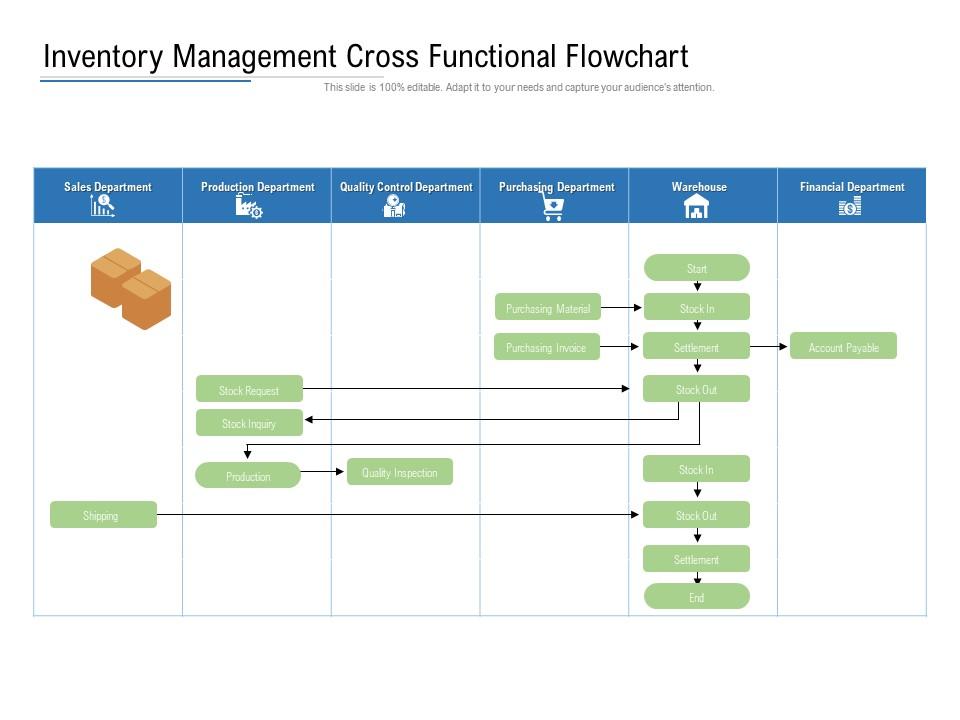
Presenting this set of slides with name Inventory Management Cross Functional Flowchart. The topics discussed in these slides are Inventory Management, Cross Functional, Flowchart. This is a completely editable PowerPoint presentation and is available for immediate download. Download now and impress your audience.

FAQs for Inventory management

Key metrics for evaluating inventory management efficiency include inventory turnover ratio, stockout rates, carrying costs, order fulfillment accuracy, and days sales outstanding. These metrics enable organizations to streamline operations, minimize waste, and enhance customer satisfaction by optimizing stock levels, reducing storage expenses, and ensuring product availability, with many retailers and manufacturers finding that strategic tracking ultimately delivers improved cash flow and competitive advantage.

AI and blockchain revolutionize inventory management by enabling real-time tracking, predictive analytics, automated reordering, and transparent supply chain visibility. Through machine learning algorithms and distributed ledger technology, retailers and manufacturers streamline operations, reduce stockouts by up to 30%, and enhance supplier collaboration, ultimately delivering lower costs and improved customer satisfaction.

Small businesses commonly face challenges including inaccurate demand forecasting, limited storage space, cash flow constraints from overstocking, inadequate tracking systems, and supplier reliability issues. These obstacles often result in stockouts, excess inventory costs, and missed sales opportunities, with many retailers finding that implementing strategic inventory planning and automated tracking systems significantly enhances operational efficiency and customer satisfaction.

Seasonal demand significantly impacts inventory planning by requiring flexible forecasting models, strategic buffer stock adjustments, and dynamic supplier relationships to handle fluctuations. Retail businesses often increase inventory 40-60% before peak seasons while manufacturers adjust production schedules months ahead, ultimately enabling better customer satisfaction and reduced carrying costs through strategic timing.

Inventory turnover serves as a critical financial health indicator, measuring how efficiently a company converts stock into sales, manages cash flow, and optimizes working capital. A higher turnover ratio typically signals strong demand and effective inventory management, while low turnover may indicate overstocking or weak sales, with many retail and manufacturing businesses using this metric to enhance operational efficiency and competitive positioning.

Businesses implement JIT inventory systems effectively through accurate demand forecasting, strong supplier partnerships, streamlined communication channels, and robust quality control processes. Manufacturing companies like Toyota and Dell have successfully reduced carrying costs by 30-40% while minimizing waste, with many organizations finding that strategic supplier collaboration and real-time data integration ultimately deliver enhanced cash flow and operational efficiency.

Effective strategies include demand forecasting using historical data, implementing just-in-time ordering systems, establishing safety stock levels, utilizing ABC analysis for priority management, and leveraging automated reorder points. These approaches streamline inventory control by reducing carrying costs, minimizing waste, and ensuring product availability, with many retailers and manufacturers finding that strategic combination of these methods delivers improved cash flow and enhanced customer satisfaction.

Inventory management integrates with supply chain management through real-time data sharing, demand forecasting synchronization, and automated reorder systems that align procurement with actual consumption patterns. This strategic combination enables organizations to minimize carrying costs, reduce stockouts, and enhance supplier relationships, while retailers and manufacturers increasingly find that seamless integration delivers faster order fulfillment and improved customer satisfaction.

Best practices for inventory audits include cycle counting, ABC analysis, barcode scanning, physical verification protocols, and reconciliation procedures. These methods streamline accuracy by systematically checking high-value items, automating data capture, and identifying discrepancies early, with many organizations finding that regular audits reduce shrinkage, optimize stock levels, and enhance operational efficiency.

Data analytics enhances inventory forecasting accuracy by analyzing historical sales patterns, seasonal trends, market fluctuations, and customer behavior data to predict future demand more precisely. Through machine learning algorithms and predictive modeling, retailers and manufacturers can reduce stockouts, minimize excess inventory, and optimize supply chain operations, ultimately delivering cost savings and improved customer satisfaction.

E-commerce significantly disrupts traditional inventory management systems by requiring real-time synchronization across multiple channels, faster fulfillment speeds, and more accurate demand forecasting. Through integrated platforms and automated systems, retailers can streamline warehouse operations, reduce stockouts, and enhance customer experiences, while many organizations find that omnichannel approaches ultimately deliver competitive advantage and operational efficiency.

Retail focuses on demand forecasting, seasonal adjustments, and rapid turnover to minimize carrying costs, while manufacturing emphasizes raw material scheduling, work-in-progress tracking, and supply chain coordination. Industries like fashion retail prioritize trend-based inventory cycles, whereas automotive manufacturing requires just-in-time delivery systems, with each approach ultimately delivering optimized cash flow and operational efficiency.

Poor inventory management creates significant cash flow strain through excess capital tied up in unsold stock, stockouts leading to lost sales, and increased carrying costs including storage and insurance. These inefficiencies directly erode profitability by reducing working capital availability, forcing emergency procurement at premium prices, and creating write-offs from obsolete inventory, ultimately compromising competitive positioning.

Businesses ensure inventory compliance through comprehensive tracking systems, regular audits, automated documentation processes, staff training programs, and standardized procedures that align with industry regulations. These integrated approaches enable organizations to maintain accurate records, minimize regulatory risks, and streamline compliance reporting, with many companies finding that proactive compliance management ultimately delivers operational efficiency and competitive advantage.

Inventory management software offers real-time tracking, automated reordering, reduced human error, enhanced forecasting accuracy, and seamless integration with other business systems. These technologies streamline operations by eliminating manual data entry, providing instant stock visibility, and enabling predictive analytics, with many retailers and manufacturers finding significantly lower carrying costs and improved customer satisfaction through automated processes.

Ratings and Reviews

0% of 100
Review Form
Write a review
Most Relevant Reviews

No Reviews