


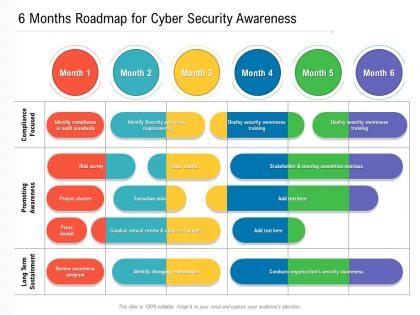
6 months roadmap for cyber security awareness




Try Before you Buy Download Free Sample Product
 Impress Your
 Audience
 100%
100% Editable
 Save Hours
 of Time


Visualize your work plan and communicate your ideas impactfully with our pre designed 6 Months Roadmap For Cyber Security Awareness. Showcase the detailed overview of the project, the key deliverables, and the milestones to be achieved with the help of our fully customizable PowerPoint layout. You can easily emphasize on the project goals and discuss all the activities involved in an easy to comprehend manner by utilizing our professionally designed PPT theme. This roadmap PowerPoint layout is a perfect strategic planning tool that can help in keeping the project on track. With our attractive PowerPoint theme, you can articulate the workflow, track the work progress, and have a clear vision of the goal to be achieved. Download this versatile 6 Months Roadmap For Cyber Security Awareness and save your hours of work.
People who downloaded this PowerPoint presentation also viewed the following :
6 months roadmap for cyber security awareness with all 2 slides:
Use our 6 Months Roadmap For Cyber Security Awareness to effectively help you save your valuable time. They are readymade to fit into any presentation structure.
FAQs for 6 months roadmap for
Honestly, most security training is garbage because it's just boring marathon sessions that put everyone to sleep. Break it into small chunks instead. You want four things: regular short training, fake phishing tests, policies written in actual English (not corporate speak), and updates about new scams going around. Oh, and measure if people's behavior actually changes - completion rates mean nothing if they still click sketchy links. Start by figuring out what your team doesn't know, then build training around those gaps. Consistency beats cramming everything into one session.
Look at your phishing sim click rates first - that's your baseline. Then see if people actually start reporting more suspicious emails after training. That's the real test, honestly. Pre/post assessments work but can feel like school quizzes if you overdo it. Check your platform's completion rates too - low engagement means your content probably sucks. I'd review everything quarterly to catch trends early. If click rates aren't improving after a few months, scrap whatever you're doing and try something else. Oh, and track how many people finish the training without falling asleep.
Honestly, getting your coworkers talking about security stuff is way more effective than those boring training sessions. People actually listen when someone from their own team shares a story - like when Mike almost got tricked by that fake IT email last month. Everyone remembers that! You could try starting casual security chats during team meetings or maybe set up a group where people can share their "oh crap, I almost clicked that" moments. It's weird how much more people care when it feels like teammates looking out for each other instead of just another company requirement.
Okay so the main threats you gotta watch out for: phishing emails are probably the worst offenders right now. They're getting ridiculously good at looking real - I almost fell for a fake PayPal one last week. Malware's still a problem too, usually from sketchy downloads or infected sites. Don't even get me started on social engineering - like when someone calls pretending to be IT asking for your password. Such BS. Oh and ransomware's everywhere now. Just use different passwords for everything, double-check suspicious emails, and call IT if something feels off.
Each department needs training tailored to their actual risks. HR gets hit with sketchy resumes containing malware. Finance deals with fake invoice scams constantly - those wire fraud attempts are brutal. Sales teams share documents everywhere, which honestly makes them almost as risky as executives who click on literally anything. IT obviously needs the hardcore technical stuff about system vulnerabilities. Marketing teams juggle customer data and social accounts, so privacy compliance and account security are huge for them. Watch each team work for a day first though. You'll spot the real threats they face instead of guessing.
KnowBe4 and Proofpoint are your best bet for phishing sims and general training - they're the gold standard. Gamified stuff actually works way better than you'd think because people don't just zone out clicking through slides. If you're tight on budget and already using Microsoft, Vanguard isn't terrible. For deeper technical training, check out Cybrary or SANS. Here's the thing though - pick something that measures actual understanding, not just "did they sit through it." I'd run a pilot first with whatever platform catches your eye before going all-in company-wide.
Honestly? Do it quarterly. I know that sounds like a lot, but cyber threats move crazy fast now. Twice a year just isn't enough anymore - I've watched companies get hit because they're still training people on old stuff while hackers are already using completely different tricks. You really need to stay on top of the latest attack methods and social engineering tactics as they come out. Don't just recycle the same boring phishing examples from 2019 or whatever. The threats happening right now are what matter. Set a reminder for every three months and actually stick to it.
Honestly, you've gotta get everyone bought in - not just dump it on IT. Skip those boring generic phishing trainings nobody pays attention to. Instead, run interactive sessions with scenarios that actually relate to your workplace. I'd celebrate people who catch suspicious emails, maybe even do department competitions (sounds cheesy but it works). Get your managers modeling good habits too - if leadership doesn't care, nobody will. Try adding quick "security moments" to regular meetings where you mention current threats. The whole thing needs to feel like daily culture, not some annual thing you check off.
Honestly, gamification works really well for this stuff. People get so competitive over the weirdest things - you could totally use that! Try setting up phishing contests where teams get points for catching fake emails. Security trivia with prizes is another easy win. I've seen companies do escape room scenarios for incident response training, which sounds way more fun than sitting through another PowerPoint. Monthly "security champion" competitions are solid too. Just start with something simple like weekly trivia and see how it goes. The whole point is making it feel less like boring mandatory training, you know?
Oh man, yeah you could be in deep trouble if your cybersecurity training sucks. GDPR, HIPAA, SOX - they all demand proper training and the fines are insane. Like, millions of dollars insane. If there's a breach and they find out your training was garbage? Lawsuits from customers and shareholders will follow. Honestly, regulators are pretty ruthless about this stuff. They want proof your people actually know what they're doing with sensitive data. My advice? Document everything you do for training and make sure you're hitting whatever your specific industry requires. Better safe than sorry.
Yeah, remote cybersecurity training is a total pain honestly. You can't just walk by someone's desk and casually mention "hey, that email looks sketchy" anymore. Everyone's stuck on their home Wi-Fi (which let's be real, half of them probably never changed the default password). Virtual sessions are rough too - people have kids screaming in the background or they're clearly checking their phone. I'd break things into shorter chunks instead of those brutal 2-hour Zoom calls. Maybe quick 15-minute sessions weekly? Way easier to tell if someone actually absorbed the info when you're not talking to a sea of black squares.
Honestly, if your leadership doesn't care about cybersecurity, you're screwed from the start. Nobody else will take it seriously either. Get your executives actually doing the training themselves - not just firing off those boring "use strong passwords" emails. Management needs to put real money behind security tools and treat breaches like the company's on fire. I've seen too many places where bosses preach security then click every sketchy link they get. Make it part of performance reviews too. Once leadership is visibly on board, rolling out policies to everyone else becomes way easier.
Honestly, ditch the boring PowerPoint lectures - nobody's retaining that stuff. Make it interactive instead. Use real examples, like actual phishing emails that look like they're from your vendors or whatever. Keep each module super short, maybe 10-15 minutes tops. I'd mix it up with videos, quick quizzes, hands-on practice. The trick is making it feel relevant to what they're actually doing every day. Otherwise they'll just zone out and forget everything by next week. Oh, and survey your team first about what security issues they run into most - that way you're not just guessing what they need.
Create a solid "no blame" policy and actually follow through with it. People need to know they won't face consequences for reporting stuff that ends up being harmless - better safe than sorry, right? Leadership should publicly thank reporters when possible and set up anonymous channels for those who prefer it. Don't just mention this policy once during training either. Communicate it regularly. If someone reports something and gets any grief for it, shut that down fast. Oh, and make sure your current policy explicitly protects anyone reporting in good faith. That's honestly the foundation of everything else.
Honestly, skip the tech jargon completely - regular employees just tune out. Focus on stuff they actually deal with, like sketchy emails or keeping their work laptops secure. Mix up how you deliver it too. Short videos work great, but so do those quick lunch sessions or even random tips in the break room (sounds cheesy but people actually read those). Different people absorb info differently, so the more variety the better. Track who's participating so accounting doesn't accidentally skip it while IT does it twice. Oh, and make sure your bosses actually enforce attendance - otherwise half your team won't show up.
-
Best Representation of topics, really appreciable.
-
Really like the color and design of the presentation.
-
Editable templates with innovative design and color combination.
-
Informative presentations that are easily editable.
-
Visually stunning presentation, love the content.
-
The content is very helpful from business point of view.