


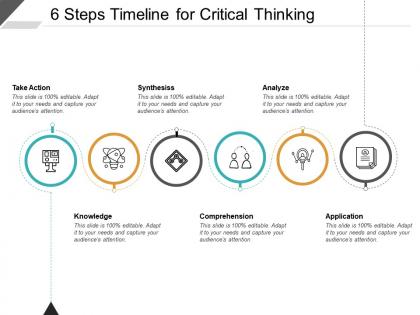
6 steps timeline for critical thinking




Try Before you Buy Download Free Sample Product
 Impress Your
 Audience
 100%
100% Editable
 Save Hours
 of Time


Avoid compromises with our 6 Steps Timeline For Critical Thinking. Always aim for acquiring the best.
People who downloaded this PowerPoint presentation also viewed the following :
6 steps timeline for critical thinking with all 5 slides:
Always acquire the best with our 6 Steps Timeline For Critical Thinking. They ensure you avoid compromises.




FAQs for 6 steps timeline
The critical thinking process involves observation, analysis, interpretation, evaluation, inference, and explanation as core stages. These stages enable professionals to systematically examine information, identify assumptions, assess evidence quality, and draw logical conclusions, with many organizations finding that structured critical thinking frameworks enhance decision-making accuracy, reduce costly errors, and deliver stronger strategic outcomes.
Critical thinking influences decision-making in professional settings by enabling systematic analysis of complex problems, evaluation of multiple perspectives, and assessment of potential risks and outcomes. Through structured reasoning frameworks, professionals in sectors like finance, healthcare, and consulting make more informed strategic choices, reduce costly errors, and ultimately deliver superior business results while gaining competitive advantage.
Tools for enhancing critical thinking include the Socratic method, SWOT analysis, root cause analysis, decision matrices, and mind mapping techniques. These frameworks streamline complex problem-solving by encouraging systematic questioning, structured evaluation, and comprehensive perspective analysis, with many organizations finding that employees using these tools deliver more strategic solutions, minimize cognitive biases, and ultimately enhance decision-making quality across departments.
Critical thinking enhances problem-solving through systematic analysis, evidence evaluation, assumption questioning, multiple perspective consideration, and logical reasoning application. In healthcare, financial services, and manufacturing, professionals leverage these approaches to diagnose complex issues, assess risk factors, and develop strategic solutions, ultimately delivering more accurate decisions and competitive operational advantages.
Cognitive bias significantly impairs critical thinking by distorting information processing, limiting perspective consideration, and reinforcing preexisting beliefs rather than objective analysis. These mental shortcuts lead organizations to make flawed strategic decisions, with many financial institutions and healthcare systems finding that bias-awareness training enhances decision quality, reduces costly errors, and ultimately delivers more accurate risk assessments and patient outcomes.
Questioning serves as the foundation of critical thinking by challenging assumptions, exploring alternative perspectives, and uncovering underlying biases that might cloud judgment. It enables professionals to examine evidence more thoroughly, identify knowledge gaps, and develop more robust solutions, with many organizations finding that systematic questioning approaches ultimately enhance decision-making quality and strategic outcomes.
Educators can effectively teach critical thinking skills through Socratic questioning, case-based learning, debate exercises, problem-solving scenarios, and reflective writing assignments. These approaches enhance analytical reasoning by encouraging students to evaluate evidence, challenge assumptions, and construct logical arguments, with many educational institutions finding that structured critical thinking curricula ultimately improve student decision-making and academic performance across disciplines.
Strategies to overcome critical thinking barriers include actively seeking diverse perspectives, questioning assumptions through structured analysis, practicing intellectual humility, creating decision-making frameworks, and establishing environments that encourage open dialogue. Organizations implementing these approaches find that teams develop stronger problem-solving capabilities, make more informed strategic decisions, and ultimately deliver better business outcomes through reduced cognitive biases and enhanced analytical reasoning.
Emotional intelligence enhances critical thinking by enabling better self-awareness of biases, improved perspective-taking when evaluating arguments, and stronger regulation of emotions that can cloud judgment. Through emotional self-monitoring and empathy, professionals in fields like healthcare, finance, and management make more objective decisions, consider diverse viewpoints more thoroughly, and ultimately deliver more balanced, comprehensive analysis in complex situations.
Technology enhances critical thinking through collaborative platforms, data visualization tools, AI-powered analytics, simulation software, and decision-support systems. These technologies streamline information processing, enable real-time collaboration, and provide structured frameworks for analysis, with many organizations finding that digital tools accelerate problem-solving while reducing cognitive biases, ultimately delivering more strategic outcomes.
Collaboration significantly enhances critical thinking quality by introducing diverse perspectives, challenging individual biases, and fostering comprehensive problem analysis through collective expertise. Through structured team discussions, organizations in sectors like healthcare, finance, and consulting achieve more robust decision-making, reduced cognitive blind spots, and ultimately superior strategic outcomes compared to isolated thinking approaches.
Critical thinking contributes to ethical decision-making by enabling leaders to systematically evaluate consequences, identify stakeholder impacts, and examine underlying assumptions before acting. Through structured analysis, organizations can navigate complex moral dilemmas, assess long-term implications, and maintain transparency in their reasoning processes, ultimately delivering more principled outcomes and stronger stakeholder trust.
Critical thinking and creative thinking are complementary cognitive processes that enhance problem-solving and decision-making capabilities. While critical thinking evaluates, analyzes, and refines ideas through logical assessment, creative thinking generates innovative solutions and explores new possibilities, with many organizations finding that combining both approaches delivers more robust strategies, breakthrough innovations, and competitive advantages in increasingly complex business environments.
Assessing critical thinking capabilities involves evaluating your ability to analyze information objectively, question assumptions, identify biases, recognize logical fallacies, and draw evidence-based conclusions. Through self-reflection exercises, seeking feedback from colleagues, and analyzing past decision-making processes, professionals can identify strengths and improvement areas, ultimately enhancing their analytical skills and strategic judgment in increasingly complex business environments.
Common misconceptions include believing critical thinking means being negative or argumentative, that it's an innate talent rather than a learnable skill, and that it requires extensive time or complex frameworks. Many organizations find that these beliefs prevent systematic implementation, while successful companies demonstrate that structured critical thinking processes actually streamline decision-making, enhance problem-solving efficiency, and deliver faster, more strategic outcomes.
No Reviews